


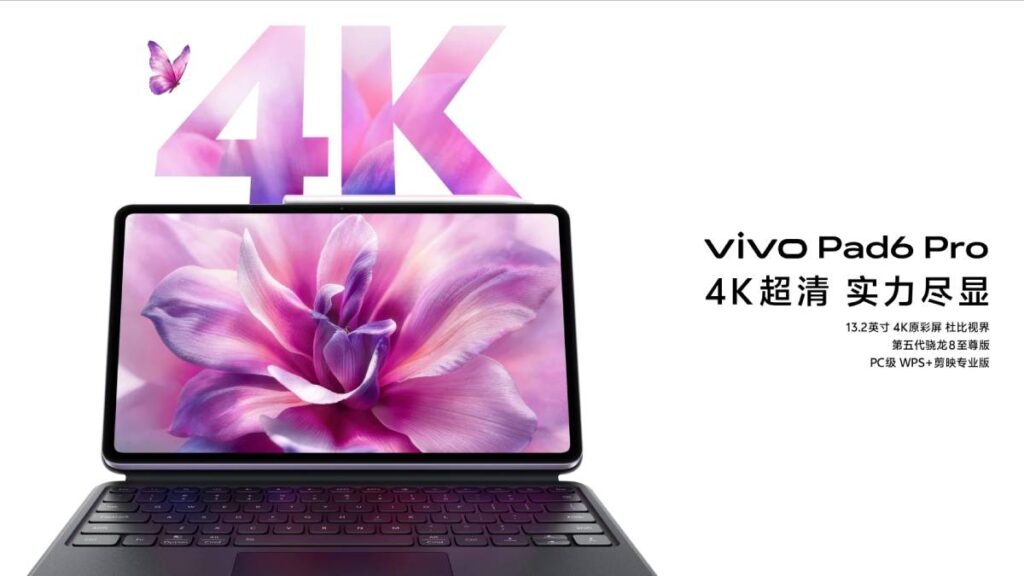
The race for tablet performance has taken a sharp turn, and Vivo Pad 6 Pro is currently the device setting the pace. In AnTuTu’s May 2026 rankings, it reached an average score of 4,132,697 points, placing it firmly at the top of the flagship tablet class.
That result matters because the gap is not small. In a segment where many premium tablets aim to balance speed, efficiency, and battery life, Vivo Pad 6 Pro stands out for raw power instead.
Snapdragon 8 Elite Gen 5 drives the lead
The main force behind that result is Snapdragon 8 Elite Gen 5. The tested unit came with 8 GB of RAM and 256 GB of storage, and it was priced at around Rp13.1 million or about 822 US dollars.
That positioning places Vivo Pad 6 Pro in the premium tablet category, aimed at users who want serious performance rather than a basic entertainment device. The benchmark score suggests that the hardware is being pushed to a level that few Android tablets can match right now.
The top tier is heavily dominated by the same chipset
Vivo Pad 6 Pro is not the only tablet showing what Snapdragon 8 Elite Gen 5 can do. iQoo Pad 6 Pro followed in second place with 4,081,031 points, while Lenovo Legion Y700 fifth generation came in third with 4,073,338 points.
The pattern continues across the top six, which also includes Oppo Pad 5 Pro, OnePlus Pad 3 Pro, and Honor MagicPad 3 Pro 13.3-inch. All six use Snapdragon 8 Elite Gen 5, making it clear that this chipset is currently shaping the upper end of the tablet performance chart.
Other platforms still appear in the top 10
The list is not entirely uniform, though. Redmi K Pad 2 is the only top-10 tablet powered by MediaTek Dimensity 9500, and it secured seventh place with an average score of 3,716,562 points.
There is also an Intel-based entry in the mix. H3C MegaBook took eighth place with Intel Core Ultra 5 228V and scored 3,390,074 points, showing that tablet performance is not limited to a single architecture.
What this means for high-performance tablet buyers
For users who rely on a tablet for heavy work, video editing, multitasking, or high-end entertainment, these numbers offer a useful signal. Consistent benchmark strength often translates into a smoother experience when demanding apps need stable performance.
The ranking also reflects how tablet makers are increasingly treating these devices as more than media consumption tools. They are now being positioned as portable productivity hardware with performance levels closer to lightweight computers.
A market snapshot with wider relevance
Although the ranking comes from China, it remains relevant for buyers in Indonesia. Devices that perform strongly in this kind of early flagship comparison often help set expectations for the broader premium tablet market.
The bottom of the top 10 is still occupied by Oppo Pad 4 Pro and OnePlus Pad 2 Pro, both of which use the previous Snapdragon 8 Elite. Their presence shows that even the older generation still holds competitive value, even as Snapdragon 8 Elite Gen 5 begins to dominate the newest flagship tier.