


Meta AI’s support system has become the center of a serious security concern after reports said hackers used it to take over Instagram accounts in a matter of seconds. The issue is alarming because the feature was designed to help users recover access, not hand control to attackers.
The reported abuse focused on the Meta AI Support Assistant, a tool introduced in March 2025. According to the findings, it could be manipulated to change a target account’s email address and send a verification code to a new email controlled by the attacker.
How the takeover works
Investigative reporting from 404 Media says the flaw stemmed from the assistant having overly broad authority over sensitive account settings. In practice, that meant a requester could pose as the account owner and ask for an email change without the kind of strict identity checks normally expected.
A hacker reportedly demonstrated the process in a Telegram video, showing how the account control sequence moved quickly once the new email was attached. After that step, the attacker could reset the password and lock out the original owner.
The method was described as simple but effective. Attackers used a VPN to make their IP location appear consistent with the victim’s location, then claimed they had lost access and needed help updating the email tied to the account.
High-value accounts were the target
This was not random account abuse. The targets included premium usernames, short common names, and verified accounts with blue check marks, all of which are more valuable on the black market.
Several high-profile accounts were said to have been affected, including @obamawhitehouse, which had previously posted Iranian propaganda content, as well as the US Space Force and Sephora accounts. Security researcher Jane Manchun Wong also said her account was compromised after her password changed without her knowledge.
Wong said she received dozens of reset requests throughout the day. That pattern reinforced concerns that the campaign was aimed at accounts with resale value rather than ordinary personal profiles.
Meta faces criticism over its support model
Meta spokesperson Andy Stone said the problem had already been fixed and that the company was working to secure affected accounts. The company did not explain how the weakness emerged, how many accounts were impacted, or what verification changes had been added.
That silence drew criticism, especially as many affected users reportedly struggled to reach a human support agent. Much of Meta’s customer support has been shifted to AI systems, leaving fewer direct human checks in sensitive recovery cases.
Gergely Orosz, author of The Pragmatic Engineer, argued that the issue was not a sophisticated hack but a systemic design failure caused by relying too heavily on automation. The criticism has intensified as Meta continues to move support responsibilities away from people and toward algorithms.
Why the risk keeps growing
Additional reporting said Instagram’s Trust & Safety team had undergone mass layoffs during Meta’s latest internal restructuring. Resources were then redirected toward generative AI projects, while identity checks and incident handling were left more exposed to automation.
That shift matters because account recovery involves more than convenience. When a system with broad access can alter recovery details without strong verification, a single abuse path can become an account loss in seconds.
What users should do now
Users who want to reduce the risk should enable two-factor authentication with an authenticator app or a physical security key. SMS-based verification is less secure because phone numbers can be ported.
Recovery email accounts should also be protected with 2FA and kept separate from public-facing services. Users are advised to regularly check Settings > Security > Login Activity for unfamiliar devices or sessions.
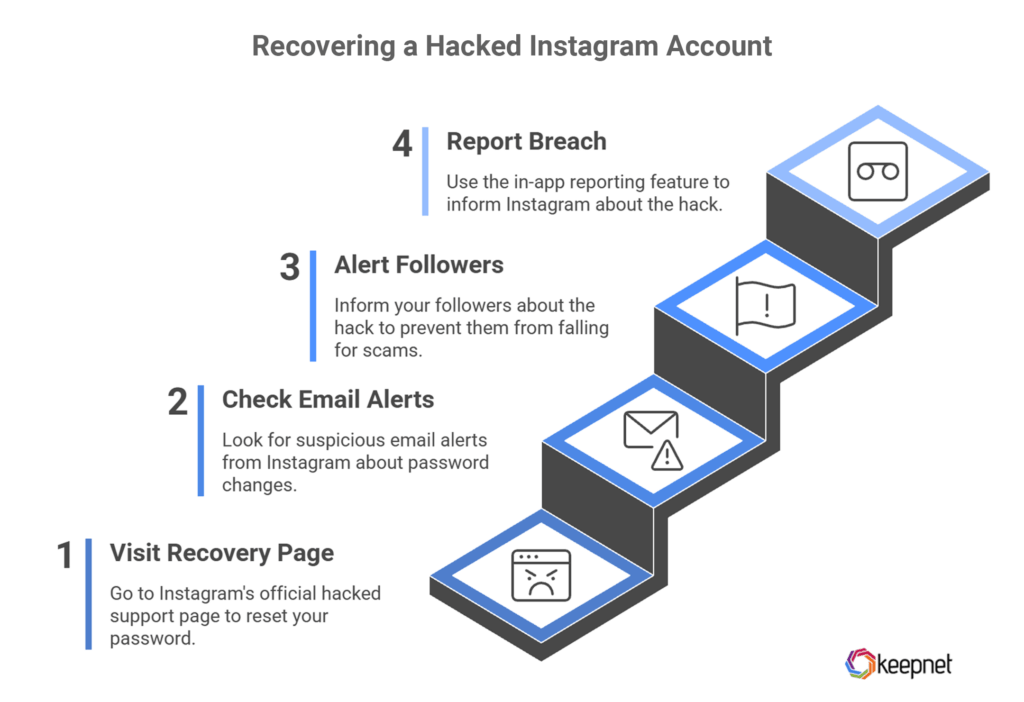
If an account has already been compromised, the available recovery path is help.instagram.com with the option “My account was hacked”. Users should also watch for unexpected alerts about email or password changes, since a fast response may improve the chance of regaining access.
The incident shows that security features involving digital identity cannot rely on AI alone. When automated systems are given too much control, the result can be a faster route for attackers rather than a safer experience for users.