


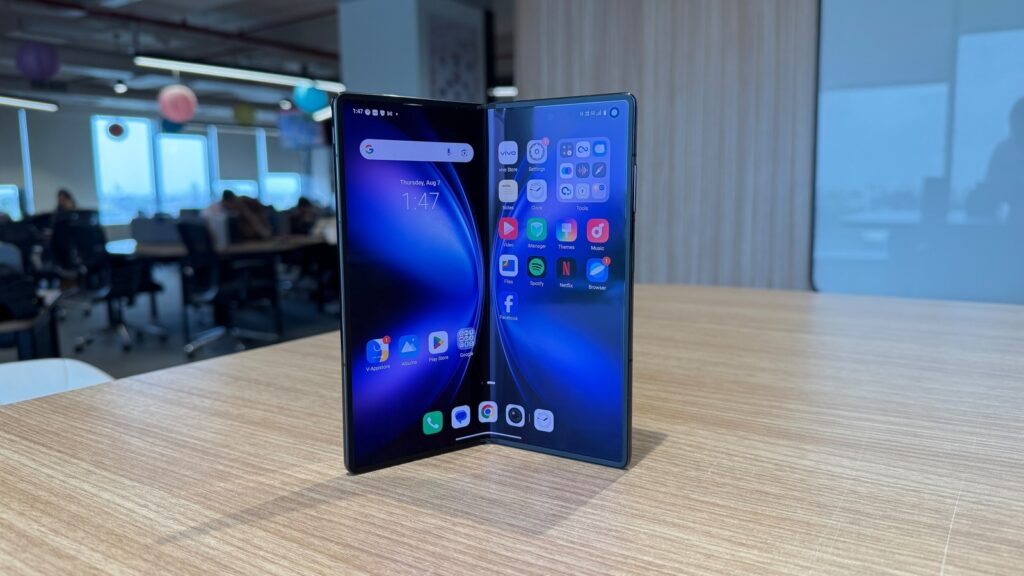
Vivo is positioning the X Fold 6 as more than a premium foldable. The company is building its next book-style phone around a custom Dimensity 9500 Super Edition chip designed specifically for foldables and AI workloads.
That approach points to a clear strategy: make the large-screen experience feel more like a productivity device than a conventional smartphone. Vivo appears to be focusing on multitasking, heavy multi-threaded processing, and smoother window rendering across multiple apps.
Custom silicon aimed at foldable workloads
According to Vivo, the X Fold 6 will be the first smartphone to use the Dimensity 9500 Super Edition. The company says this is not a standard version of MediaTek’s flagship chipset.
Vivo says the chip was co-developed with MediaTek and that the work started nearly two years ago. The goal was to build a platform tuned for the demands of foldable devices rather than adapting a general-purpose chip afterward.
The optimization effort centers on three areas that matter most on a foldable display. Those areas are multitasking, multi-threaded processing, and rendering several windows at the same time.
For users, that should translate into a device that can better use its expanded screen space. In other words, the hardware is being shaped to support the form factor, not just sit inside it.
AI performance gets a major efficiency push
Vivo says peak AI processing performance is up 111% versus the previous generation, while power consumption is down 56%. That combination is significant because on-device AI typically demands both speed and battery efficiency.
The company is also adding a new AI voice engine to the X Fold 6. Vivo claims the engine can deliver offline transcription seven times faster, along with a 7% improvement in recognition accuracy.
Other AI tools are also getting attention. For content summarization, Vivo says generation speed is improved by 57%, which could help with meeting notes and other quick-read tasks.
The AI File Manager is being upgraded as well, with improvements to large language model processing. Vivo says text summarization and AI question-and-answer responses are now about 20% faster, and a new topic-based question feature will be added.
Productivity features built for real multitasking
The custom chip also supports a new concurrency engine for an improved Atomic Workbench experience. Vivo says this makes it easier for several apps to run at once, with smoother window switching and file dragging.
On a foldable, those small interactions matter as much as raw benchmark gains. Smooth app handoffs and cleaner multitasking often define whether a large-screen device feels genuinely useful day to day.
Vivo will pair the hardware with OriginOS 6 Fold. The company says the software is more tightly integrated with the hardware to support AI-centered productivity.
Together, the chip, concurrency engine, and operating system suggest a device built with work-oriented use in mind. Vivo is clearly treating the X Fold 6 as a serious mobile productivity machine rather than a standard flagship with a flexible display.
Other hardware details already circulating
Beyond the chip strategy, reports indicate that the X Fold 6 may come with a 6,900mAh battery. That would place battery capacity among the device’s most notable hardware points.
Camera details are also circulating, with a rear setup said to include a 200MP main camera, a 50MP ultra-wide camera, and a 50MP periscope telephoto camera.
Security may rely on a side-mounted fingerprint sensor, according to the same reports. Vivo has not framed those details as the main headline yet, but they add to the picture of a foldable built for high-end use.
For now, the clearest message from Vivo is that the X Fold 6 is being rebuilt from the computing core upward. With a foldable-specific Dimensity 9500 Super Edition at the center, the device is being tuned for AI, multitasking, and large-screen productivity in a way that standard flagships usually are not.