


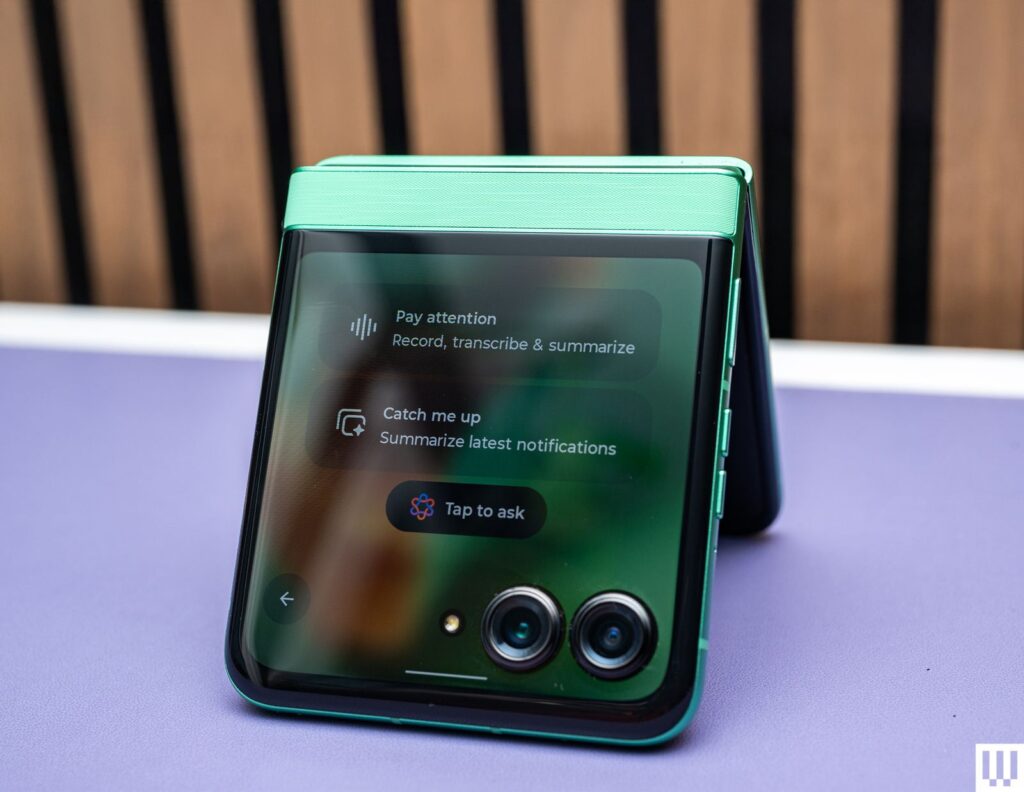
Motorola is putting a different kind of camera tool in front of holiday travelers: one that helps control the framing even after the phone has been handed to someone else. The feature, called Frame Match, is designed to make group and travel photos land closer to the composition the user originally wanted.
The problem it tries to solve is familiar. Many vacation photos are taken by friends, strangers, or passersby, and the final result often misses the angle or placement the person in the frame had in mind.
How Frame Match works
Frame Match starts with an initial photo that becomes an overlay. That image then acts as a guide in the camera viewfinder, allowing the person holding the phone to line up the shot with the original framing.
Once the overlay is visible, the user can step into the scene while the helper adjusts the phone to match the layout. Motorola also gives users control over overlay opacity through a slider at the bottom, with access in some cases requiring the icon with five boxes.
When the composition is aligned, the helper presses the shutter and captures the final image. The idea is to keep the framing consistent without forcing repeated instructions about angle, position, or background placement.
Built for trips, landmarks, and crowded moments
The feature is especially useful for travel photography, where a precise composition can make a big difference. It is aimed at scenes where the subject, perspective, and landmark background need to fit together cleanly.
Motorola’s example use case points to iconic locations such as the Eiffel Tower or the Leaning Tower of Pisa. Those kinds of photos often depend on careful alignment, and Frame Match is intended to simplify that process.
That focus makes the feature more relevant than a simple camera upgrade for many users. For travelers who want a polished image without depending on someone else’s guesswork, the software layer becomes the main advantage.
Part of Motorola’s software-first camera approach
Frame Match joins other camera features already available on the Razr line, including Action Shot for fast-moving subjects and Signature Style for building a personal color look. Motorola has increasingly used software to shape the shooting experience on its foldable phones.
The Razr Fold itself is described as having one of the better cameras in the foldable category. It uses a triple 50MP camera system with Pantone-validated sensors, but Motorola continues to emphasize that the experience is not defined by hardware alone.
For now, Frame Match is available on Motorola’s newest phones, including the Razr 2026 series. Motorola has suggested that similar support could eventually reach other 2025 models, but no official expansion has been confirmed.
A familiar idea with a different focus
The concept recalls Add Me on the Pixel 10, which lets one person take a group shot and then be included after the phone is handed over. Frame Match is not presented in exactly the same way, but it shares the same broader goal of helping the user stay in control of the final frame.
For people who often dislike how their photos turn out when someone else takes over the camera, that can matter more than a spec-sheet upgrade. Motorola is betting that smarter framing tools will be just as valuable as stronger imaging hardware.
Using the feature is straightforward. Open the camera app, swipe to Frame Match, take the first photo, then hand the phone to another person while stepping into the shot and adjusting the overlay until everything lines up.
That simple workflow could make a noticeable difference in holiday photos, especially when the moment is brief and the composition needs to be right the first time.