


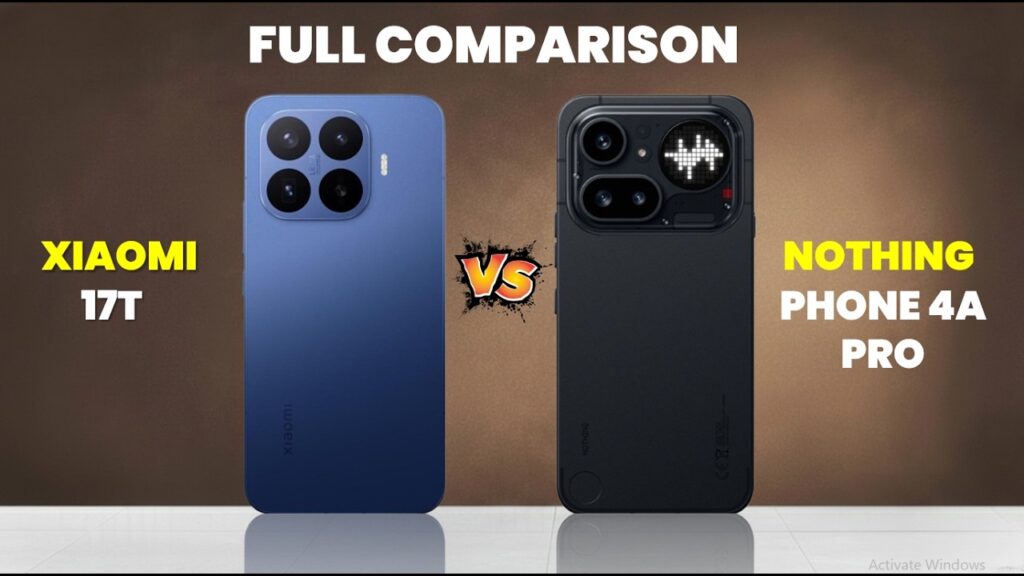
Price is the clearest reason these two phones are being compared, because the gap between them is large enough to change the buying decision. Xiaomi 17T Pro sits around ₹75,000, while Nothing Phone (4a) Pro is priced around ₹40,000, making the latter feel far more accessible.
That difference pushes the conversation beyond raw specifications and into value. Xiaomi is the more complete flagship on paper, but Nothing is the one that may make more sense for many buyers who want premium features without spending nearly twice as much.
What Xiaomi adds for the extra money
Xiaomi 17T Pro is built around MediaTek Dimensity 9500 on a 3nm process, giving it the stronger performance package of the two. It also pairs this with up to 16GB RAM and 1TB UFS 4.1 storage, which places it in a clearly higher hardware class.
Nothing Phone (4a) Pro uses the Snapdragon 7 Gen 4 on a 4nm process, along with up to 12GB RAM and 256GB UFS 3.1 storage. That is still solid for daily use, but it does not match Xiaomi’s headroom for demanding gaming or heavier workloads.
Graphics support follows the same pattern, with Mali-G1 Ultra MC12 on Xiaomi and Adreno 722 on Nothing. The result is a straightforward split between a full-blooded flagship and a more restrained mid-premium option.
Battery and charging widen the gap further
Xiaomi 17T Pro carries a 7000mAh battery, which is much larger than the 5400mAh unit in the India version of Nothing Phone (4a) Pro. The capacity difference alone gives Xiaomi a clear advantage for users who want longer endurance.
Charging is another area where Xiaomi pulls away. It supports 100W wired charging and 50W wireless charging, while Nothing offers 50W wired charging without wireless support.
Xiaomi also goes further with 22.5W reverse wired charging, compared with 7.5W reverse wired charging on Nothing. That makes Xiaomi notably more flexible if the phone is also expected to power accessories or other devices.
Cameras remain competitive, but Xiaomi is more complete
Both phones use a 50MP main camera with OIS, so the basic setup starts from a similar level. Xiaomi adds Leica tuning and is said to use a larger main sensor, which should help it in image processing and overall shooting flexibility.
Zoom is where the difference becomes more visible. Xiaomi uses a 50MP periscope telephoto camera with 5x optical zoom, while Nothing’s 50MP periscope telephoto reaches 3.5x optical zoom.
Xiaomi also has the stronger ultrawide camera at 12MP, compared with 8MP on Nothing. Video is another major divider, since Xiaomi supports up to 8K, 4K at 120fps, and Log recording, while Nothing stops at 4K at 30fps.
The front cameras are both 32MP, but Xiaomi again has the stronger feature set with 4K selfie video recording. Nothing tops out at 1080p, which keeps it behind in video versatility even though the selfie resolution matches.
Display and design still give Nothing a reason to exist
Both phones use a 6.83-inch AMOLED panel with a 144Hz refresh rate and HDR support, so the core viewing experience is already strong on each side. Nothing goes higher in peak brightness at 5000 nits, while Xiaomi is listed at 3500 nits.
Xiaomi balances that with Dolby Vision, HDR10+, and PWM dimming at 3840Hz. Nothing includes HDR10+ and PWM at 2160Hz, which still keeps it competitive for display quality.
Design is where Nothing creates its own appeal. It uses an aluminium unibody and the brand’s familiar mini-LED lighting system, giving it a more distinctive visual identity than many Android rivals.
Xiaomi, by contrast, leans into a more conventional flagship build with a glass back, aluminium frame, and IP68 protection. Nothing is rated IP65, so Xiaomi has the stronger dust and water resistance on top of the more expensive hardware mix.
Audio, connectivity, and software complete the comparison
Xiaomi 17T Pro adds stereo speakers with Dolby Atmos, while Nothing also uses stereo speakers but without Dolby Atmos support. Xiaomi further leads in connectivity with Wi‑Fi 7 and Bluetooth 6.0, compared with Wi‑Fi 6 and Bluetooth 5.4 on Nothing.
Both devices run Android 16, but they approach software positioning differently. Nothing promises 3 major updates, while Xiaomi ships with HyperOS 3 on top of Android, reinforcing its premium positioning.
Seen as a whole, Xiaomi 17T Pro is the more powerful and more feature-rich phone in nearly every major category. Nothing Phone (4a) Pro still stands out because it delivers a 144Hz AMOLED display, a periscope telephoto camera, and a design with real personality at a much lower price.