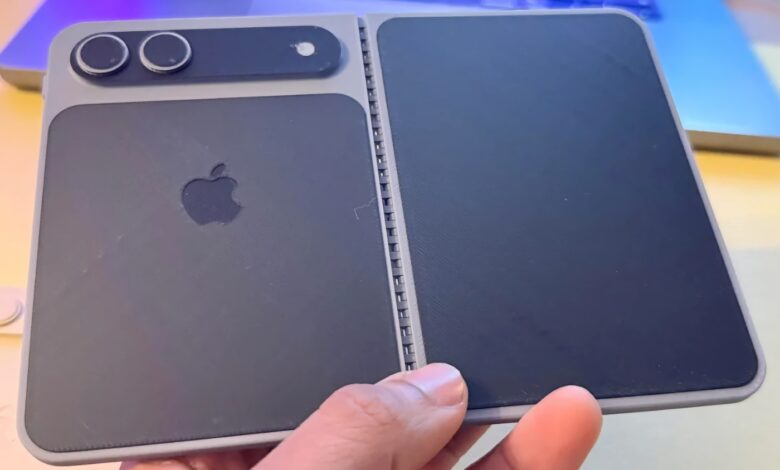
Apple’s long-rumored iPhone Fold now appears to be moving farther away from a 2026 debut. The latest signals point to an early 2027 launch, suggesting the company is choosing caution over speed as it prepares its first foldable iPhone.
The shift matters because Apple had been widely expected to introduce the device alongside the iPhone 18 Pro and iPhone 18 Pro Max in September 2026. That timeline is now looking less likely as the company continues to treat foldable hardware as a category that must be mature before it reaches customers.
Signals from Apple’s supply chain
One of the clearest hints comes from Largan Precision, Apple’s key camera lens supplier. CEO Enping Lin said the fourth quarter of this year will be busier than the same period last year because of product rescheduling by customers.
Largan supplies the main camera lenses for Apple’s entire iPhone lineup, so any change in its schedule tends to draw close attention from the market. Lin did not name any product directly, but analysts see the message as highly relevant to Apple’s next major launch plans.
Because of the complexity involved, the iPhone Fold is considered the most likely candidate behind the revised timing. A foldable device would require more demanding optical and mechanical coordination than a standard iPhone model.
Why Apple may be moving slowly
The delay also fits Apple’s long-standing habit of waiting until a product category is ready rather than rushing to be first. In foldables, that caution is easy to understand, given the durability and consistency issues that have challenged rival brands.
Samsung, Xiaomi, and Honor already compete in the foldable market, but the category still faces familiar concerns around screen durability, hinge reliability, and uneven user experience. Apple appears to be taking a slower path to avoid repeating those early-generation mistakes.
Clues already seen in software
There are also hints inside Apple’s software work. Developers reportedly found hidden code in iOS 27, the beta version introduced at WWDC 2026, with technical terms such as “foldState” and “angleDegrees”.
Those terms strongly suggest fold-position detection, a function that would make sense on a folding device but not on the iPhone, iPad, or Mac models currently on sale. That has fueled growing confidence that Apple is building dedicated software support for a new form factor.
Another clue came from testing that combined Dynamic Island and Touch ID. The two features have never appeared together in any Apple product, which points to a different design direction for the company’s foldable plans.
A launch pattern that may mirror iPhone X
If the new schedule holds, Apple may use a staged rollout similar to the one it used for iPhone X. In that case, a device could be introduced with the main lineup but arrive in stores a few months later.
Under that scenario, iPhone Fold could take the spotlight at an Apple event in March or April 2027, after the iPhone 18 Pro family has already arrived in late 2026. That would give Apple extra time to refine production and finalize the user experience.
The approach would also help Apple avoid the problems that affected early foldable phones, when many manufacturers were criticized for fragile screens, unreliable hinges, and unfinished software experiences.
Two generations are already being planned
The delay does not appear to signal a retreat from foldables. Reports indicate that Apple is already planning at least two foldable generations for 2027 and 2028, which suggests a longer-term commitment to the category.
The second-generation model is said to be bezelless and may even adopt a flip-style design. For now, Apple seems determined to prioritize quality and stability over simply being first into a market that is still working through its biggest weaknesses.