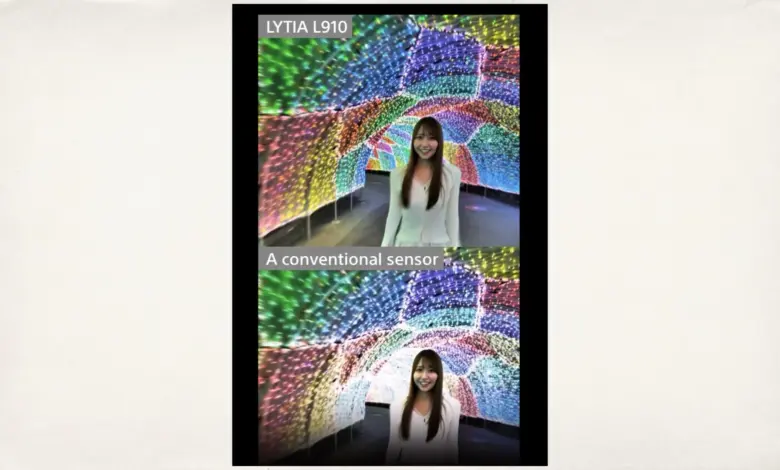
Sony has introduced the Lytia L910, a new smartphone camera sensor built to raise the bar for HDR and video performance. Its pitch is simple but significant: stronger highlight control, better low-light results, and high dynamic range from a single exposure.
The sensor uses LOFIC, or Lateral Overflow Integration Capacitor, a structure Sony says helps extend dynamic range by storing excess charge from the photodiode. Paired with Triple Conversion Gain HDR, the system is designed to reach up to 100dB of dynamic range while keeping power use low.
HDR Built For Real-World Shooting
One of the most important claims around the Lytia L910 is its single-exposure HDR approach. Sony says this can reduce motion blur and flicker, two problems that often appear when HDR depends on multiple exposures.
The sensor reads image data from one exposure with three different conversion gains. That method is intended to preserve highlight detail in bright areas while keeping shadows and mid-tones intact.
Sony also added an Ultra High Conversion Gain, or UHCG, circuit to improve charge-to-voltage efficiency. The company says this lowers random noise by around 30 percent compared with the LYT-828.
High-End Specs With A Clear Video Focus
The Lytia L910 is a stacked CMOS sensor with a 1/1.28-inch size, 50 megapixels of effective resolution, and 1.22 µm pixels. It uses a Quad Bayer color filter array, which groups four neighboring pixels under the same color filter to support both sensitivity and resolution.
For video, Sony says the sensor supports recording up to 4K at 60fps. It also enables HDR video at 60fps in both DCG-HDR and TCG-HDR modes with LOFIC.
Internal circuit optimization is also said to speed up analog-to-digital conversion. That should allow phones using the sensor to show HDR previews on screen while maintaining a wide dynamic range during capture.
Designed For Premium Phones, But Not Yet Tied To One Model
The sensor is aimed at premium smartphones, although Sony has not named the first device to use it. Mass shipments of the Lytia L910 are scheduled to begin in the summer of 2026.
That timeline has already fueled speculation across the industry. Vivo X500 Pro and X500 Pro Max have been linked with a 50-megapixel main camera using a 1/1.28-inch sensor and LOFIC technology.
Xiaomi 18 Pro Max has also entered the conversation, with reports pointing to a 1/1.28-inch sensor built on a 22nm process and support for next-generation LOFIC HDR 3.0. For now, those connections remain unconfirmed.
What is clear is Sony’s direction for its premium camera hardware. The company is focusing less on megapixel counts alone and more on how well a sensor handles light, contrast, noise, and motion in difficult shooting conditions.
If the Lytia L910 performs as described, it could become one of the key components behind the next wave of flagship smartphone cameras.