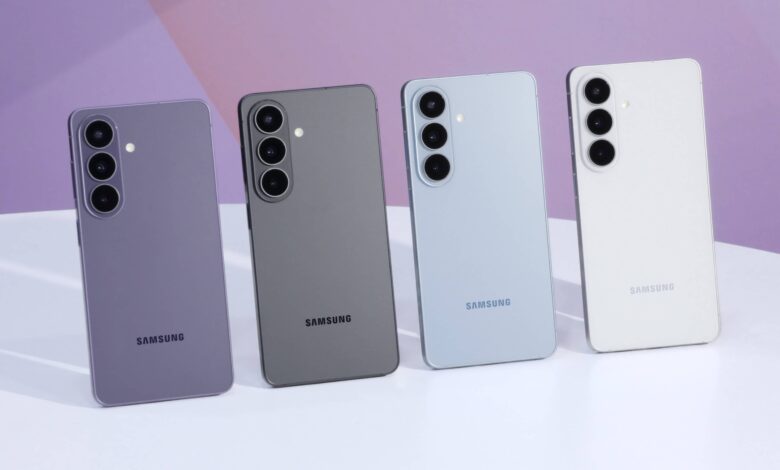
For mobile gaming, the Galaxy S26 Series is positioned as more than a processor upgrade. Samsung appears to be building the experience around stability, display quality, battery endurance, and software support rather than relying on chipset power alone.
That approach matters because long gaming sessions expose weaknesses quickly. Heat, battery drain, screen responsiveness, and network stability can shape the real experience more than benchmark numbers.
Cooling matters when the session runs long
Heat control is one of the most important parts of gaming performance. When a device gets too warm, performance can drop and frame rates can become unstable.
That is why a stronger cooling system becomes essential in a flagship phone used for extended play. Better thermal management helps the device maintain smoother gameplay under sustained load.
120Hz display brings a clear advantage
The Galaxy S26 Series uses a Dynamic AMOLED 2X panel with an adaptive 120Hz refresh rate. This combination makes motion look smoother and touch response feel faster during play.
It is especially relevant for FPS, MOBA, and battle royale games. Compared with a 60Hz display, the visual movement feels more fluid, which can improve comfort and control.
Samsung also includes Vision Booster across the lineup. The feature helps keep the screen easier to view in different lighting conditions, which is useful during gaming in bright environments.
Battery life and power efficiency remain central
Gaming needs strong performance, but it also demands consistent power use. Efficient hardware helps a phone stay active longer without forcing the user to charge too often.
Samsung says the Galaxy S26 Series is designed to deliver optimal performance with better power efficiency. That is important because modern gaming sessions are often long and demanding.
Battery capacity varies by model. The Galaxy S26 comes with 4,300 mAh, the Galaxy S26+ has 4,900 mAh, and the Galaxy S26 Ultra carries 5,000 mAh.
Charging speeds are also different across the series. The Galaxy S26 supports 25W fast charging, the Galaxy S26+ supports 45W, and the Galaxy S26 Ultra is said to reach up to 75% in about 30 minutes, while also supporting Super Fast Wireless Charging.
AI adds a practical layer during gameplay
AI is no longer just a premium-phone feature with vague benefits. In gaming, it can help users access information without leaving the game for too long.
The Galaxy S26 Series includes Circle to Search 3.0 for that purpose. It lets users search for guides, strategies, or game-related information directly from the screen without exiting the game.
For players who regularly look up builds, mission explanations, or quick tips, that function can make the experience feel more seamless. It reduces interruption while keeping information close at hand.
Chipset still matters, but it is only one part of the equation
Performance cores and graphics hardware remain the foundation of gaming speed. A stronger CPU and GPU determine how well a phone handles demanding titles and heavier visual loads.
Samsung says the Galaxy S26 Series is powered by Snapdragon 8 Elite Gen 5 for Galaxy, with improvements to CPU, GPU, and NPU performance. The company says that combination supports faster response, smoother visuals, and more stable gaming performance.
However, the specification table shows different chipset configurations by model. The Galaxy S26 and Galaxy S26+ are listed with Exynos 2600 2nm, while the Galaxy S26 Ultra is listed with Snapdragon 8 Elite Gen 5 for Galaxy.
That difference makes model selection more important for gaming-focused buyers. Choosing between the variants is not only about size or battery, but also about the chipset configuration inside each device.
Other specifications complete the gaming package
All models come with 12GB RAM as the base, while storage goes up to 512GB on the Galaxy S26 and S26+. The Galaxy S26 Ultra goes further with a 16GB/1TB option, which offers more space for large games and extra data.
Display size also changes across the lineup. The Galaxy S26 has a 6.3-inch FHD+ panel, the Galaxy S26+ uses a 6.7-inch QHD+ panel, and the Galaxy S26 Ultra features a 6.9-inch QHD+ display.
Connectivity support is also broad across the series. All models support 5G, LTE, Wi‑Fi 7, and Wi‑Fi Direct, which matters for online gaming where speed and stability are both important.
The Galaxy S26 Series runs Android 16 with One UI 8.5. That software layer is part of the overall equation, since good gaming performance depends on how hardware, power management, display behavior, and the operating system work together.
In the end, the Galaxy S26 Series shows that gaming readiness is no longer defined by a single component. Cooling, a 120Hz display, battery efficiency, AI tools, and chipset choices all shape the final experience in different ways.