The budget phone race is getting tighter, but the gap between Samsung Galaxy A17 and OnePlus Nord CE5 is harder to ignore than the price difference alone suggests. In several key areas, OnePlus appears to offer the stronger package for buyers who want more out of a mid-range budget phone.
The most decisive advantage comes from the combination of display, performance, battery, and charging speed. Samsung still keeps a few meaningful strengths, yet the Galaxy A17 now looks more like the conservative choice while Nord CE5 pushes harder on hardware value.
Display is where OnePlus starts pulling away
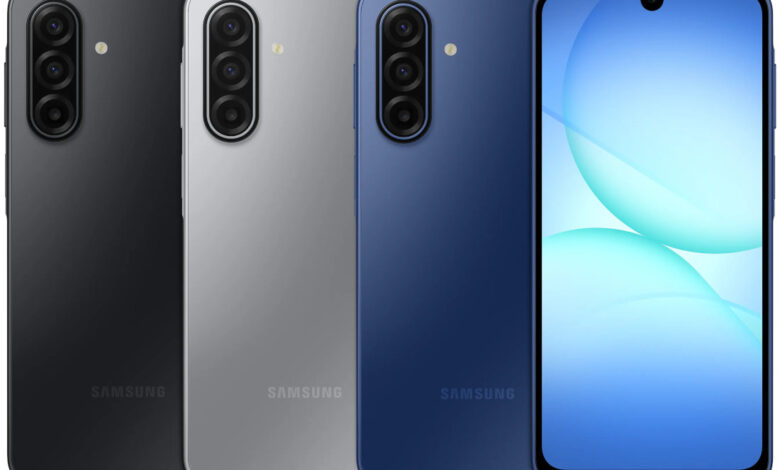
Samsung Galaxy A17 uses a 6.7-inch Super AMOLED panel with a 90Hz refresh rate. It is rated at 800 nits of brightness, which should remain usable for everyday viewing and preserve the familiar Samsung color profile.
OnePlus Nord CE5 steps up to a 6.77-inch Fluid AMOLED screen with a 120Hz refresh rate. It also supports HDR10 Plus and reaches a peak brightness of 1430 nits, making it better suited for video playback and gaming in brighter conditions.
For users who care about smoother scrolling and stronger outdoor visibility, the Nord CE5 has the clearer edge. The difference is not subtle, especially once the display is compared side by side.
Performance separates the two even more clearly
Galaxy A17 is powered by the Exynos 1330, a 5nm chipset aimed at daily tasks and casual gaming. It comes with 6GB or 8GB of RAM and storage options of 128GB or 256GB.
Nord CE5 uses the MediaTek Dimensity 8350 Apex built on a 4nm process. It is paired with 8GB or 12GB of RAM and UFS 3.1 storage, which gives it a more capable setup for heavier multitasking and faster app loading.
That hardware gap is likely to matter most when the phone is pushed beyond basic use. In that situation, OnePlus looks more prepared for demanding games and more intensive day-to-day workloads.
Battery life becomes a major selling point
Samsung includes a 5000 mAh battery on the Galaxy A17 with 25W charging. The capacity is respectable, but the charging speed is modest by current standards.
OnePlus counters with a huge 7100 mAh battery and 80W wired charging. That pairing gives the Nord CE5 one of the biggest practical advantages in the comparison, both for endurance and for how quickly it can be topped up.
For people who spend long hours away from a charger, this is one of the clearest reasons to consider the OnePlus model. The battery setup alone makes the Nord CE5 feel significantly more modern and more aggressive.
Camera choices reflect two different priorities
Galaxy A17 comes with a triple rear camera setup that includes a 50 MP main sensor with OIS, a 5 MP ultrawide camera, and a 2 MP macro lens. Its front camera is rated at 13 MP.
Nord CE5 keeps the rear array simpler with a 50 MP main camera and an 8 MP ultrawide lens. On the front, it uses a 16 MP selfie camera and also supports 4K video recording.
Samsung’s setup is more varied by count, mainly because it still adds the macro lens. OnePlus, however, offers the more practical package for many buyers thanks to the higher-resolution ultrawide camera, the stronger selfie camera, and 4K video support.
Build, protection, and storage still matter
Galaxy A17 uses Gorilla Glass Victus on the front, along with a glass-fiber-reinforced plastic back. It weighs 192 grams and carries an IP54 rating for protection against dust and splashes.
Nord CE5 is slightly heavier at 199 grams and also uses plastic materials, but it is described as having a slimmer profile and an IP65 rating. That makes it better protected against low-pressure water jets.
Both phones offer 128GB and 256GB storage variants, and both support microSDXC expansion. The difference is that OnePlus uses UFS 3.1 storage, which should improve responsiveness in everyday use.
In the end, the Galaxy A17 still has a place for buyers who want a lighter body, Gorilla Glass Victus protection, and a more flexible rear camera count. But for shoppers looking for the strongest overall budget value, the Nord CE5 stands out with its 120Hz display, faster chipset, larger battery, 80W charging, and 4K video support.