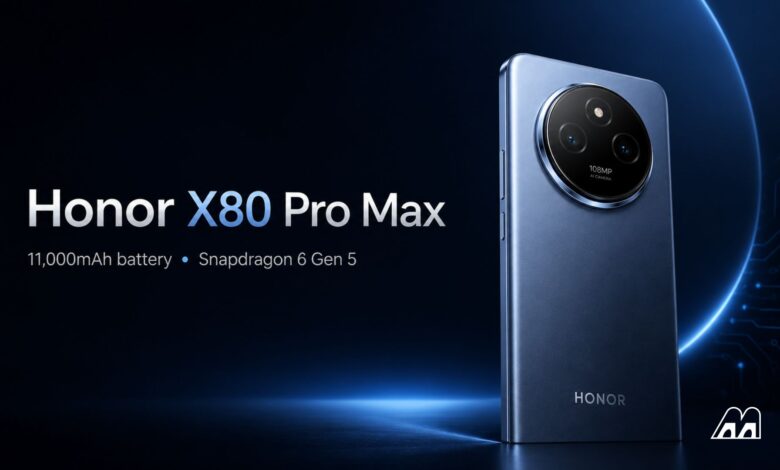
Honor has introduced the X80 Pro Max in China with two headline features that are hard to ignore: a flat display claimed to reach 10,000 nits at peak and an 11,000mAh battery. The combination places the new model in an unusual spot, especially for users who value long endurance and strong outdoor visibility.
The phone starts at CNY 1,999 for the 8GB/128GB version, while the top-end 12GB/512GB model is priced at CNY 2,799. Sales in China are set to begin on June 26 through Honor’s online store.
Pricing and configurations
Honor X80 Pro Max is available in four memory and storage variants, giving buyers several entry points across the lineup. The base model comes with 8GB of RAM and 128GB of storage, while other options include 8GB/256GB, 8GB/512GB, and 12GB/512GB.
| Variant | Price |
|---|---|
| 8GB + 128GB | CNY 1,999 |
| 8GB + 256GB | CNY 2,199 |
| 8GB + 512GB | CNY 2,499 |
| 12GB + 512GB | CNY 2,799 |
Honor is also offering the device in Lightning Red, Moonlight White, Mystic Black, and Vibrant Orange. That color range gives the phone a more expressive look than many large-battery models usually provide.
A display built to stand out
The screen is one of the device’s strongest selling points. Honor uses a 6.8-inch LTPS AMOLED panel with a 1.5K resolution of 1,280 x 2,788 pixels.
The display supports a 120Hz refresh rate and 3,840Hz PWM dimming. Honor also lists 100 percent DCI-P3 coverage, 1.07 billion colors, and an HDR peak brightness of 10,000 nits.
The panel is protected by aluminosilicate glass and uses a flat design. That approach may appeal to users who prefer a more practical feel in daily use.
Battery capacity takes the lead
Honor says the 11,000mAh battery in the X80 Pro Max is the largest cell it has ever put into a phone. The capacity alone makes it one of the most distinctive devices in the current Honor lineup.
Charging is handled through 90W wired fast charging, while 27W reverse wired charging is also supported. That means the phone can be used to top up other devices through a cable when needed.
The large battery suggests a clear focus on users who need strong endurance for long days away from a charger. Honor is pairing that capacity with fast charging to keep the device practical rather than simply massive.
Performance, software, and connectivity
Inside, the Honor X80 Pro Max is powered by Qualcomm’s octa-core Snapdragon 6 Gen 5 chipset. The processor includes four 2.0GHz efficiency cores and four performance cores clocked up to 2.6GHz.
It is paired with an Adreno 812 GPU, up to 12GB of RAM, and as much as 512GB of internal storage. The phone runs MagicOS 10 based on Android 16 and includes dual SIM support.
Connectivity options cover 5G, 4G LTE, Wi-Fi 6, and Bluetooth 6.0. Navigation support includes BeiDou, GPS, GLONASS, Galileo, QZSS, and NavIC.
Cameras and durability
Honor keeps the camera setup relatively simple with a 50-megapixel rear camera featuring an f/1.88 aperture and optical image stabilization. Digital zoom goes up to 10x, which adds some flexibility for casual shooting.
On the front, the phone uses an 8-megapixel selfie camera with an f/2.0 aperture. Video recording is supported at up to 4K 30fps.
Honor also claims IP68, IP69, and IP69K protection for dust and water resistance. For a phone with such a large battery, that level of durability helps reinforce its practical positioning.
Dimensions and everyday hardware
The device measures 162.2 x 77 x 8.08 mm and weighs about 203 grams. Along with the usual motion and positioning hardware, it also includes an IR blaster and a fingerprint scanner.
Other sensors listed for the phone include a gravity sensor, gyroscope, e-compass, ambient light sensor, proximity sensor, and accelerometer. Honor also notes support for reverse wired charging and the broader sensor package expected in a modern midrange device.
The X80 Pro Max arrives only days after Honor introduced the X70 Pro Max in China. With its huge battery, very bright display, and starting price of CNY 1,999, the new model is aimed at buyers who want endurance and display visibility without giving up modern connectivity.