


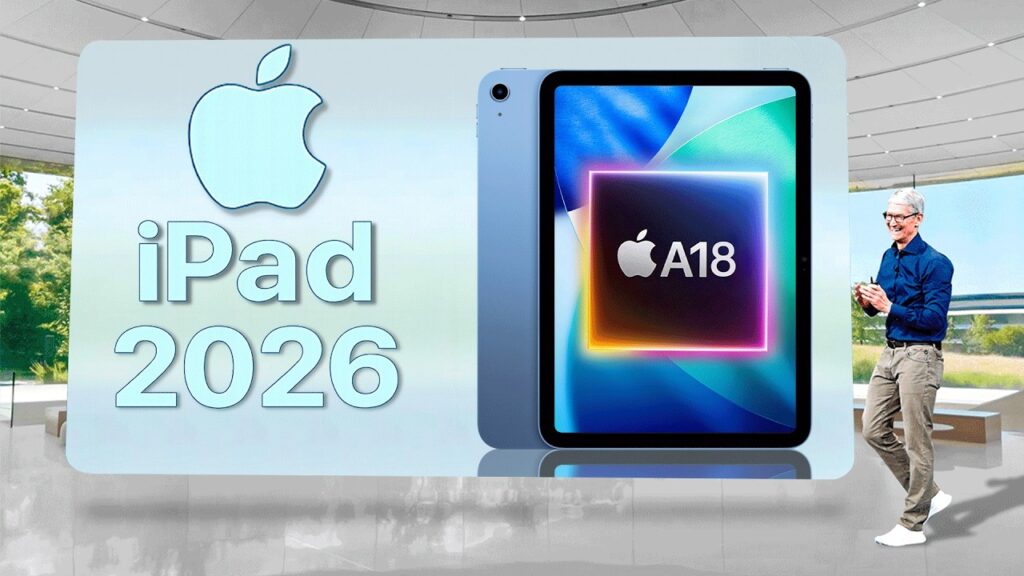
Apple’s iPad lineup in 2026 is no longer defined by a single “best” model. The real decision now depends on whether the priority is price, portability, or laptop-level performance.
That shift matters because the company has widened the gap between its entry tablet, its midrange option, its compact model, and its top-tier device. For many buyers, the strongest choice is not the most powerful one, but the one that matches how the tablet will actually be used.
iPad 11 remains the safest choice for everyday use
The iPad 11, released in 2025, is still the most practical starting point for many users. It comes with the A16 chip, an 11-inch display, USB-C, Touch ID, and a 12MP camera that is sufficient for video streaming, online classes, document reading, and light productivity.
With a starting price of US$299, it remains the easiest entry into Apple’s tablet ecosystem. It does not support Apple Intelligence because of memory limitations, but that is unlikely to matter for users who only need basic tablet functions.
iPad Air M4 moves closer to serious work
For students, office workers, and content creators, the iPad Air 2026 sits in a more capable middle ground. It uses the M4 chip, comes in 11-inch and 13-inch sizes, and includes 12GB of RAM with full Apple Intelligence support.
That combination makes it much better suited to modern computing needs. The model also works with Apple Pencil Pro and Magic Keyboard, which helps push it further into productivity territory.
Starting at US$559 for the 11-inch version, the iPad Air offers a strong balance between cost and capability. It is powerful enough for daily work, yet still far below the price of the Pro model.
iPad Mini stays relevant for users on the move
While many tablets continue to chase larger displays, the iPad Mini keeps its identity as a compact device. The seventh-generation model uses the A17 Pro chip and an 8.3-inch display that is easy to carry anywhere.
Its size remains the main advantage for frequent travelers, readers, note-takers, and mobile gamers. Even with a 60Hz refresh rate, it still handles demanding apps and AI-based features well.
Support for Apple Pencil Pro also keeps the iPad Mini relevant in the small-tablet segment. The category is smaller than it once was, but Apple continues to keep it in the lineup because portability still matters.
iPad Pro M5 is built for the most demanding users
At the top end, the iPad Pro with the M5 chip is aimed at users who truly need maximum performance. It features an OLED 120Hz display, up to 16GB of RAM, and computing power described as capable of matching professional laptops.
The main audience includes graphic designers, video editors, digital illustrators, and musicians who want a flexible but powerful device. For them, the iPad Pro offers a serious work environment in tablet form.
Its starting price is also high, at around US$900 for the 11-inch model and US$1,200 for the 13-inch model. Once the separately sold Magic Keyboard is added, the total cost rises even further.
iPadOS 27 strengthens the case for tablets
Hardware is only part of the story. Apple is also pushing the software side with iPadOS 27, which is scheduled to arrive at the end of 2026.
The update is expected to bring major improvements in artificial intelligence integration, including Siri support based on Google Gemini technology. Multitasking is also becoming more mature through windowed apps, allowing users to manage several apps at once in a way that feels closer to a desktop computer.
That evolution shows that the iPad is no longer positioned purely as a content-consumption device. Apple is increasingly treating it as a primary productivity tool for selected users.
For most buyers, the choice now comes down to a clear trade-off. The iPad 11 is the most economical option, the iPad Air M4 is the most balanced, the iPad Mini is the most portable, and the iPad Pro M5 is reserved for those who need the highest level of power.