


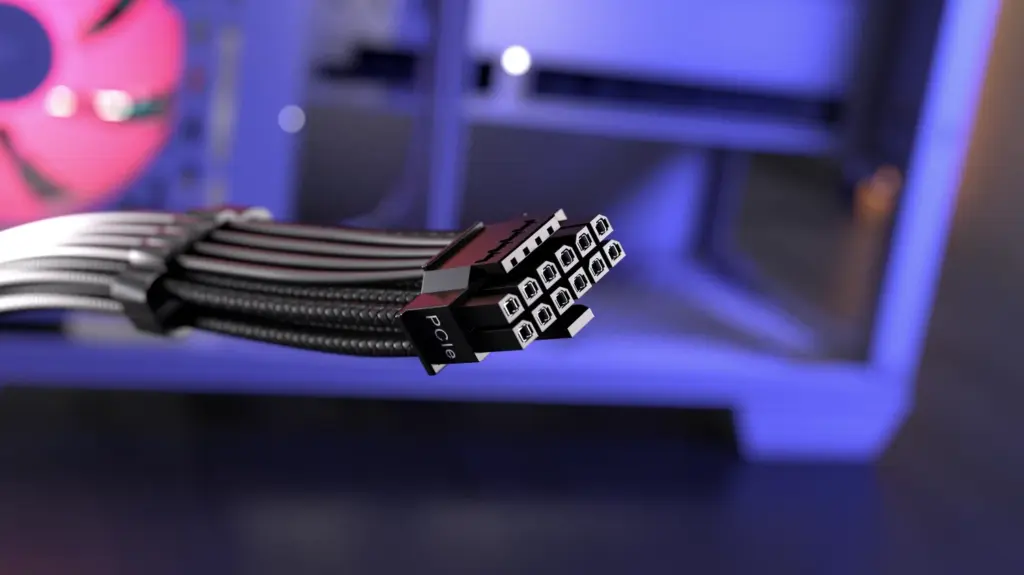
Another GeForce RTX 5090 has reportedly suffered a melted power connector during testing, renewing concern over Nvidia’s 16-pin power design. The latest case adds pressure on the 12V-2×6 standard, which was meant to address the issues that plagued the earlier 12VHPWR connector.
The problem matters because it appears on a flagship graphics card with extreme power demands. In the latest incident, the connector failure was reported even though there was no obvious installation mistake, which makes the situation more worrying for prospective RTX 5090 buyers and current owners alike.
A failure that left visible damage
Club386 reported that its GeForce RTX 5090 Founders Edition was badly damaged after a 12V-2×6 power connector melted during testing. Photos shared by the outlet showed burnt and deformed pins on both the graphics card and cable, along with damage to the power supply.
The setup used a Be Quiet Dark Power 13 1000W PSU and a single native 12V-2×6 cable. According to Club386, the connection was made correctly, which led the publication to state that user error was not involved.
A similar issue was also reported by YouTuber Daniel Owen on his RTX 5090 Founders Edition. In that case, the connector melted while the card was powered through a 4x 8-pin to 12V-2×6 adapter.
Why the 12V-2×6 standard is under scrutiny
The 12V-2×6 connector was introduced as an update to 12VHPWR, with shorter sense pins designed to better detect whether the cable is fully seated. It was also intended to handle higher power delivery more safely than the previous design.
Real-world use is again exposing weaknesses, especially on the RTX 5090. Reports suggest the GPU can draw sharp power spikes above 500W and reaching 600W, placing heavy stress on the connector.
Technical factors such as uneven current distribution across pins, slight cable bends, and heat buildup are still being discussed as possible causes. Club386 went further and called the design “flawed” and “not fit for purpose.”
What Nvidia says, and how vendors are responding
Nvidia has continued to defend the connector, saying that 12V-2×6 meets the ATX 3.1 specification and recommending native cables from high-quality PSUs. Even so, the recurring incidents have kept concerns alive among enthusiast PC users.
Some third-party companies are trying to reduce the risk with extra safeguards. MSI, for example, has offered reinforced cables with improved monitoring.
That response shows the market has not fully accepted the new connector as a final fix. For a premium GPU line like RTX 50 series, every new failure quickly becomes a wider debate about durability, safety, and design margins.
What owners of RTX 5090 should pay attention to
For current RTX 5090 users, the latest reports reinforce the importance of careful cable management. Making sure the connector is fully seated and avoiding tight bends near the plug remain basic precautions.
Some users may also consider undervolting to reduce power draw. That is being viewed as one practical option while hardware-level fixes remain unresolved.
Anyone affected by this kind of damage should keep records of the card, cable, and PSU. Photos and configuration notes may help support an RMA claim if a warranty case is needed after a connector failure.
The latest RTX 5090 incident suggests that the shift from 12VHPWR to 12V-2×6 has not ended Nvidia’s connector problems. As long as top-end GPUs continue to demand very high power, the debate over connector safety is unlikely to disappear.