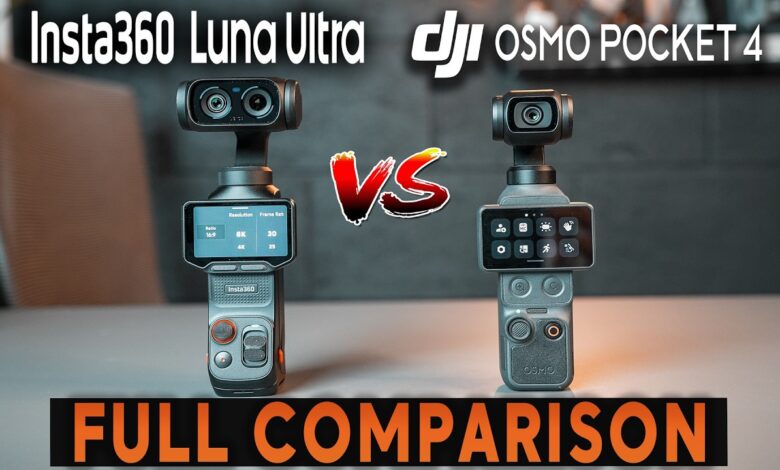
The compact camera race is no longer shaped by DJI alone. Insta360 has stepped in with the Luna Ultra, creating a direct challenge in a category long associated with the Osmo Pocket line.
What makes the matchup notable is that both cameras use a similar formula, yet they lean into different strengths. Each comes with a compact body, built-in gimbal, and a dual-lens setup that marks an important first for both brands in this segment.
For vloggers, travelers, and creators, that means the pocket camera market now offers a sharper set of choices. The real decision is no longer just about size, but about which balance of image quality, zoom flexibility, battery life, storage, and smart features matters most.
Where DJI takes the lead
DJI positions the Osmo Pocket 4P as the most advanced model in its pocket camera lineup. It uses a 1-inch main sensor, paired with a 20mm f/2.0 wide lens and a second 60mm f/1.8 lens that DJI describes as a “golden portrait” focal length.
On paper, the camera is built for creators who care about latitude in post-production. It offers 17 stops of dynamic range and 10-bit D-Log2 recording, both of which give more room for color grading and recovery of highlight and shadow detail.
DJI also pushes hard on motion performance. The Osmo Pocket 4P can record up to 4K at 240fps, and ActiveTrack 8.0 is designed to keep subjects locked in frame even when the zoom lens is in use.
Practical details also work in its favor. The camera includes 103GB of internal storage, a claimed 210-minute battery life, and support for charging to 80 percent in 18 minutes.
It weighs 230 grams and supports Wi‑Fi 6 plus USB 3.1 for faster file transfer. In China, the starting price is around 3,799 yuan, while global pricing is estimated at $649 to $699.
There is, however, one major limitation for the U.S. market. Because DJI is on the FCC Covered List since late 2025, the Osmo Pocket 4P cannot be sold officially in the United States.
Why the Luna Ultra remains a serious threat
Insta360 has built the Luna Ultra around a different kind of appeal. The camera launched in June and was made available almost immediately, including in the United States, at $769.99.
Its headline feature is 8K at 30fps, a mode not available on the Osmo Pocket 4P. For users focused on higher-resolution capture, that alone gives the Luna Ultra a clear talking point.
The company also leans on its Leica partnership. The camera uses a Leica Summicron 20mm f/1.8 lens and includes Leica-branded color filters meant to produce a cinematic look more quickly.
Another standout feature is its detachable 2-inch OLED touchscreen. The display can be removed from the body and used as a wireless remote, then reattached in different positions depending on how the camera is being used.
Under the hood, Insta360 says the Luna Ultra uses a triple AI chip setup, combining a 4nm AI processor with two dedicated imaging chips. It also supports Dolby Vision, the I-Log color profile, and PureVideo 4K60fps for low-light shooting.
Battery life is claimed at about four hours, with charging to 80 percent taking around 23 minutes. The camera weighs just over 200 grams, and although its internal storage is smaller at 47GB, it has the advantage of being widely available from the start.
How the battle is likely to split buyers
The Osmo Pocket 4P looks stronger on dynamic range, internal storage, fast charging, and extreme slow motion. DJI also enters the comparison with mature software support, accessories, and tracking technology.
The Luna Ultra answers with 8K, a more experimental design, Dolby Vision, Leica branding, and official U.S. availability. For buyers in the American market, that distribution advantage may matter as much as the hardware itself.
The bigger story is that pocket cameras are no longer competing only on stabilization inside a small body. The category is moving toward a wider contest that blends optics, AI-assisted processing, and everyday usability into a device that still fits in a pocket.