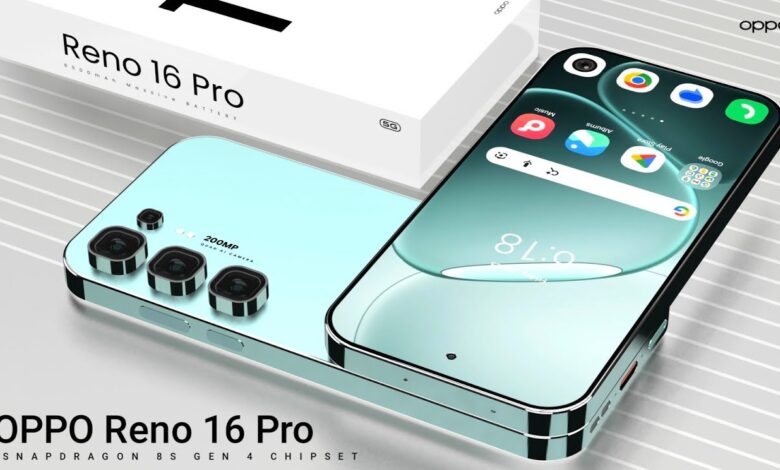
Oppo is bringing the Reno16 series to international markets, and the Reno16 Pro stands out for keeping its 200MP main camera and Dimensity 8550 Super chipset while moving to a much smaller body. The global version is not a direct copy of the China model, which makes the launch more interesting for buyers tracking the lineup across markets.
The most noticeable change is the size. The global Reno16 Pro arrives with a 6.32-inch form factor, far smaller than the 6.78-inch Reno16 Pro sold in China, and that shift changes the way the device fits into the series from the start.
In global markets, the Reno16 Pro sits unusually close to the regular Reno16 in overall design. The two share the same appearance, but their differences are easier to explain than their similarities.
What separates the Pro from the regular model
The Reno16 Pro pairs its 200MP primary camera with the Dimensity 8550 Super chipset, giving it a stronger positioning in the lineup. The standard Reno16 uses a 50MP main camera and Snapdragon 7 Gen 4 instead, with 8GB or 12GB RAM options, although only the 8GB version is available in the European Union.
That specification gap matters more than the shared design language. For everyday users, the Pro model’s appeal comes from the mix of higher camera resolution, standard 12GB RAM, and a more powerful chipset rather than from a dramatic visual redesign.
Design language, AI button, and practical touches
Oppo calls the shared design the 3D Pop Planet design, and the company says it uses HoloVerse 3D technology for the first time in the industry. The effect is meant to evoke a nebula-like look that changes with light and movement.
The camera island blends into the back panel with a smooth curve, giving the rear a cleaner finish. Oppo also says this approach helps reduce dust buildup around the sides of the camera module.
A new AI Snap Key sits on the upper left edge of the body. By default, it captures what the user is viewing and sends it to AI Mind Space.
The button is also customizable, which makes it more flexible in daily use. It can be reassigned to open the camera, switch on the flashlight, mute the ringtone, or launch another app.
Display, software, and long-term promise
The Reno16 Pro supports a maximum 144Hz refresh rate, while the standard Reno16 tops out at 120Hz. Oppo says the difference is most noticeable in games that are built to support higher refresh rates.
Even so, the display is not the main reason to choose the Pro model. Its stronger pitch is the combination of camera, memory, and chipset, while the screen advantage remains a more situational benefit.
ColorOS handles the software side, bringing Oppo’s familiar interface with a look that still takes cues from iOS. Oppo also says the phone is expected to stay smooth for up to six years of use, signaling a stronger focus on longevity.
Colors, pricing, battery, and box contents
The Reno16 Pro is offered in Pop White and Starlight Black, with 12/256GB and 12/512GB configurations. Its launch price is set at €900 during a promotional period that runs until 31 July, after which the regular price rises to €1,100.
Battery capacity is not fully uniform across regions. The device can ship with a battery as large as 6,700mAh, although some markets may receive a smaller pack.
The retail box is also unusually complete by current standards. Oppo includes the phone, an 80W charger, a USB-A to USB-C cable, and a clear case.
That bundle gives the Reno16 Pro extra value at a time when many brands are trimming accessories. With a 200MP camera, 12GB RAM as standard, a 144Hz display, and a full accessory package, Oppo is clearly trying to make the global Reno16 Pro feel easier to recommend without forcing buyers into a much larger phone.