


Apple is reportedly preparing a major change to its Mac chip roadmap, with the company said to be dropping the M6 Pro and M6 Max entirely. If accurate, the move would mark one of the biggest shifts in Apple Silicon strategy so far.
Instead of rolling out the full M6 family, Apple is said to focus on the base M6 for lower-end Macs, while reserving its more advanced silicon plans for a later generation. The change is tied to a broader push toward stronger on-device AI and heavier graphics workloads.
A smaller M6 lineup, but a bigger strategic shift
Bloomberg’s Mark Gurman reported that Apple is reshaping its processor roadmap as part of this transition. In the reported plan, the M6 would appear in devices such as a refreshed 14-inch MacBook Pro and possibly other entry-level Mac models.
The most striking detail is that Apple is said not to be developing M6 Pro or M6 Max chips at all. That would make M6 the first generation in the M-series line to skip the higher-end variants that have normally defined the range.
The company is believed to be moving some technologies forward sooner than originally planned so that its next chips can better support AI on the device itself. That also aligns with the need for stronger graphics performance in future Mac hardware.
What the M6 is expected to bring
M6 is said to be the first Apple processor made using TSMC’s 2nm process, a step up from the 3nm manufacturing used in the latest generation before it. That fabrication jump is expected to be one of the chip’s defining changes.
Other reported upgrades include around 200GB/s of memory bandwidth, compared with roughly 153GB/s on M5. Apple is also said to be redesigning its memory architecture while delivering faster CPU performance across all cores.
The Neural Engine is also expected to be improved, reinforcing the idea that AI will sit at the center of the next major silicon cycle. Multimedia performance is said to improve as well, with upgrades to video encoding and decoding.
On the graphics side, Apple is reported to be revising the GPU configuration, with core count potentially rising to as many as 12 from 10 on M5. That would help explain why Apple is emphasizing graphics alongside AI in the next wave of chips.
M7 is where the full premium lineup returns
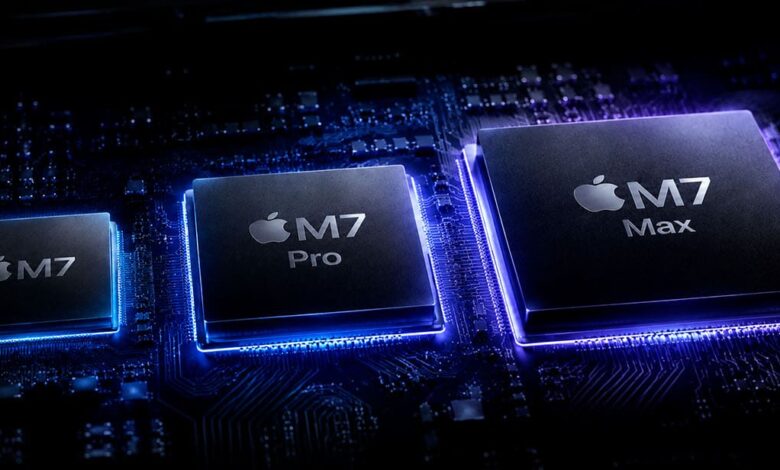
After the base M6, Apple is said to shift attention to the M7 family, which is reportedly planned in a fuller lineup that includes M7, M7 Pro, M7 Max, and M7 Ultra. This is where the company’s next major performance push is expected to become more visible.
The M7 series is described as carrying stronger AI performance and further graphics gains, especially in the higher-end variants. For the standard M7, memory bandwidth is said to reach about 240GB/s, showing that Apple is preparing for larger data movement as workloads become more demanding.
That approach suggests M6 may function mainly as a transition point, while the more complete step-up for professional and high-end users is held back for M7. It also indicates a different release pattern from earlier M-series generations, which usually arrived with multiple performance tiers in one family.
M5 Ultra still remains in the pipeline
Even as Apple reportedly reorganizes its future chip strategy, the company is still said to be preparing M5 Ultra for a coming Mac Studio model. That keeps Apple’s workstation-class plans active while the company moves its main consumer roadmap in a new direction.
Testing on the M5 Ultra is said to involve up to 36 CPU cores, 80 GPU cores, and unified memory support of up to 768GB. Those figures show that Apple is not walking away from extreme-performance silicon, even while it prioritizes a more AI-centered path for the next generations.
If the reported roadmap holds, the result will be a Mac chip lineup that looks less conventional than before. Apple appears to be reshaping the balance between entry-level machines, professional models, and future AI-focused silicon.