


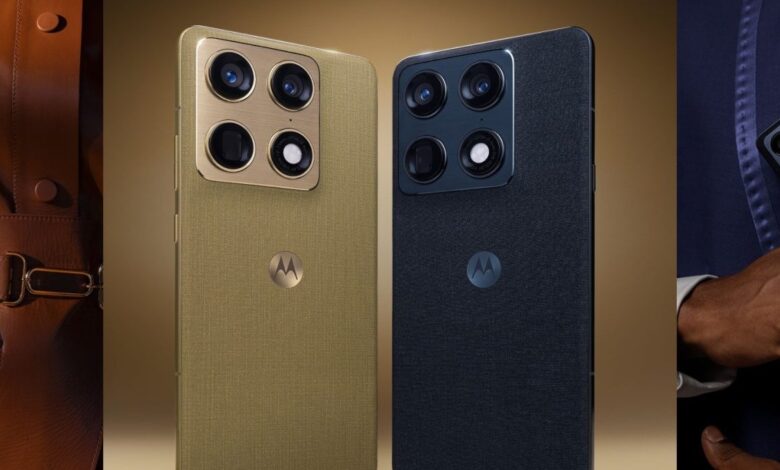
Motorola Signature enters the premium smartphone race with a specification sheet that looks fully loaded on paper. The device aims at the Rp10-12 jutaan class, where buyers expect not only speed, but also a polished experience that can hold up over time.
That ambition is clear across its design, display, performance, and software support. Yet the same package also comes with several compromises that may matter more than the raw numbers suggest.
Lightweight build and premium materials
One of the first details that stands out is the chassis. Motorola Signature weighs about 180 grams and measures only 7 mm thick, which makes it noticeably easier to handle than many larger rivals.
The company pairs that slim profile with an aluminum frame and Gorilla Glass Victus 2 protection. In the flagship segment, that combination helps the phone feel premium without sacrificing day-to-day comfort.
A display built for efficiency
The screen is another major selling point. Motorola uses an LTPO panel with 1.5K resolution and adaptive refresh rates that can scale up to 120Hz, then drop as low as 1Hz when the image is static.
That flexibility is meant to improve power efficiency while keeping motion smooth. The panel is also said to support up to 165Hz in certain apps, leaving room for even faster scrolling in specific scenarios.
| Key Display Details | Specification |
|---|---|
| Panel | LTPO |
| Resolution | 1.5K |
| Refresh Rate | Up to 120Hz, down to 1Hz |
| Special Support | Up to 165Hz in certain apps |
Strong hardware, but not the only factor
Under the hood, Motorola Signature uses Snapdragon 8 Gen 5, paired with 12GB of RAM and 256GB of internal storage. That is a high-end setup for gaming, multitasking, and heavy daily use.
Benchmark results are reportedly still below some rivals powered by top-tier MediaTek chipsets, but that does not always translate directly into a weaker real-world experience. Software optimization can matter just as much, and Motorola appears to be leaning on that advantage.
Productivity features that push beyond a typical phone
Motorola also adds features aimed at users who want the phone to do more than handle mobile tasks. The USB 3.1 port enables faster data transfer and supports external display output, which broadens its usefulness in a desk setup.
Smart Connect is included as well, allowing the phone to switch into a desktop-like interface similar to Samsung DeX. For users who want one device for both communication and light work, that is a meaningful addition.
Long software support adds long-term value
Another important part of the package is software policy. Motorola promises up to seven years of operating system and security updates, which gives the device a longer useful life than many buyers typically expect from a smartphone.
That kind of support has become increasingly important in the premium category. It turns the purchase into a longer-term investment rather than a short-lived upgrade.
Cameras are strong for photos, less convincing for video
The camera setup is one of the most interesting aspects of Motorola Signature. The rear system uses 50MP sensors across the main, ultrawide, and periscope telephoto cameras, while the front camera also uses a 50MP sensor.
Technology reviews say the still images are consistent in color and detail, especially in good light. The telephoto camera is also described as capable of producing sharp zoom results even beyond optical magnification.
Video is where the system appears to fall short of competing flagships. Although it supports up to 8K and 4K 60fps recording, low-light footage is said to need further refinement, especially in stabilization and color reproduction.
Battery and charging are well covered
Battery life is backed by a 5,200 mAh silicon-carbon cell, paired with 90W fast charging. Motorola also includes 50W wireless charging and reverse wireless charging.
On paper, that makes the device look complete in almost every major category. Even so, a strong spec sheet does not automatically make it the best fit for every premium buyer.
Three compromises that buyers should not overlook
Motorola Signature does not support eSIM, which is increasingly seen as a standard feature in premium smartphones. For frequent travelers or users who rely on digital operator services, that omission can be a real limitation.
The Indonesian market also gets only the 256GB variant, with no 512GB option. Users who record a lot of high-resolution video or store large files may find that capacity too restrictive.
Accessory availability is another weak point. With no bundled screen protector and limited official accessories, buyers are more likely to depend on third-party products.
In the end, Motorola Signature shows that a flagship today needs more than speed alone. It is strong in design, display, productivity features, and photography, but the lack of eSIM, the limited memory option, and the weaker video performance make it best suited for buyers who know exactly which features matter most.