


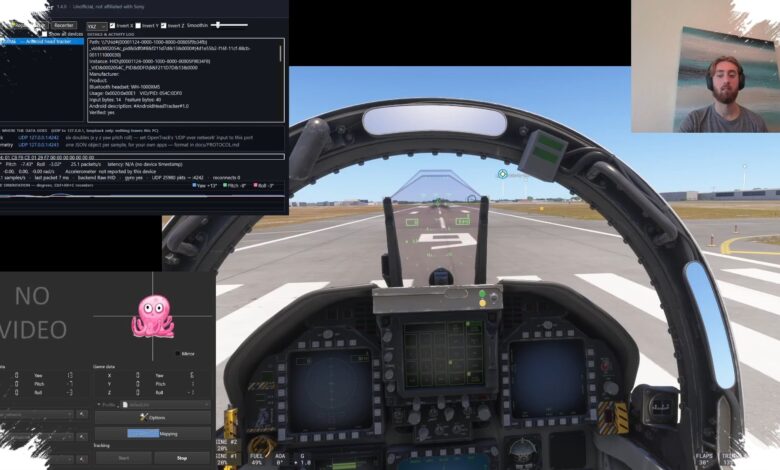
A new software project is turning selected Sony headphones into a real-time head tracker for PC simulation games, giving players a cheaper way to add cockpit-style immersion without buying dedicated hardware. The setup works through Windows and is already being shown with titles such as Microsoft Flight Simulator and Assetto Corsa.
What makes the idea stand out is that the motion sensors are already inside the headphones. Instead of adding new hardware, the software simply unlocks a feature that was designed for spatial audio and redirects it toward head tracking in games.
How the system works
The project is called Sony Head Tracker and was created by developer Nicholas Slattery. It connects compatible Sony headphone sensors to OpenTrack, a long-established PC tool that supports head tracking in a wide range of games.
OpenTrack works with more than 200 games and can accept input from phones, webcams, eye trackers, and infrared trackers. In this case, the Sony headphones act as the source of motion data, letting the player turn their head naturally to control the in-game view.
Why simulator players care
For simulation fans, head tracking can make a major difference inside a cockpit or vehicle cabin. Looking into turns, checking mirrors, or glancing around a flight deck feels more natural than moving the camera with a mouse.
The project is especially relevant because it offers a simpler alternative to dedicated trackers or VR headsets for users who already own the right Sony audio device. In demonstrations, the tracking response has been described as very fast and fluid.
| Supported Sony Models | Type | Notes |
|---|---|---|
| WH-1000XM6 | Headphones | Compatible with spatial audio and head-tracking sensors |
| WF-1000XM6 | Earbuds | Compatible with spatial audio and head-tracking sensors |
| WH-1000XM5 | Headphones | Compatible with spatial audio and head-tracking sensors |
| WF-1000XM5 | Earbuds | Compatible with spatial audio and head-tracking sensors |
| WH-ULT900N | Headphones | ULT WEAR model with support for the feature |
What is and is not supported
At the moment, support is limited to Sony models that already include spatial audio hardware and the related motion sensors. That limitation matters because not every Sony headphone or earbud carries the same internal components.
The same approach does not work for Apple headphones and earbuds on Windows, since those devices use a proprietary protocol that cannot be accessed in the same way.
The larger significance of Sony Head Tracker is that it exposes a capability many users may already have but never used on PC. By bridging the headphone sensors to OpenTrack, the project turns consumer audio hardware into a practical gaming input without adding a separate tracker.
For simulator communities, that means a device built for listening can now also help control perspective in games that depend on precise head movement. It is a narrow compatibility window, but for the right Sony owners, it opens a surprisingly useful shortcut to more immersive play.