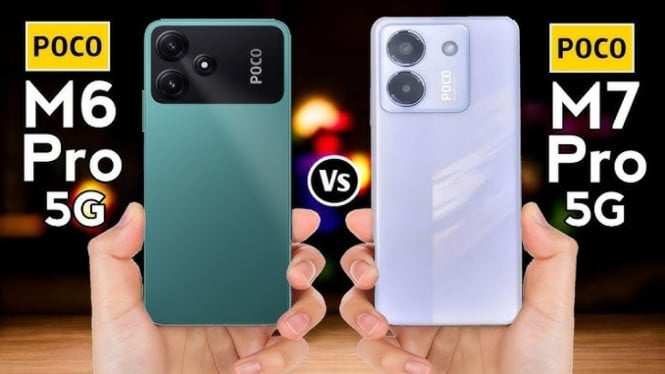
Poco recently launched the M7 Pro as the successor to the Poco M6 Pro, keeping the same price at approximately $200 USD. Both phones sell officially for around 2.9 million Indonesian Rupiah (about $200), making the choice between them a topic of interest for budget-conscious buyers in 2025. This comparison highlights which device offers better value for the same price.
Design and Build Quality
The Poco M7 Pro features a more minimalist design with a curved bezel for comfortable grip and a back cover that resists fingerprints. In contrast, the M6 Pro has a solid back cover but tends to show smudges easily and uses sharper bezels with a slightly slimmer chin. The M7 Pro’s design aims for simplicity and usability, while the M6 Pro prioritizes solid feel over cleanliness.
Display Features
Both models sport a 6.67-inch AMOLED screen with Full HD+ resolution and a 120 Hz refresh rate, ensuring smooth visuals. However, the M7 Pro adds HDR10+ support, enriching video content quality. Both phones use Corning Gorilla Glass 5 for screen protection, providing durability against scratches.
Audio Quality and Feedback
Audio performance is robust on both devices, with stereo speakers reaching up to 300% volume capability. The M7 Pro’s back cover is hollow, causing vibrations at high volume, whereas the M6 Pro’s more solid build avoids this issue. In terms of haptic feedback, the M6 Pro offers better tactile response. Audio quality scores favor the M7 Pro slightly, with a rating of 9 compared to M6 Pro’s 8.
Performance and Chipset
The M6 Pro is powered by a Mediatek Helio G99 Ultra with a Mali G57 MC2 GPU, known for stable gaming performance. The M7 Pro upgrades to a Dimensity 7025 Ultra chipset with a 6nm fabrication process for improved CPU and memory performance but uses a less powerful PowerVR BXM 8-256 GPU. Benchmark tests show the M7 Pro excels in CPU and UX scores, but the M6 Pro maintains stronger GPU performance and more stable gaming with fewer frame drops.
Camera Capabilities
The M6 Pro offers a 64MP main camera with Optical Image Stabilization (OIS), an 8MP ultra-wide lens, a 2MP macro camera, and a 16MP front-facing camera. Conversely, the M7 Pro steps down to a 50MP main camera (still with OIS), replaces the ultra-wide lens with a 2MP depth sensor, and upgrades the selfie camera to 20MP. Video recording on the M6 Pro can reach 1080p at 60fps, while the M7 Pro maxes out at 1080p at 30fps, lacking some pro video features.
Battery and Charging
Battery capacity is slightly larger on the M7 Pro at 5110mAh, offering longer usage times. The M6 Pro has a 5000mAh battery but supports faster charging at 67W compared to the M7 Pro’s 45W charging speed. Buyers must decide between marginally longer battery life or faster recharge times based on their daily needs.
Gaming Performance
During intensive gaming tests on Mobile Legends with high settings, both phones maintained similar average FPS around 58 over 16 minutes. The M6 Pro demonstrated cooler temperatures and more stable frame rates, while the M7 Pro ran slightly hotter and showed more frequent frame drops, indicating less consistent gaming performance despite newer hardware.
Final Considerations
At the same price point, Poco M6 Pro continues to offer excellent value with better gaming stability, a superior main camera configuration, and faster charging. The M7 Pro’s 5G connectivity and HDR10+ display support come with certain compromises, including downgraded camera sensors and less stable GPU performance. For users who do not urgently require 5G and prioritize long-term daily usability, the M6 Pro remains the more worthwhile option in 2025.
Choosing between Poco M7 Pro and M6 Pro depends on what features are most important. If 5G and HDR video are priorities, M7 Pro fits the bill. However, for balanced performance, better photography, and gaming, M6 Pro holds the edge while maintaining affordability.