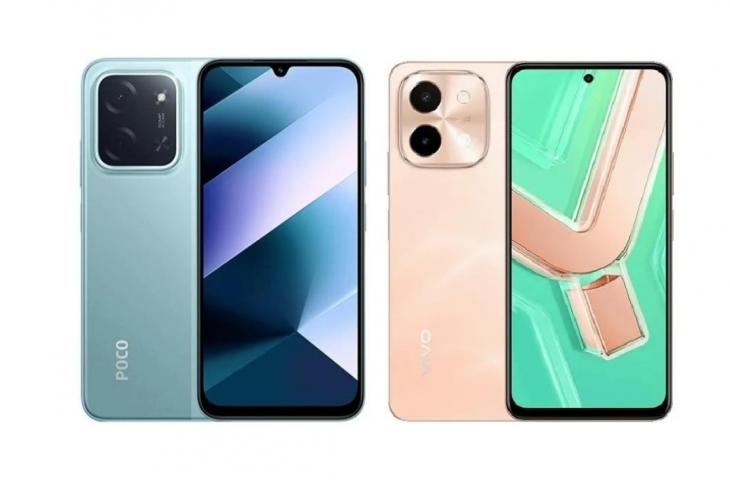
When choosing between Poco C85 and Vivo Y28, battery performance plays a key role for many users. Both phones target the entry-level segment with a focus on endurance and efficiency. This comparison highlights their strengths and differences to help decide which one fits better for daily use.
Poco C85 stands out with a massive 6000 mAh battery capacity, combined with 33W fast charging support. This large battery can last a full day easily and even extend to two days under light usage. The faster charging capability also reduces downtime significantly.
In contrast, Vivo Y28 offers a smaller 5000 mAh battery and slower 15W charging. While still sufficient for normal daily activities, its overall endurance falls behind Poco’s offering. Users needing longer screen-on time will likely prefer Poco C85.
Design and Build
Poco C85 is physically larger, measuring 171.6 x 79.5 x 8 mm and weighing 205 grams. Vivo Y28 has a more compact design at 163.7 x 75.4 x 8.1 mm and only 186 grams in weight. Vivo’s lighter body feels easier to handle for prolonged use.
Regarding durability, Poco C85 carries IP64 certification, providing better protection against dust and water splashes. Vivo Y28 has a lower IP54 rating, offering protection mainly against light dust and minor splashes. For users concerned about ruggedness, Poco has the advantage.
Display
Poco C85 features a 6.9-inch IPS LCD screen with a 120Hz refresh rate and peak brightness of 810 nits in high brightness mode. This large, smooth display benefits video watching and gaming. Its HD+ resolution (720 x 1600 pixels) remains adequate for everyday tasks.
Vivo Y28’s display is smaller at 6.56 inches, with 90Hz refresh rate and slightly higher 840 nits brightness. Its resolution is marginally better at 720 x 1612 pixels. Although the refresh rate is lower, the screen still delivers satisfactory visual experience for typical users.
Performance and Software
Poco C85 runs on a MediaTek Helio G81 Ultra chipset built on a 12nm process. It handles light to moderate activities well and comes pre-installed with Android 15 overlaid by HyperOS 2, offering a fresh user interface. This provides a modern software experience out of the box.
Vivo Y28 uses the MediaTek Dimensity 6020 chipset fabricated on a 7nm node. It is more power-efficient, aiding battery longevity, and runs Android 13 with Vivo’s Funtouch 13. Lower Android version might deter some, but Dimensity’s efficiency is a notable plus.
Camera Capabilities
Both phones are equipped with a 50 MP primary camera featuring f/1.8 aperture and PDAF autofocus. Each includes an auxiliary lens and an 8 MP front camera with f/2.0 aperture. Their camera performance is comparable, suitable for everyday photography needs.
Poco C85 additionally supports NFC, a useful feature for mobile payments and connectivity. Vivo Y28 lacks NFC support, which might influence buyers who value this convenience.
Summary Table
- Battery Capacity: Poco C85 (6000 mAh) > Vivo Y28 (5000 mAh)
- Charging Speed: Poco C85 (33W) > Vivo Y28 (15W)
- Weight: Vivo Y28 (186 g) < Poco C85 (205 g)
- Water/Dust Protection: Poco C85 (IP64) > Vivo Y28 (IP54)
- Screen Size & Refresh Rate: Poco C85 (6.9", 120Hz) > Vivo Y28 (6.56", 90Hz)
- Chipset Efficiency: Vivo Y28 (7nm Dimensity 6020) > Poco C85 (12nm Helio G81 Ultra)
- Software: Poco C85 (Android 15/HyperOS 2) > Vivo Y28 (Android 13/Funtouch 13)
- NFC: Poco C85 (Available) vs Vivo Y28 (Not available)
Choosing between the Poco C85 and Vivo Y28 depends primarily on user priorities. Those desiring longer battery life and faster charging will favor Poco C85. For a lighter form factor and slightly newer chipset efficiency, Vivo Y28 could be preferable. Both offer solid cameras and balanced specs for budget-conscious buyers. Ultimately, the decision rests on which features matter most to the individual user.
-

-
-

-