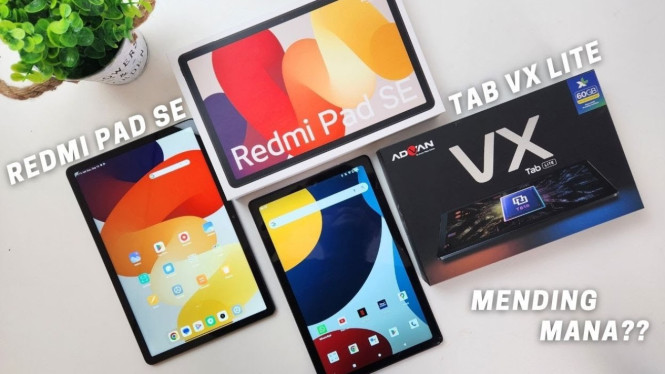
When choosing a budget tablet around $70, the Redmi Pad SE and Advan Tab VX Lite present two distinct options. Both tablets come at a similar price point but cater to different user needs with unique advantages and specifications.
Build Quality and Display
The Redmi Pad SE shines with its metal unibody design, offering a premium and solid build. It feels more durable and comfortable for long usage compared to the Advan Tab VX Lite, which uses plastic that tends to creak under pressure. Redmi is also slimmer, despite packing a larger 8000 mAh battery, while Advan’s battery is smaller at 6000 mAh.
Screen size and quality also highlight big differences. Redmi features an 11-inch Full HD+ screen with a 90 Hz refresh rate, providing smoother animations and better multimedia experience. Meanwhile, Advan’s 10.4-inch display has a standard HD resolution and a lower refresh rate, making it less sharp for watching videos or browsing.
Performance and Software
Under the hood, Redmi incorporates a Snapdragon 680 chipset fabricated on 6 nm technology, which promises efficiency and decent performance. Advan is equipped with the Unisoc T618 processor, which generally trails Snapdragon in benchmarks. RAM options show Redmi with 4 GB but with an added 2 GB virtual RAM feature, effectively offering up to 6 GB for multitasking. Advan comes with a larger 6 GB RAM but no virtual extension.
On software, Redmi runs MIUI 14 based on Android 13 tailored for tablets, which optimizes the interface and settings for larger screens. Advan uses stock Android 13, mostly resembling a large smartphone interface, which may be less user-friendly for tablet use.
Connectivity and Storage
Advan’s key advantage is its support for 4G LTE connectivity, allowing internet access without relying on Wi-Fi or smartphone tethering. It supports nano SIM cards along with microSD for expanded storage. Redmi only supports microSD and lacks SIM card support, making it less versatile for mobile internet.
Both offer 128 GB onboard storage, adequate for typical users, but Advan’s SIM card slot gives it an edge for on-the-go connectivity.
Camera and Multimedia Features
In terms of camera, both tablets have similar 8 MP rear and 5 MP front cameras. However, Redmi delivers superior video call quality, supporting 1080p recording at 30 FPS, which benefits users attending virtual meetings. Redmi also boasts a quad-speaker setup with Dolby Atmos support, enhancing audio immersion significantly better than Advan’s dual speakers.
Both devices include a 3.5mm headphone jack and USB Type-C port, fulfilling basic multimedia and charging needs.
Battery Life and Charging
With an 8000 mAh battery, Redmi offers potentially longer usage times compared to Advan’s 6000 mAh battery. Both tablets use 10-watt charging speeds, which means slower charging times, an important consideration if fast charging is a priority.
Summary Comparison Table
| Feature | Redmi Pad SE | Advan Tab VX Lite |
|---|---|---|
| Price | ~$70 | ~$70 |
| Build | Metal unibody (premium) | Plastic (less solid) |
| Display | 11" FHD+ 90 Hz | 10.4" HD |
| Processor | Snapdragon 680 (6 nm) | Unisoc T618 |
| RAM | 4 GB + 2 GB virtual RAM | 6 GB |
| Storage | 128 GB + microSD only | 128 GB + microSD + nano SIM |
| Connectivity | Wi-Fi only | 4G LTE with SIM card |
| Cameras | 8 MP rear, 5 MP front (1080p video) | 8 MP rear, 5 MP front |
| Speakers | Quad Dolby Atmos | Dual speakers |
| Battery | 8000 mAh | 6000 mAh |
| Charging | 10 W slow charging | 10 W slow charging |
| Software | MIUI 14 on Android 13 (tablet optimized) | Stock Android 13 (phone-like UI) |
Ultimately, the choice boils down to what users prioritize: the Redmi Pad SE excels for those who want a large, sharp display with robust build quality and optimized software for multimedia and daily use. Alternatively, the Advan Tab VX Lite is a better pick for users needing reliable 4G connectivity and higher RAM for productivity on the go.
Both tablets deliver value for around $70, but deciding between build quality and mobile network support depends on individual lifestyle and work habits.