


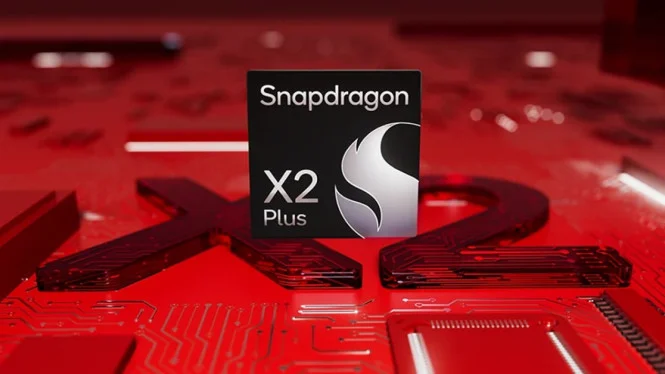
Qualcomm has officially unveiled the Snapdragon X2 Plus processor at CES 2026, aiming to disrupt the laptop CPU market. The company claims this new chip delivers CPU performance up to 3.5 times faster than Intel’s Core Ultra 7 265U while maintaining the same power consumption, marking a significant leap toward high efficiency in thin and light laptops.
This launch underscores Qualcomm’s growing ambition to expand its presence in the Windows ecosystem. Snapdragon X2 Plus follows earlier releases like the Snapdragon X2 Elite and Elite Extreme, providing a more accessible yet powerful option for a wider range of laptop manufacturers. It continues to use the third-generation Oryon CPU architecture, balancing strong performance with excellent battery life.
Design and Variants
Snapdragon X2 Plus comes in two main versions. The first is the X2P-42-100, featuring a 6-core CPU configuration. The second, X2P-64-100, includes a more powerful 10-core setup. Both variants incorporate the integrated Adreno X2-45 GPU, optimized for modern graphics workloads.
For the 10-core model, Qualcomm combines six Prime cores with four Performance cores to enhance overall efficiency and responsiveness. Meanwhile, the 6-core version relies solely on Prime cores, prioritizing energy saving and quick responsiveness. Both models exceed 4GHz clock speeds, which is impressive given their focus on low power consumption.
Performance and Efficiency Enhancements
Qualcomm has also optimized cache configurations in both chips to favor sustained performance over short bursts. This focus is intended to support heavy multitasking and daily productivity workloads without throttling or performance drops.
The Adreno X2-45 GPU supports advanced graphics APIs, including DirectX 12.2 Ultimate and Vulkan 1.4. The GPU clock speed on the 10-core variant is tuned higher for additional graphical horsepower, highlighting Qualcomm’s effort to balance performance and efficiency, especially in slim laptop designs.
On the memory and connectivity front, Snapdragon X2 Plus supports LPDDR5x RAM up to 128GB. It also integrates Wi-Fi 7 and Bluetooth 5.4, along with multiple USB-C ports for versatile peripheral support. The processor can drive up to three external 4K displays simultaneously, making it highly suitable for modern professional workflows.
Benchmark Results and AI Capabilities
According to Qualcomm’s Geekbench 6.5 benchmarks, the 10-core Snapdragon X2 Plus delivers a 35% improvement in single-core performance and a 17% gain in multi-core speed compared to the previous Snapdragon X Plus generation. GPU performance sees a 29% boost in 3DMark Steel Nomad Light tests.
The chip’s Neural Processing Unit (NPU) also receives significant improvements, offering a 78% leap in AI processing power over its predecessor. This demonstrates Qualcomm’s commitment to advancing artificial intelligence features on Windows laptops.
For the 6-core variant, the single-core performance advances similarly to the 10-core model, with a 10% multi-core performance increase. Its GPU performance jump reaches 39% compared to previous versions.
Power Efficiency Compared to Intel
One of the Snapdragon X2 Plus’s most remarkable claims is its power efficiency. Qualcomm reports that the 10-core variant achieves 3.5 times better performance than Intel’s Core Ultra 7 265U at the same power level. Additionally, its peak single-core score is 28% higher.
Qualcomm highlights that the competing Intel processor requires up to 4.6 times more power to hit its maximum performance. This stark difference supports the narrative that ARM-based platforms, like Qualcomm’s, have a distinct advantage in energy efficiency, especially for portable laptops.
Looking Ahead
Qualcomm advises caution by noting that benchmark results are preliminary indicators. Real-world tests will ultimately determine how well Snapdragon X2 Plus meets user expectations for laptops. Devices equipped with this processor are expected to enter the market in the first half of 2026, potentially reshaping the landscape of thin and light Windows laptops.
This development signals a shift toward processors that combine high performance with superior energy efficiency, addressing the needs of mobile professionals and everyday users seeking long battery life without compromising speed. Qualcomm’s Snapdragon X2 Plus positions itself as a key contender in this evolving market.