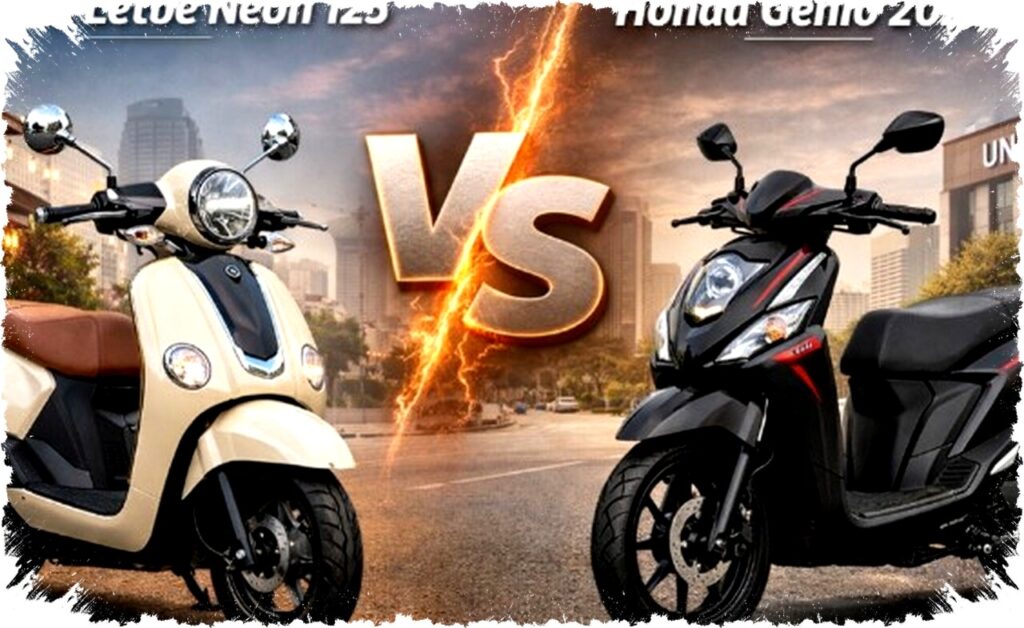
The entry-level modern scooter market heats up in 2026 with fresh competition. WMoto has launched the Letbe Neon 125, a neo-retro scooter priced under Rp20 million (approximately $1,200). This new contender directly challenges the well-established Honda Genio, which has long dominated the stylish skutik segment for young riders.
The Letbe Neon 125 stands out with its classic yet contemporary design. It features a rounded body, oval LED headlamp, and a hybrid analog-digital instrument panel. These elements give it a vintage vibe infused with modern technology, targeting youngsters seeking unique street presence. The retro-modern look aligns with current trends favoring fashion-forward and distinctive rides.
In contrast, the Honda Genio adopts a more casual-modern approach. Its design is slim, simple, and appeals to a broader demographic. Rather than emphasizing vintage style, the Genio leans toward a clean and practical fashionable appearance that fits everyday use. This makes it a versatile option for various user groups without strong design statements.
Performance-wise, the Letbe Neon 125 is powered by a 125 cc SOHC air-cooled engine. It delivers about 8.8 PS of power and 10 Nm of torque, slightly outperforming the Genio’s 110 cc eSP engine. The neon’s larger displacement translates to a more responsive and fuller throttle feel, especially at low to mid RPMs. Riders seeking more power for city maneuvering may appreciate this advantage.
However, the Honda Genio compensates with superior fuel efficiency. Its 110 cc eSP technology is renowned for economical fuel consumption. Under ideal conditions, the Genio achieves notably high mileage, which is crucial for cost-conscious users like students and young professionals with busy schedules. This fuel economy helps reduce daily operating expenses.
Feature-wise, the WMoto Letbe Neon aggressively packs tech for its price segment. It includes full LED lighting, a combination analog-digital dashboard, and some variants offer keyless ignition plus an alarm system. The fuel tank holds 5.3 liters, allowing a longer riding range per fill-up. These extras enhance convenience and security for modern commuters on a budget.
Meanwhile, Honda Genio’s baseline models may have fewer high-tech features. Yet, Honda’s strength lies in its well-established brand reputation and extensive after-sales network across Indonesia. This widespread service availability ensures easier maintenance and spare part accessibility, a major consideration for long-term ownership reliability.
WMoto faces challenges in brand awareness and a relatively limited service network compared to Honda. This factor might influence potential buyers who prioritize quick and reliable support. Building customer trust and expanding service coverage will likely be critical for WMoto to gain sustainable market share.
Summarizing the comparison:
Design: Letbe Neon sports strong retro-modern styling; Genio is sleek and straightforward.
Engine: Letbe Neon uses a 125 cc unit; Genio’s engine is 110 cc but highly efficient.
Performance: Letbe Neon offers a punchier throttle feel; Genio focuses on fuel economy.
Features: Letbe Neon provides more tech features including full LED, keyless, and alarms; Genio has a simpler feature set.
Fuel Tank: Letbe Neon’s 5.3-liter capacity supports longer rides; Genio’s is smaller but balanced by fuel efficiency.
- After-Sales Support: Honda leads with a bigger service network and spare parts availability; WMoto is building its presence.
The debate between WMoto Letbe Neon 125 and Honda Genio in 2026 showcases two distinct approaches in the modern scooter segment. If one prioritizes standout retro aesthetics combined with richer features and engine displacement, the Neon is appealing. On the other hand, those valuing practical styling, proven fuel efficiency, and dependable brand servicing may lean toward the Genio.
This rivalry reflects evolving consumer preferences where style, technology, cost-efficiency, and after-sales support all influence purchase decisions. It also signals that local and emerging brands like WMoto are stepping up their game to challenge longstanding competitors in Indonesia’s dynamic skutik market.
Buyers ultimately must weigh what matters most—whether that’s impressive design flair and more power or trusted economy and service convenience. Both scooters fulfill important niches in the Rp20 million (~$1,200) price category, making them relevant and worthy choices for young riders seeking affordable, stylish urban mobility solutions in 2026.