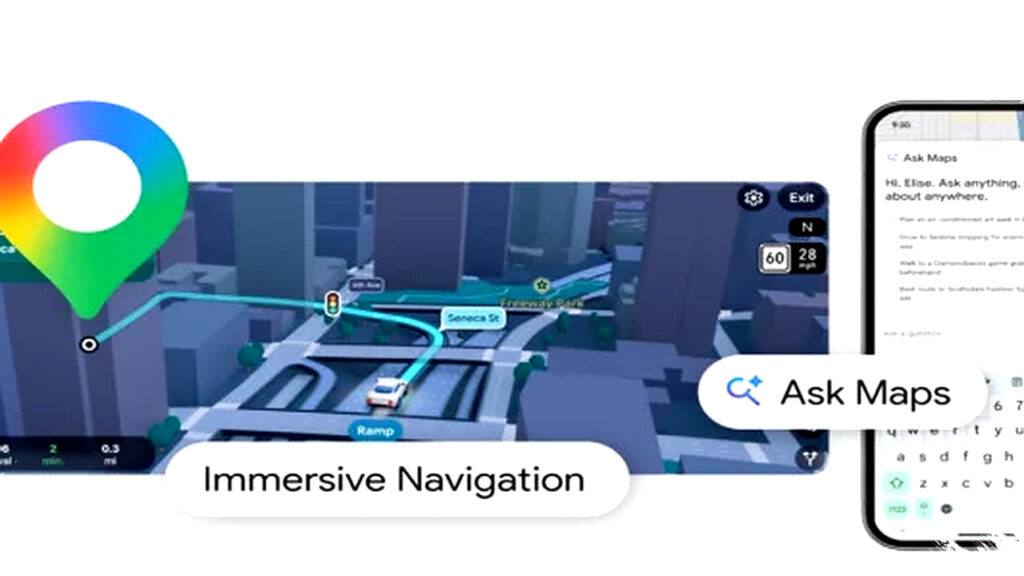
Google has unveiled major enhancements for its Maps service, introducing two innovative features powered by its advanced AI model, Gemini. These updates aim to transform navigation and location search into a more intuitive and interactive experience for users worldwide.
The first feature, Ask Maps, leverages Gemini’s AI capabilities to deliver personalized and conversational search results. Users can ask highly specific queries about locations, such as finding a phone charging station with no waiting lines or a tennis court equipped with lighting for night use. Ask Maps understands complex, natural language questions without the need for rigid keywords, responding with relevant text answers accompanied by visual map guidance. This helps users quickly locate their destinations and start navigation or share locations seamlessly.
The second addition is Immersive Navigation, designed to offer a visually rich and realistic route preview for drivers. This feature enhances the traditional map by providing detailed visuals of the surrounding environment, including building shapes, terrain contours, and road conditions. It covers up-to-date information about traffic congestion, toll roads, and alternative routes to improve route planning. Such visual aid helps users comprehend the travel environment more clearly before they begin their journey.
These updates represent the most significant overhaul to Google Maps in more than a decade. The incorporation of Gemini AI signals a shift toward smarter, more context-aware digital mapping services. Google rolled out these features initially in the United States and India, supporting both Android and iOS devices, with the desktop version and integration into Android Auto and Apple CarPlay expected soon.
Ask Maps: Conversational AI for Location Search
Ask Maps reinvents how users interact with mapping software. Instead of typing fixed keywords, users can engage Google Maps in a natural dialogue. Gemini processes various data points, including location details, user reviews, and individual preferences, to generate highly relevant recommendations.
Examples include queries like, "Where can I find a quiet coffee shop open until midnight?" or "Show me nearby parks with wheelchair access." These questions get immediate answers displayed alongside annotated maps, enabling users to save or share spots instantly. This feature not only improves accuracy but also personalizes suggestions according to each user’s unique needs.
Immersive Navigation: Enhanced Visual Guidance
Immersive Navigation offers a new layer of environmental awareness. Its photorealistic route renderings depict architectural landmarks, road layouts, and even surface details of pathways. By visualizing possible obstacles or traffic conditions, drivers can make better-informed decisions.
Google reports that this technology helps reduce travel anxiety by allowing drivers to preview difficult intersections or complex highway interchanges. Additionally, updated data about tolls and alternate paths ensures users optimize their routes to save time and avoid delays.
Deployment and Future Prospects
Currently, Google Maps’ Ask Maps and Immersive Navigation features are available on mobile platforms in the U.S. and India markets. Support for desktop use is expected to follow, aiming to provide a seamless experience across all devices. Integration efforts with Android Auto and Apple CarPlay are underway, highlighting Google’s commitment to delivering smart navigation support inside vehicles.
These advancements reinforce Google Maps’ role beyond a simple finder app. By embedding Gemini’s AI deeply, Google is setting new standards in digital mapping, blending machine learning with real-world navigation needs. This synergy creates smarter, context-sensitive assistants that enhance day-to-day travel planning.
Summary of Google Maps New Features
Ask Maps
- Uses Gemini AI for conversational and personalized location queries.
- Provides answers and annotated maps for complex user requests.
- Allows saving, sharing, and quick navigation to locations.
- Immersive Navigation
- Presents detailed and realistic route visuals with environmental context.
- Displays current traffic, tolls, and alternate routes clearly.
- Helps drivers anticipate complex driving scenarios before starting their trip.
These features demonstrate how AI integration can enhance user experience by providing not just directions but enriched contextual awareness. As Google continues refining these technologies, Maps is set to become an indispensable travel companion tailored to user preferences and real-world conditions.