


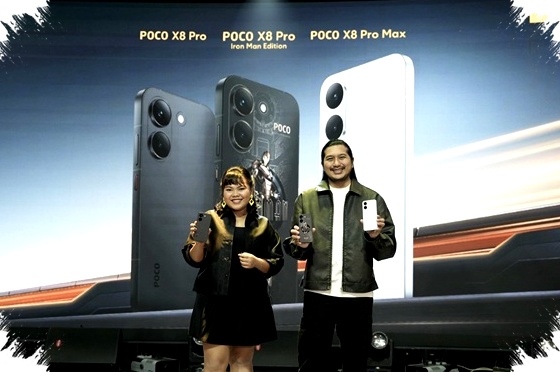
POCO has officially introduced the X8 Pro Series in Indonesia, positioning the lineup as a fast, stylish, and aggressively priced option for users who want flagship-style performance without the usual premium-brand positioning. The launch took place on Thursday, April 2, 2026, while the first sales window is set to run from April 4 to April 25, 2026.
The headline model is the POCO X8 Pro Max, which claims a world-first debut with MediaTek’s latest flagship chipset, the Dimensity 9500s. POCO also brought in the regular POCO X8 Pro and the limited Iron Man Edition, building a series that targets mobile gamers, power users, and buyers who care about design as much as speed.
Flagship performance at the center
POCO says the X8 Pro Series continues the brand’s “Extreme Performance, Extreme Value” identity. In practical terms, the company is betting on raw processing power, thermal control, and battery endurance as the three pillars of the product strategy.
The POCO X8 Pro Max uses the Dimensity 9500s built on a 3nm process, which the company says delivers both speed and efficiency. POCO also cites an AnTuTu score of 3,085,998 for the device, a number that places it in the top tier of current Android performance claims.
The standard POCO X8 Pro takes a slightly different route with the Dimensity 8500-Ultra. POCO says that chip brings a 25% GPU performance boost while still keeping power use under control, making it more suitable for sustained gaming sessions and daily multitasking.
What the hardware package includes
Both phones lean on a premium component stack designed to keep performance stable under pressure. That matters because high-end chips only deliver value if the rest of the hardware can support them properly.
Here is a simple look at the key performance-related specifications highlighted by POCO:
| Model | Chipset | Memory / Storage | Cooling | Battery |
|---|---|---|---|---|
| POCO X8 Pro Max | Dimensity 9500s | LPDDR5X 9600Mbps, UFS 4.1 | 3D IceLoop Cooling System, 5,800mm² | 8,500mAh silicon-carbon |
| POCO X8 Pro | Dimensity 8500-Ultra | LPDDR5X, UFS 4.1 class storage support | 3D Dual-layer IceLoop, 5,300mm² | 6,500mAh silicon-carbon |
POCO says the X8 Pro Max can lower SoC temperature by up to 3°C through its cooling system. For gamers, that detail is important because heat management often decides whether a phone keeps its frame rate stable after long play sessions.
The company also includes WildBoost Optimization, a software layer that predicts computing needs to reduce frame drops. Combined with hardware-level ray tracing support, the phones are clearly aimed at users who want smoother visuals and more consistent gaming performance.
Battery life becomes a major selling point
POCO is not treating endurance as a side feature. The X8 Pro Max carries an 8,500mAh silicon-carbon battery, which POCO says is the largest battery ever used in a POCO phone.
That battery is marketed to last up to two days on a single charge, depending on usage. POCO also claims it can retain more than 80% of its capacity after 1,600 charging cycles, which the company frames as roughly six years of regular use.
The POCO X8 Pro uses a 6,500mAh silicon-carbon battery, which is smaller but still unusually large by mainstream smartphone standards. Both models support 100W HyperCharge, while POCO also highlights 27W reverse charging, a feature that is still rare enough to stand out in the market.
Display and multimedia are built for daily use
POCO gives the X8 Pro Max a 6.83-inch display and the X8 Pro a 6.59-inch panel, with both claiming peak brightness up to 3,500 nits. The company says that level of brightness helps visibility in strong sunlight, which is especially relevant for users in markets like Indonesia.
The screens use an M10 panel and include 3,840Hz PWM dimming plus TÜV Rheinland certification to reduce eye strain. The Pro Max also adds an ultrasonic fingerprint sensor, which should improve unlocking speed and consistency compared with standard optical solutions.
Audio is another area where POCO wants to impress buyers. The X8 Pro Max features dual symmetrical 1115F speakers, Hi-Res Audio, and Dolby Atmos support, along with a 400% volume boost mode for louder environments and a night mode for softer listening.
Durability gets more attention than usual
POCO is also pushing a toughness message. The X8 Pro Max uses a metal frame and fiberglass back, while the X8 Pro adopts a glass back finish.
Both models come with Corning Gorilla Glass 7i protection and a long list of dust and water ratings: IP66, IP68, IP69, and IP69K. That is a notable combination because many phones stop at a single or dual IP rating, while POCO is trying to signal broader environmental resistance.
The X8 Pro Max also earned a 5-star SGS Premium Performance certification for resistance to drops and pressure. For consumers who use their phones heavily while commuting, gaming outdoors, or carrying them through demanding daily routines, that kind of positioning can matter almost as much as benchmark numbers.
Camera setup focuses on practicality and creative tools
POCO is not marketing the X8 Pro Series as gaming devices only. The company has also equipped them with camera hardware intended for everyday shooting and content creation.
The POCO X8 Pro Max includes a 50MP Light Fusion 600 sensor with OIS, while the POCO X8 Pro carries a 50MP Sony IMX882 sensor with OIS. Optical stabilization remains important for handheld night shots, video, and quick-moving subjects.
POCO also mentions UltraSnap, Dynamic shots, and AI Creativity Assistant tools. These features are designed to help users capture motion more easily and edit content with less friction, which reflects how smartphone photography has shifted toward fast sharing and social-ready output.
HyperOS 3 brings software integration
The series runs Xiaomi HyperOS 3, which adds system-level integration through Xiaomi HyperConnect and Xiaomi HyperIsland. POCO also says the phones support Google Gemini and Circle to Search, while Xiaomi Offline Communication allows voice calls even without a mobile network.
That last feature could be useful in limited-coverage areas, although the real-world performance will depend on implementation and available device-to-device connectivity. Still, it shows how POCO and Xiaomi are trying to combine performance hardware with software features that feel more current and practical.
Iron Man Edition adds a distinct identity
POCO is also using pop culture to widen appeal. The POCO X8 Pro Iron Man Edition uses a black-and-gold design inspired by Stark Industries aesthetics, with a camera flash element styled like an Arc Reactor.
The special edition also includes an Iron Man-themed UI, with custom wallpapers, app icons, and a dedicated boot animation titled “Iron Man awakens.” Beyond the visual treatment, the edition gives POCO a way to target collectors and fans who want a device that stands out from standard flagship-looking phones.
Why the launch matters in Indonesia
Indonesia remains one of the most competitive smartphone markets in Southeast Asia, especially in the midrange and upper-midrange tiers where gaming performance and battery life often drive buying decisions. POCO appears to be leaning into that demand with a formula built around speed, endurance, and a louder design language than most rivals use.
For buyers, the key question will be whether the X8 Pro Series can translate its spec-sheet strength into real-world value. If POCO’s performance, cooling, and battery claims hold up in daily use, the X8 Pro Series could become one of the more talked-about Android launches in Indonesia during the April sales period.