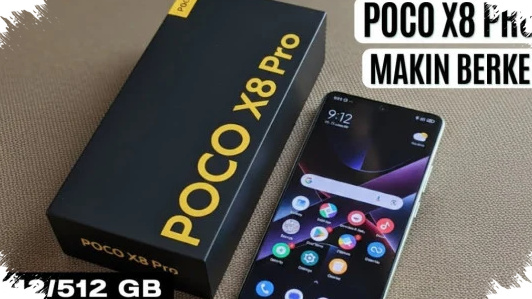
Poco X8 Pro has officially arrived in Indonesia in 2026, and the biggest talking point is simple: the price stays the same, but some key specs have changed. At $315, it sits in the same bracket as the previous Poco X7 Pro, yet buyers now get a different mix of hardware that may affect value depending on what they need most.
That makes the decision less straightforward than before. Poco still targets the midrange crowd with a spec-heavy formula, but this year’s version shifts the balance between design, display size, memory options, battery capacity, and usage experience in ways that deserve a closer look.
Price stays flat, but the starting package changes
Poco X8 Pro is sold at $315 in Indonesia, matching last year’s launch price for the X7 Pro. The difference appears in the base configuration, because the lowest variant now comes with 8GB of RAM and 256GB of storage.
For comparison, the earlier model at the same price offered 12GB of RAM and 512GB of storage. If buyers want a spec level closer to that older package, they need to add about $49 more, based on the reported price difference.
What changed from the previous generation
The new model keeps Poco’s focus on performance, but the hardware mix looks more restrained in some areas and stronger in others. That means buyers should look beyond the sticker price and compare the experience as a whole.
Here is a simple breakdown of the major changes:
Memory:
The base version drops from 12GB/512GB to 8GB/256GB.Frame:
Poco switches from a plastic frame to a metal frame.Display size:
The screen shrinks from 6.67 inches to 6.59 inches.Processor:
The chipset moves from Dimensity 8400 to Dimensity 8500.Battery:
Capacity grows from the previous generation, reaching 6,500 mAh.- Extra feature:
A new RGB LED ring appears around the rear camera module.
That combination shows Poco is not simply repeating the old formula. It is adjusting the product to keep the price stable while changing the overall feel and usage pattern.
Design feels more premium
One of the clearest upgrades sits in the frame. Poco X8 Pro now uses a metal body frame, which gives it a more solid in-hand feel than plastic.
That matters because midrange phones often compete not only on speed, but also on build quality. The metal frame can make the device feel cooler, denser, and more refined during daily use.
Smaller display, but easier to handle
Poco also trims the display size slightly, moving from 6.67 inches to 6.59 inches. The change may look small on paper, but it can improve one-handed handling and comfort.
The device still uses an AMOLED panel with a 120Hz refresh rate. It also brings a higher 3,840Hz PWM dimming rate and a brighter peak output, which should help reduce eye fatigue during long reading or scrolling sessions.
Performance rises, but only modestly
The new chipset, Dimensity 8500, is said to be around 10% faster than the Dimensity 8400 used in the previous generation. That is not a dramatic jump, but it still gives Poco X8 Pro an advantage in everyday responsiveness and gaming.
In practical testing mentioned in the source, Mobile Legends: Bang Bang runs smoothly at 120 fps with temperatures staying below 40 degrees Celsius. Genshin Impact at the highest settings begins to drop frames after about 15 minutes, which is still understandable for this price class.
That means the phone remains suitable for competitive mobile gaming, but heavy sustained gaming still has its limits. Buyers who want stronger long-session performance may need to look at higher-tier models.
Battery gets larger and charging stays fast
Battery life is another area where Poco improves the formula. The capacity climbs to 6,500 mAh, adding more room for all-day use.
Fast charging also remains a major selling point, with 100W charging support. According to the source, the phone can reach a full charge in about 48 minutes, while one hour of YouTube streaming only uses around 5% of the battery.
That kind of efficiency should appeal to users who spend a lot of time outdoors, travel often, or simply want fewer charging interruptions. In normal use, the phone should comfortably last through a full day.
Cameras remain familiar
Poco does not make major camera changes this year. The main camera still uses a 50MP sensor with OIS, which means the device keeps optical image stabilization for steadier shots and better low-light control.
The source notes that the camera produces sharp images, although the colors may look brighter than real-life scenes. The 8MP ultrawide camera remains fairly basic, which makes it more suitable for casual documentation than demanding photography.
That puts the camera system in a familiar midrange position. It should satisfy general users, but it is not the main reason to buy the phone.
RGB LED ring adds a small but visible twist
A new RGB LED ring appears around the rear camera area, and it brings a more playful identity to the device. Poco uses it as a notification light, music indicator, timer display, and battery-status signal.
The feature is not essential, but it adds personality and practical feedback at the same time. For buyers who like small visual details, this may be one of the most noticeable additions on the X8 Pro.
Who should consider Poco X8 Pro
The phone is still aimed at users who want strong performance, an AMOLED 120Hz display, and a large battery without moving into flagship pricing. It feels more polished than before, but the reduced RAM and storage at the base price make the value calculation more complicated.
- Good fit for: gamers, heavy social media users, and people who want long battery life.
- Less ideal for: buyers who want maximum storage at the base price.
- Worth noting: the upgrade path to the higher-memory version adds cost quickly.
- Best comparison point: the previous Poco X7 Pro, especially if you already own one.
- Buying signal: stronger if you prioritize build quality and battery over memory size.
Poco X8 Pro in Indonesia now looks like a phone that trades raw bundled storage for a more premium body, a slightly more compact display, a newer chipset, and a bigger battery. For buyers who want a balanced midrange phone with gaming power and practical battery life, the X8 Pro still has a strong case, but the unchanged $315 price no longer guarantees the same value formula as before.