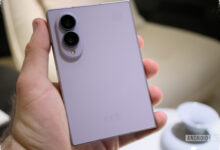

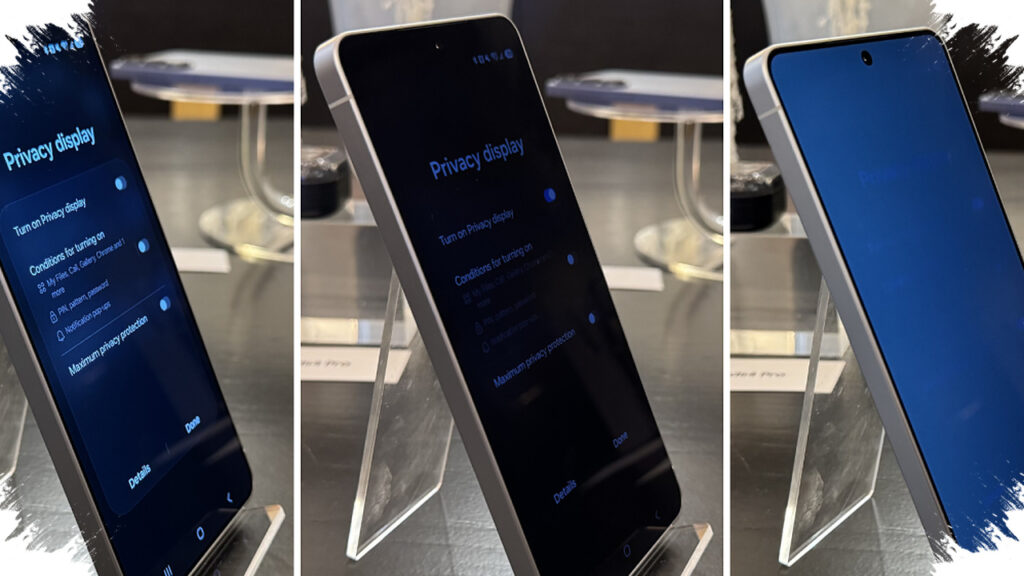
Samsung is reportedly preparing a more aggressive answer to one of the most common but least discussed smartphone problems: visual privacy in public. With the Galaxy S26 Ultra, the company is said to be introducing a hardware-based Privacy Display that narrows viewing angles so the screen stays readable from the front while becoming much harder to read from the side.
The timing is not random. A recent study highlighted how often people in Europe unintentionally look at other people’s phones, especially on public transport where seats are tight and screens are easy to see.
Why visual privacy is becoming a bigger issue
The research behind the concern points to a simple reality of modern mobile use. Phones now carry private photos, banking apps, work messages, and identity data that people often open in places that are far from private.
The study found that more than half of Europeans have accidentally glanced at someone else’s device, according to the article’s reference data. Nearly a quarter admitted they do it out of curiosity, showing that “shoulder surfing” is still a real and common behavior rather than a rare security risk.
That matters because the information exposed on a screen can be sensitive in seconds. A calendar notification, a bank balance, or a personal chat can reveal far more than most users expect when they open an app in public.
How Samsung’s Privacy Display is expected to work
Samsung’s Privacy Display is positioned as a hardware-level defense, not just a software filter or a dark mode variant. It is designed to limit the screen’s viewing angle so that the content remains clear for the person directly in front of the phone while nearby viewers see a reduced or obscured image.
That approach is important because hardware-based privacy controls tend to be more consistent than app-based solutions. Software can hide notifications or blur content, but a display-level limitation protects whatever is on the screen, including photos, messages, payment details, and video calls.
The feature also signals that Samsung sees privacy as a daily usability issue, not only a security setting buried in menus. For users who commute, work in shared spaces, or travel frequently, this kind of protection can reduce the pressure to keep their phones hidden every time they open a sensitive app.
What the study says about real-world behavior
The same research suggests that many users are already changing how they use their phones because they feel exposed. About 38% of respondents said they delay certain activities on their phones when they are in crowded places.
That behavior includes pausing banking tasks, avoiding private messages, or waiting to check sensitive content until they are back in a safer environment. In practice, that means the fear of being watched is already shaping mobile habits, even before a user is actually targeted.
The study also found a mismatch between perception and reality. Many people believe their activity is private enough, but a large share of them still find it easy to see what others are doing on a phone screen.
Sensitive data most likely to be exposed
The article’s reference data highlights several types of content that are commonly visible to strangers. Photo galleries, video calls, text messages, and bank balances appear near the top of the list.
That pattern is important because these are not abstract risks. Photo galleries can reveal faces, locations, and personal moments, while banking screens can expose account information and spending behavior.
Here is a simplified look at the kinds of data most often at risk in public spaces:
| Data type | Why it matters |
|---|---|
| Photo gallery | Can expose private images, locations, and personal relationships |
| Video calls | May reveal faces, home spaces, or confidential conversations |
| Text messages | Can contain personal or professional information |
| Bank balance and financial apps | Can expose account details and spending habits |
For many users, these are the exact apps they open without thinking during daily routines. That is why a privacy-first display could become more relevant than flashy design changes or camera upgrades.
Why crowded places are the biggest concern
Public transport remains the most obvious weak spot, and the article’s source data points to it directly. Tight seating and limited personal space make it easy for nearby passengers to look at a screen, even without intending to.
The issue is not limited to trains and buses. Shopping lines, airports, cafes, and waiting rooms all create the same visual exposure problem, especially when someone tilts their phone slightly to read a notification or reply to a message.
Samsung’s move appears aimed at these everyday moments. Instead of asking users to constantly manage their posture, angle, or brightness, the company is trying to build privacy into the screen itself.
How users are reacting to the risk
The study suggests that many people respond defensively the moment they feel watched. A majority reportedly stop using their phones when they notice someone looking over their shoulder.
Others take narrower precautions. Some avoid opening banking apps, while others avoid reading certain messages in public, including personal chats with a partner.
Only a small number of people confront strangers directly, which shows why passive protection may be more practical than relying on users to police their surroundings. A feature like Privacy Display can work quietly in the background, which may be more effective than expecting people to always notice someone watching.
What makes the Galaxy S26 Ultra’s approach notable
Samsung’s latest privacy push stands out because it combines a screen-level feature with long-term software support. The article says the Galaxy S26 Ultra is also expected to receive seven years of security updates.
That combination matters in the premium phone market because it links immediate privacy protection with long-term trust. A secure device is more appealing when it is backed by years of updates, especially for users who store personal, financial, and work data on the same phone.
It also reflects a broader shift in smartphone design. Manufacturers are increasingly being judged not only on camera quality and processor speed, but on how well they protect daily digital behavior in public spaces.
What to look for when Privacy Display arrives
If Samsung rolls out the feature as described, users will likely want to know how it affects brightness, color accuracy, and battery use. Those details often determine whether a privacy feature feels useful in real life or becomes something people disable after a few days.
A practical way to evaluate it will be to see how well it preserves the front-on viewing experience while actually reducing side visibility. If Samsung gets that balance right, the Galaxy S26 Ultra could set a new standard for what a premium smartphone screen is expected to do in crowded, high-risk public settings.