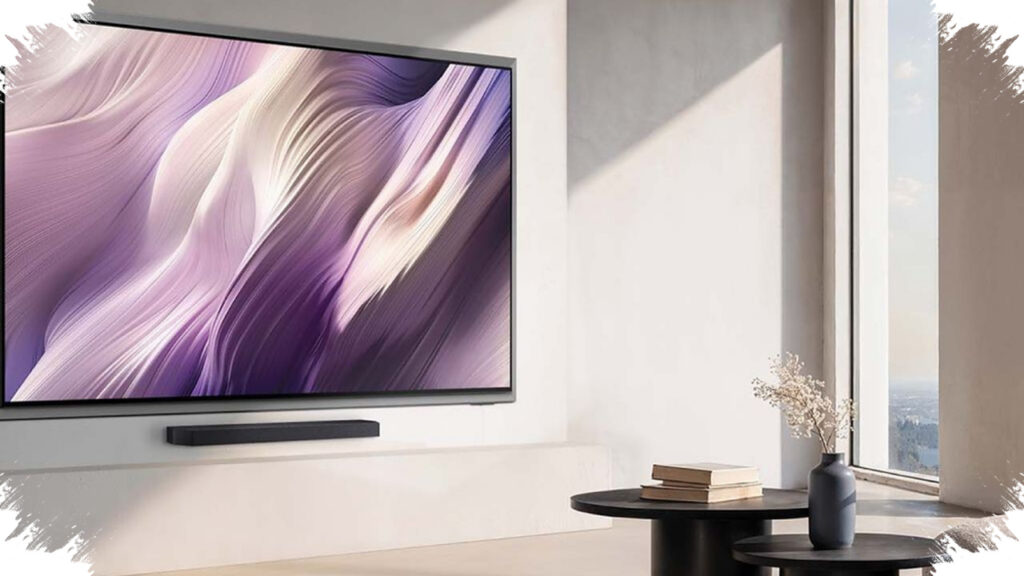
Samsung is expanding its 2026 premium TV lineup across global markets, and the update shows how far the company is pushing OLED and lifestyle displays beyond basic screen duties. The new models combine brighter picture processing, stronger gaming specs, cleaner installation, and long-term software support in a package aimed at living rooms that also function as entertainment hubs.
The biggest shift comes from Samsung’s OLED and The Frame Pro ranges, both of which now carry features that were once reserved for separate product categories. That includes advanced AI upscaling, higher refresh rates, wireless cable management, and access to Samsung’s growing art ecosystem, all designed to make the TV more versatile in daily use.
Samsung’s new OLED lineup: S95H, S90H, and S85H
Samsung’s refreshed OLED family consists of three models: S95H, S90H, and S85H. The lineup spans multiple screen sizes and goes up to 83 inches, giving buyers more room to choose a model for smaller rooms or larger home theaters.
The flagship S95H sits at the top with a FloatLayer design, which uses a flat metal frame that creates a floating look when the TV is mounted on a wall. Samsung also gives the S95H and S90H Glare Free treatment, a useful addition for bright living rooms where reflections often reduce visibility during the day.
Samsung positions the S95H with OLED HDR Pro, while the S90H uses OLED HDR+, both aimed at improving brightness and contrast. The S85H serves as the entry point to the series, keeping the OLED experience available at a lower starting price.
AI processing and picture tuning get more aggressive
All three OLED models use the NQ4 AI Gen3 processor. Samsung says the chip powers 4K AI Upscaling Pro, Auto HDR Remastering, Color Booster Pro, AI Motion Enhancer Pro, and AI Customization Mode.
That matters because much of today’s viewing still comes from streaming apps, live broadcasts, and older content that is not always produced in native 4K. These tools aim to sharpen detail, lift color performance, and adjust motion more intelligently depending on the content on screen.
For viewers, the result is not just a brighter picture but a TV that tries to adapt in real time. That approach mirrors a wider trend in premium TVs, where software now plays a larger role in image quality than panel hardware alone.
Gaming support becomes a major selling point
Samsung is also using the new OLED lineup to target console and PC gamers. Motion Xcelerator now reaches 165Hz, while NVIDIA G-SYNC and AMD FreeSync Premium Pro support help reduce tearing and improve motion consistency.
The audio package is equally loaded, with Dolby Atmos, Object Tracking Sound+, Adaptive Sound Pro, Active Voice Amplifier Pro, and Q-Symphony. Q-Symphony lets compatible Samsung soundbars work with the TV’s built-in speakers for a fuller sound stage.
What Samsung changed in the Frame family
The Frame Pro and standard The Frame keep Samsung’s design-first approach, but the Pro model adds a major ergonomic upgrade. It uses a Wireless One Connect Box that can be placed up to 30 feet from the TV, helping the screen blend into a room without visible cable clutter.
The Frame Pro also switches to a Neo QLED 4K panel, which Samsung says improves brightness, contrast, and black levels over earlier versions. The standard The Frame still relies on built-in ports, but it now includes a Slim Fit Wall Mount and back stoppers to make wall installation easier.
Both versions support Glare Free and Motion Xcelerator up to 144Hz. With DLG, the refresh rate can reach 240Hz when connected to a compatible PC, adding another layer of appeal for hybrid entertainment and gaming setups.
Art features remain central to the strategy
Samsung continues to lean on the art-focused identity that made The Frame one of its most recognizable products. The company says the Art Store now extends to OLED models and includes more than 5,000 works from over 800 artists, along with collections from the Museum of Modern Art, the Art Institute of Chicago, and Art Basel.
- Art Store access with more than 5,000 artworks
- Art Store Streams with 30 rotating works each month
- Pantone Validated ArtfulColor for more accurate reproduction
- Optional bezel designs in Modern Brown, Modern Teak, Modern White, and Sand Gold Metal
Samsung also keeps third-party frame support, which gives buyers more freedom to match the display with interior design.
Software support and pricing
All of the new models run One UI Tizen OS, and Samsung says the platform will receive software updates for up to seven years. That long support window stands out in a premium TV market where many buyers expect a device to last well beyond a typical upgrade cycle.
The software suite includes Samsung TV Plus with more than 2,700 streaming options, Samsung Gaming Hub for cloud gaming, and Vision AI Companion, which connects with Bixby, Microsoft Copilot, and Perplexity AI.
Samsung’s announced global pricing starts at $2,499.99 for the S95H series and goes up to $6,499.99 depending on size. The S90H starts at $1,399.99, the S85H starts at $1,199.99, and The Frame Pro starts at $1,999.99, reaching $3,999.99 for higher-end sizes. The OLED models are already available globally, while The Frame Pro is also on sale, and the standard The Frame will follow later in the rollout.