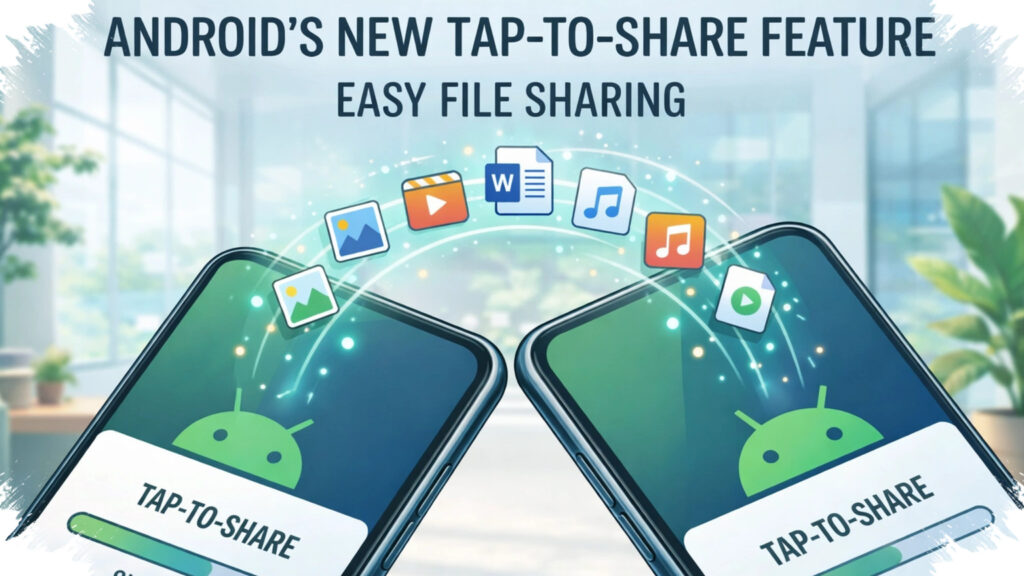
Google is reportedly preparing a new Android sharing feature called Tap to Share, and early signs suggest it could make file transfer feel much simpler on Android 17. The idea is straightforward: place two compatible phones close together, let the system recognize the devices, and start sharing content with far fewer taps than today’s usual menu-driven process.
The feature appears designed to combine NFC for the initial handshake and Wi‑Fi for the actual transfer, which would help keep large file sharing fast and stable. Early details come from an APK teardown of the latest Google Play Services release, a method often used to spot features before they are officially announced, although the final design can still change.
How Tap to Share is expected to work
Tap to Share seems to rely on a short-range detection step first, then switch to a stronger data path when the connection is approved. The leaked interface reportedly asks both phones to be unlocked and aligned near the top edge, where a glow-like effect appears once the devices detect each other.
That visual cue matters because Android hardware is not uniform across brands. NFC chip placement can differ from one phone to another, so Google likely needs a system that can identify the correct contact point without making the experience confusing for users.
What users may be able to send
The leaked information suggests Tap to Share will support a broad set of content types, which would make it useful for everyday tasks. The feature is reportedly being built to handle contacts, photos, videos, links, locations, and documents.
- Contacts
- Photos
- Videos
- Links
- Locations
- Documents
That range would put Tap to Share in line with the kind of sharing people already do through Android’s existing tools, but with a more direct interaction model. Instead of opening multiple menus or searching through device lists, users may only need to bring two phones together.
Why Google is using NFC and Wi‑Fi together
NFC is likely serving as the trigger that confirms both phones are nearby and ready to connect. After that first step, Wi‑Fi can take over the heavy lifting, which is important for transferring larger files without the speed limits of NFC alone.
This hybrid approach is common in modern device-sharing systems because it balances convenience with performance. NFC is reliable for detection and pairing at close range, while Wi‑Fi offers the bandwidth needed for photos, videos, and documents that would otherwise move too slowly.
A fast path to sharing on Android 17
Android already offers several ways to send content, but Tap to Share could become one of the most natural if Google delivers it system-wide. The appeal is not only speed, but also simplicity, because the gesture itself feels intuitive and does not depend on complex setup.
The feature also fits Google’s broader effort to make Android features look and feel more cohesive across devices. If Tap to Share reaches Android 17 as expected, it could reduce the gap between what users expect from a modern “tap and send” experience and what Android currently offers through more conventional sharing sheets.
Why the leak matters for Android users
Early software leaks often reveal more than just a name. They show the direction a platform owner wants to take, and in this case the direction points toward faster proximity-based sharing that feels more integrated into the operating system.
Google still has room to refine the details before release, including the way the interface reacts, how unlock requirements work, and how consistently the system detects different phone designs. But the core idea is already clear: Android 17 may bring a simpler way to share files by placing two phones close together and letting the system do the rest.