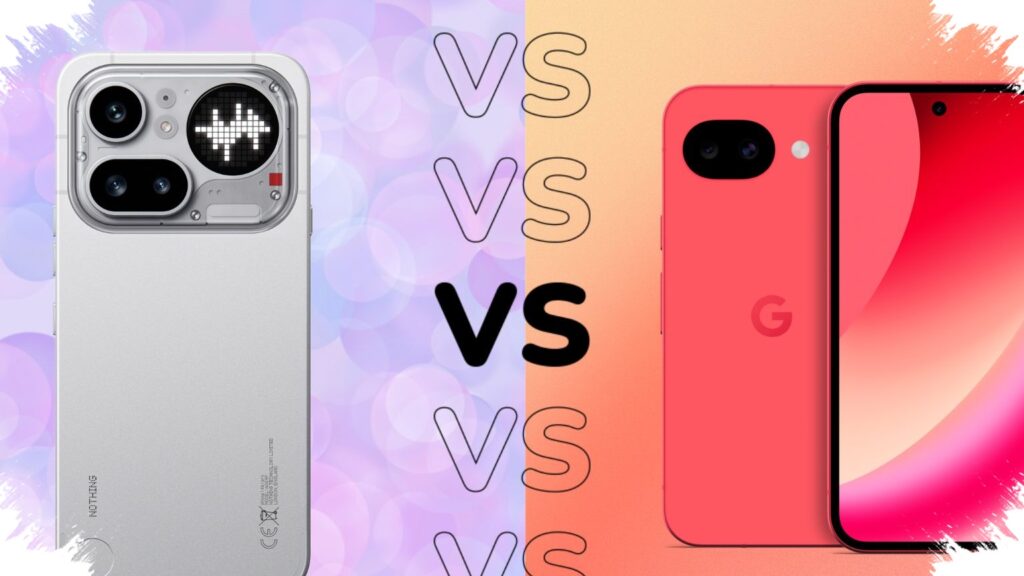
Nothing Phone 4a Pro and Google Pixel 10a sit in the same $499 class, but they target very different buyers. One pushes bold design, a dedicated telephoto camera, and faster charging, while the other focuses on clean software, longer support, and a safer all-round experience.
That contrast makes the comparison more than a spec sheet fight. In this segment, the real question is whether a phone should stand out for personality or win through smarter long-term value.
Price and market position
Both phones follow a similar pricing ladder. The Nothing Phone 4a Pro starts at $499 for the 128GB/8GB model and goes up to $599 for the 256GB/12GB version.
Google keeps the Pixel 10a on the same pricing path, with 128GB at $499 and 256GB at $599. The Pixel also comes in more color options, including Obsidian, Fog, Berry, and Lavender, while Nothing offers Black, Silver, and Pink.
Design philosophy: loud versus restrained
The biggest difference appears immediately in the design. Nothing Phone 4a Pro drops the brand’s transparent look and moves to a more industrial aluminum unibody with a large camera housing.
That camera block also introduces the Glyph Matrix to the A-series for the first time, using 137 mini-LEDs for alerts, contact icons, and small utilities like a coin flip. Pixel 10a takes the opposite route with a familiar clean back, rounded corners, and a camera bar that sits nearly flush with the body.
Durability also favors Google. Pixel 10a carries IP68 certification, while Nothing Phone 4a Pro is rated IP65, which means Google’s phone offers stronger protection against dust and water.
Display size and outdoor visibility
Nothing gives buyers a larger screen. The 6.83-inch AMOLED panel runs at 144Hz and reaches a claimed peak brightness of 1,600 nits in high brightness mode.
Pixel 10a uses a smaller 6.3-inch p-OLED display with a 120Hz refresh rate. Google counters with higher peak brightness at 2,000 nits, which should help visibility in direct sunlight.
Performance, battery, and charging
Nothing Phone 4a Pro runs on Qualcomm’s Snapdragon 7 Gen 4 with either 8GB or 12GB of RAM depending on the storage version. The phone also carries a 5,100mAh battery and supports 50W wired charging, with Nothing claiming a full charge in about an hour.
Pixel 10a stays with Tensor G4 instead of the newer Tensor G5 used by the main Pixel 10 line. Google combines that chip with the same approximate 5,100mAh battery, but charging is slower at 30W wired and 10W wireless.
Software support and AI approach
Both phones launch with Android 16. Nothing adds Nothing OS 4.1, which stays close to Pixel-style software while adding features such as Essential AI for storing and recalling information.
Pixel 10a holds a major advantage in long-term support. Google promises up to seven years of OS updates, while Nothing Phone 4a Pro is set for three major Android upgrades.
Camera: zoom is the real separator
Nothing Phone 4a Pro uses a triple-camera setup made up of a 50MP main sensor, 8MP ultra-wide, and a 50MP periscope telephoto camera with 3.5x optical zoom. That telephoto lens gives it a clear edge for portraits and distant subjects.
Pixel 10a keeps a simpler dual-camera system with a 48MP main sensor and a 13MP ultra-wide camera, but no telephoto lens. Google phones are still known for strong processing and consistent results, especially in mixed lighting and everyday shooting.
Which one makes more sense for different buyers
- Choose Nothing Phone 4a Pro if design matters, zoom photography is important, and fast charging is a priority.
- Choose Google Pixel 10a if long software support, better water resistance, and a compact body matter more.
- Choose Nothing if a more distinctive look feels worth the trade-offs.
- Choose Pixel if software stability and long-term practicality rank higher than visual flair.
The comparison shows two clear philosophies in the $500 smartphone class. Nothing Phone 4a Pro aims to feel more expressive and feature-rich, while Pixel 10a sticks to a calmer formula built around reliability, stronger protection, and years of updates.