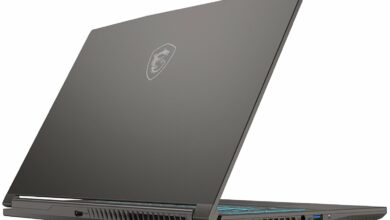
Lenovo’s Kaitian X5d G1d is built for a very specific audience: institutions that value domestic technology stacks over consumer-style design priorities. The laptop targets government bodies and enterprises in China, where compatibility, control, and data handling requirements often matter more than thinness or fashion-forward hardware.
That positioning also explains why the device has drawn attention beyond its parts list. It combines a local operating system, a Loongson processor, and strong security claims in one package, which naturally raises the question of whether the machine is designed to reduce backdoor risk through tighter control over both hardware and software.
A domestic platform at the center of the device
At the heart of the Kaitian X5d G1d is Loongson 3B6000M, a processor based on the LoongArch architecture. The chip uses 8 cores and runs at 2.4GHz, while Lenovo pairs it with a second-generation LG200 GPU.
Lenovo says graphics performance is more than 60 percent higher than the older Loongson 3A6000 generation. The company also states that the system delivers more than 7 TOPS of INT8 AI acceleration, which indicates that the laptop is intended to handle more than basic office work.
Software choices that match local workflows
Lenovo does not rely on a general-purpose consumer software stack here. The Kaitian X5d G1d ships with Chinese operating systems such as Kylin and UnionTech, making the machine fit more closely with domestic enterprise and government environments.
Application support follows the same logic. The laptop supports WPS Office and WeChat, along with OFD document formats and electronic signature tools, all of which are important in administrative workflows. For organizations that depend on local standards and internal systems, that software compatibility can matter as much as raw performance.
Security is the main selling point
Security is one of Lenovo’s strongest messages around this model. The Loongson platform includes a built-in security processor and supports Chinese cryptography algorithms such as SM2, SM3, and SM4.
Lenovo also says the system supports full hardware encryption for both storage and documents. More notably, the company claims the laptop has gone through source-code-level audit and does not contain hidden backdoors, a statement that will likely attract attention from buyers in sensitive sectors.
Hardware aimed at daily office use
The basic configuration comes with 16GB of RAM and a 512GB SSD. Users can expand memory up to 32GB and storage up to 1TB, which gives the device room to scale for heavier business workloads.
The laptop also includes a 70Wh battery, USB 3.1, HDMI, and Gigabit Ethernet. Lenovo adds a full-size keyboard and keeps the weight at around 1.5 kg, making the device practical for desk-based work and movement between office environments.
Media and connectivity support remain part of the package
For multimedia tasks, the Kaitian X5d G1d supports H.264 and H.265 encoding and decoding. Lenovo also provides HDMI and eDP output, allowing the laptop to handle high-definition playback and basic design-related tasks.
That does not place the machine in the same category as premium ultrabooks or creator-focused notebooks. Instead, its feature mix points to stable office use, presentations, document processing, and administration, where domestic compatibility and security controls are likely to carry more weight than trend-driven design choices.
The result is a laptop that reflects Lenovo’s broader Kaitian direction in China: local chips, local operating systems, local document support, and integrated security claims from hardware to software. For agencies and enterprises that want tighter technology control, that combination is likely the main reason the Kaitian X5d G1d stands out.
Source: www.gizmochina.com