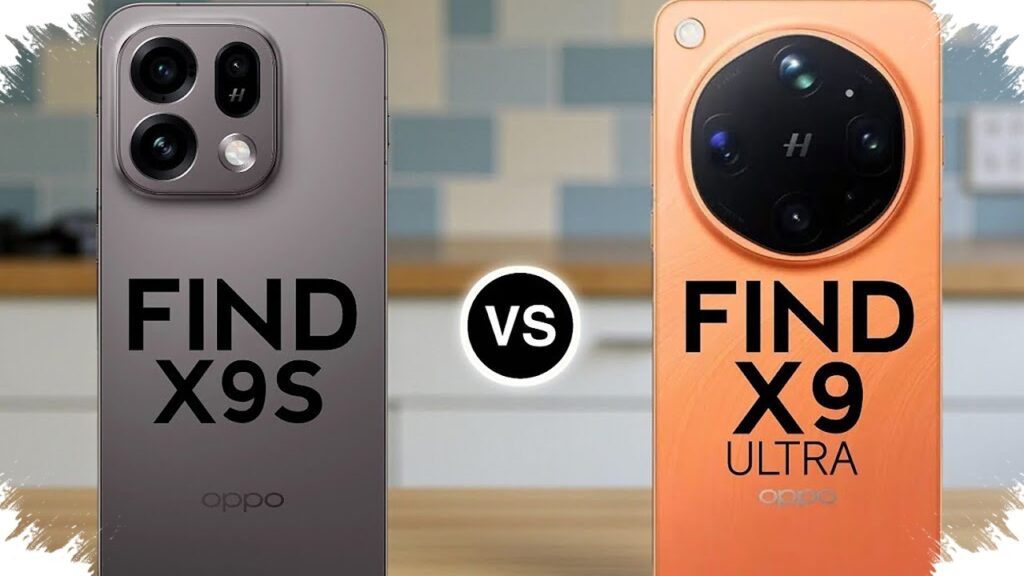
Oppo’s two Find X9 models may look closely matched at first glance, but the omission and addition of a few key specs create a clear gap in daily use. Find X9 is priced at MYR 3,999, while Find X9s sits at MYR 3,599, leaving a MYR 400 difference that changes how each model should be judged.
The shared foundation is already strong. Both phones carry a 6.59-inch ProXDR display and a 7,025mAh battery, so the starting point is firmly in flagship territory. The real separation begins once the focus moves from basic similarities to performance, charging, imaging, and connectivity.
Performance and memory define the wider gap
Find X9 uses the MediaTek Dimensity 9500 built on a third-generation 3nm process. Find X9s relies on the Dimensity 9500s based on a second-generation 3nm process, which still places it in the flagship class but with a different operating profile.
Oppo positions Find X9 as the model better suited for sustained gaming performance. Find X9s, by contrast, is framed as the more efficient option for everyday use and travel-friendly scenarios.
Memory also separates the two devices in the Malaysian market. Find X9s comes with 12GB LPDDR5X RAM and 512GB UFS 4.1 storage, while Find X9 increases the RAM to 16GB with the same internal storage capacity. That extra headroom on Find X9 can matter for multitasking and AI-based workloads.
Charging remains fast, but one model is more flexible
Both phones support wired SUPERVOOC 80W charging, so speed is not an issue on either side. The difference appears when wireless charging enters the comparison.
Only Find X9 supports AIRVOOC 50W wireless charging. For users who already depend on wireless pads or prefer a cable-free routine, that addition gives the more expensive model a practical advantage beyond raw specifications.
Camera hardware is similar only on paper
Each model includes a triple 50MP camera setup, but the main sensor is not the same. Find X9 uses a 1/1.4-inch sensor with an f/1.6 aperture, while Find X9s comes with a smaller 1/1.56-inch sensor and an f/1.8 aperture.
That larger sensor and wider aperture give Find X9 the edge in light capture. The benefit is especially relevant for night photography and for producing a more natural depth-of-field effect.
Video recording widens the distance further. Find X9 supports 4K at 120fps, including Log 4K 120fps for more advanced color grading. Find X9s stops at 4K 60fps, which remains adequate for general content creation but offers less flexibility for users with more demanding workflows.
Connectivity and design show different priorities
Connectivity is another area where the two phones diverge in subtle but meaningful ways. Find X9s supports Bluetooth 6.1, while Find X9 uses Bluetooth 6.0, and both still support premium audio codecs such as LHDC 5.0.
Find X9 also includes the NetworkBoost S1 chip. Oppo says it is designed to improve signal stability in difficult environments, including places like underground train systems.
Design choices help reinforce the different positioning. Find X9s is offered in Lavender Sky and Sunset Orange, giving it a more expressive look, while Find X9 comes in Velvet Red and Titanium Grey with a matte texture that resists fingerprints. Both models are also available in Space Black.
The premium choice is not just about price
At MYR 400 apart, the two phones are separated less by headline category and more by the amount of capability included in the larger package. Find X9 brings the stronger RAM configuration, a more capable main camera, higher video recording support, wireless charging, and network enhancement.
Find X9s still remains a solid flagship option for buyers who value a lower price and efficient use. For those who want a more complete feature set, Find X9 presents the broader and more versatile proposition in Oppo’s lineup.
Source: telset.id