The Galaxy S26 Plus does not try to win through a dramatic redesign. Instead, Samsung has focused on small but measurable gains in speed, battery life, and camera tuning, while the Galaxy S25 Plus remains the more sensible buy for anyone who values a lower starting price.
That trade-off defines the comparison between the two phones. The newer model is faster in benchmarks and slightly better in endurance, but the older one still delivers a very similar experience for less money, which makes value the deciding factor for many buyers.
Performance is where the gap is clearest
Samsung took a different chipset approach with the Galaxy S26 Plus, while the Galaxy S25 Plus uses the Snapdragon 8 Elite for Galaxy across all markets. The Galaxy S26 Plus returns to a dual-chipset setup, with Exynos 2600 in Europe and South Korea, and Snapdragon 8 Elite Gen 5 for Galaxy in the US, China, and Japan.
The Exynos 2600 version is the most interesting on paper because it is built on a 2nm process. By comparison, the Snapdragon 8 Elite inside the Galaxy S25 Plus uses a 3nm process.
Benchmark numbers favor the newer phone. In AnTuTu 10, the Galaxy S26 Plus scored 2,459,298 points versus 2,133,477 for the Galaxy S25 Plus. In Geekbench 6, the scores were 10,982 and 9,669, while 3DMark Wild Life showed 7,138 for the Galaxy S26 Plus and 6,340 for the Galaxy S25 Plus.
That puts the lead at roughly 13% in CPU and GPU tests, around 15% in combined AnTuTu performance, and also points to better sustained performance.
Battery life improves, even with the same capacity
Both phones use a 4,900 mAh battery and similar displays, yet the Galaxy S26 Plus performs better in endurance testing. It lasts longer in web browsing and video streaming, although the Galaxy S25 Plus holds up better in 4G calling.
Even with that weaker result in one category, the Galaxy S26 Plus still posts the higher Active Use Score overall. The reason is not fully confirmed, but both the Exynos 2600 and refinements in One UI have been mentioned as possible contributors.
Charging speeds stay close. Both support 45W charging through Power Delivery, and the measured results are nearly identical. The Galaxy S26 Plus reaches 38% in 15 minutes, 69% in 30 minutes, and full charge in 61 minutes. The Galaxy S25 Plus is slightly quicker at 42% in 15 minutes, 75% in 30 minutes, and 100% in 59 minutes.
Very little changes in size, build, or screen
Physically, the two phones are almost the same. Each measures 158.4 x 75.8 x 7.3 mm and weighs 190 grams.
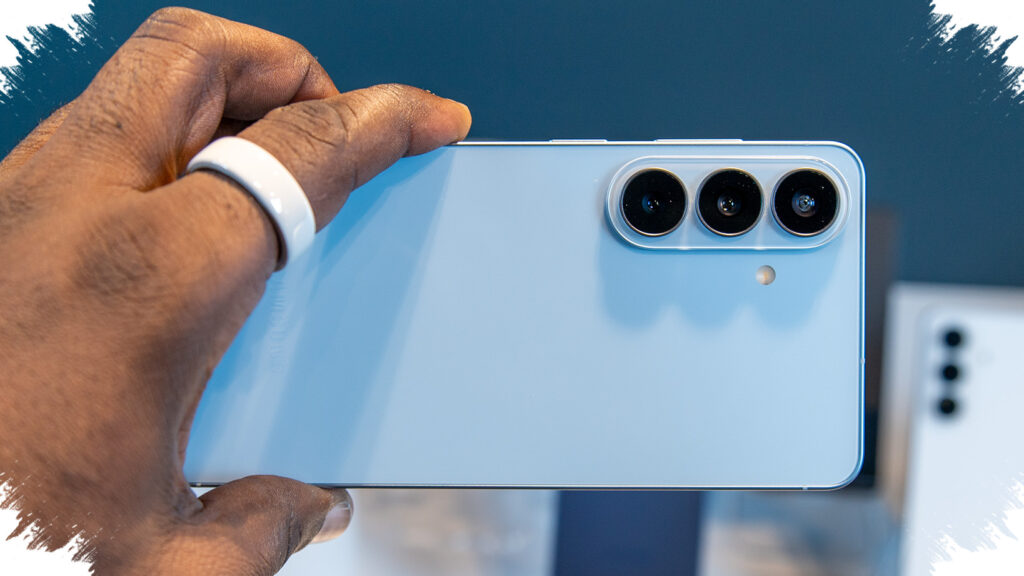
Samsung kept the Armor Aluminum 2 frame, Gorilla Glass Victus 2 on both sides, and IP68 protection. The most visible differences are the camera module design and the available colors, with the Galaxy S26 Plus described as looking calmer and more serious.
There is one practical downside to the newer camera bump: it makes the phone more prone to wobbling when placed on a flat surface.
The display hardware is nearly unchanged as well. Both use a 6.7-inch LTPO OLED panel with a 120Hz refresh rate and 1440 x 3120 resolution. Brightness is almost the same too, with the Galaxy S26 Plus measured at 1,498 nits and the Galaxy S25 Plus at 1,449 nits.
Camera changes are subtle rather than transformative
Samsung did not overhaul the rear camera system. The Galaxy S26 Plus introduces a new Isocell GNG main sensor, which is presented as an upgrade over the previous GN3 generation, still at 50MP and with an optical size of around 1/1.56 inches.
The telephoto cameras on both phones use sensors with a 1/3.94-inch size, though the exact sensor models differ. The ultrawide camera remains essentially the same and still lacks autofocus.
The front camera gets the most straightforward update. All Galaxy S26 models use a 23mm selfie lens, which is wider than the 25-26mm lens used on the earlier model.
In daylight, the difference between the two phones is modest. The Galaxy S26 Plus tends to produce slightly smoother detail and slightly more saturated colors, especially in green areas. At 3x zoom and with the ultrawide camera in daylight, the gap becomes even smaller.
Low light is another area where the Galaxy S26 Plus edges ahead. Its main camera generally produces a brighter and cleaner result, although its automatic maximum night mode showed some color shifting. The older phone’s dedicated night mode is said to be more consistent, while the Galaxy S26 Plus needs Camera Assistant to enable an independent night mode.
Audio, video, and price tilt the decision back toward value
The Galaxy S25 Plus is louder through its speakers, but the Galaxy S26 Plus has a warmer and deeper sound signature without pushing vocals and mids back.
Video support is the same in key areas. Both phones record 4K60 on all cameras and 8K30 on the main camera. The Galaxy S26 Plus adds Horizon lock stabilization and LUT support when recording in Log.
In practice, daytime video quality is almost identical. At night, the Galaxy S26 Plus looks sharper on the ultrawide and main cameras, while the Galaxy S25 Plus does better on the telephoto camera.
Price is where the older phone regains the advantage. In Europe, third-party retailer offers place the difference at about €100-200. In the US, the Galaxy S25 Plus is difficult to find outside Samsung’s official channels, where it is listed at $1,000, while the Galaxy S26 Plus is priced at $1,100 from the same store and can reportedly be found on Amazon for around $850.