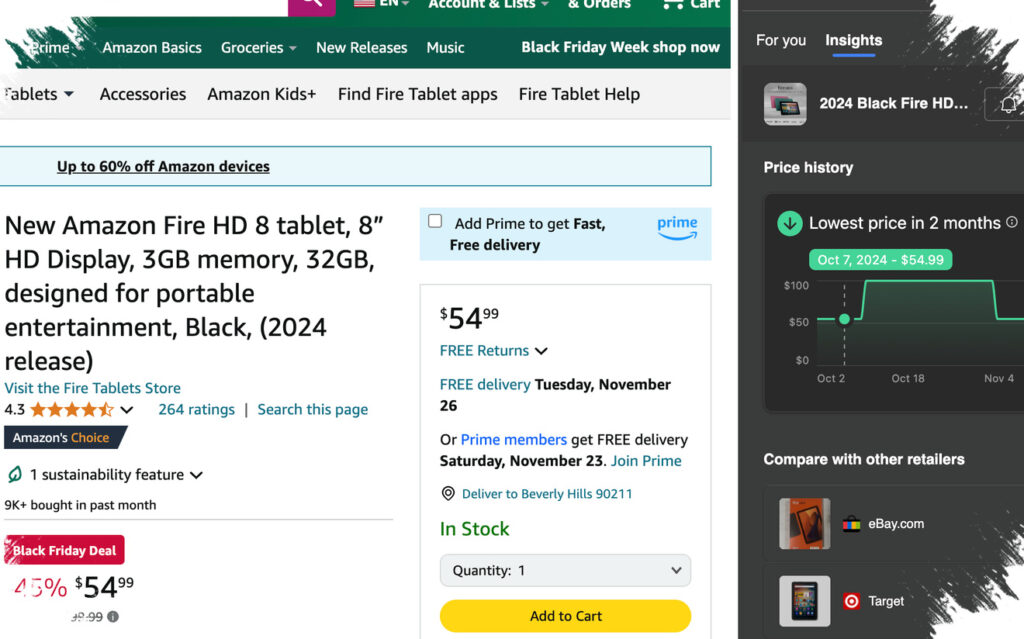
Amazon’s shopping pages now give buyers a much clearer way to judge whether a discount is genuinely attractive or only looks that way at first glance. The company has expanded its price history view to cover up to 365 days, adding a longer timeline that makes it easier to spot real pricing patterns before making a purchase.
The new view matters because discount labels are often read quickly, without enough context about earlier price movements. With a full year of history, shoppers can compare the current price with previous rises and drops, which makes it easier to tell whether a sale price is unusually low or simply part of a normal pattern.
Price history now sits closer to the product page
Amazon has placed the price history link near the item’s price, so users can check it without leaving the product page. The feature is also available through Rufus, Amazon’s AI shopping assistant, which gives shoppers another direct path to the same information.
That setup is meant to keep the process simple. Instead of opening separate services or moving between different tools, customers can review the trend where the buying decision is already happening.
Amazon now offers three time ranges for price tracking: 30 days, 90 days, and 365 days. The shorter views help with recent fluctuations, while the longer option shows how a product has moved across a much wider period.
Why the 365-day view stands out
The one-year timeline is the most useful addition for products whose prices change across seasons. Electronics, home appliances, furniture, winter clothing, and everyday essentials are among the categories that can shift in predictable cycles.
That longer window helps buyers see whether a sale is tied to a genuine drop or just reflects a price that usually returns at certain times of the year. For people waiting for a better moment to buy higher-value items, that context can make a noticeable difference.
Before this feature became part of Amazon’s own shopping experience, many customers relied on third-party browser plugins, external price-tracking sites, or extensions. Those tools could be helpful, but they were not always consistent across devices or regions, and some of them showed incomplete or less reliable data.
By keeping the information inside the product page, Amazon removes an extra step from the process. Shoppers no longer need to leave the app or open a separate website just to check whether a discount is worth attention.
Rufus makes the check even simpler
Rufus also gives shoppers a conversational way to ask about pricing. Questions such as “What’s the price history?”, “Has this item been on sale in the past 30 days?”, or “Is this the lowest price recently?” can be used to pull up the relevant context.
On the Amazon Shopping app, the Rufus icon appears in the bottom-right corner of the product detail page. On desktop, access is available through the top navigation bar, making the same feature easier to reach across devices.
Amazon says more than 50 million customers have used price history since it launched in 2024. The company also says shoppers check the feature an average of three times per month, which suggests it is being used regularly rather than only for occasional big-ticket purchases.
That pattern shows a shift in shopping behavior. Buyers are increasingly looking beyond the discount label itself and checking how a price has moved before deciding when to buy.
Availability is still rolling out
The price history feature is currently available to customers in the United States, the United Kingdom, Canada, and India. The 365-day view, however, is only being rolled out in the United States, the United Kingdom, and India for now.
Amazon says broader availability will follow in the coming weeks. That means not every user will see the same option immediately, even if the general price history tool is already present in their market.
For shoppers who regularly wait for the right discount, the longer timeline offers a more grounded way to judge a deal. It makes it easier to separate a truly low price from one that only appears attractive in the moment.