


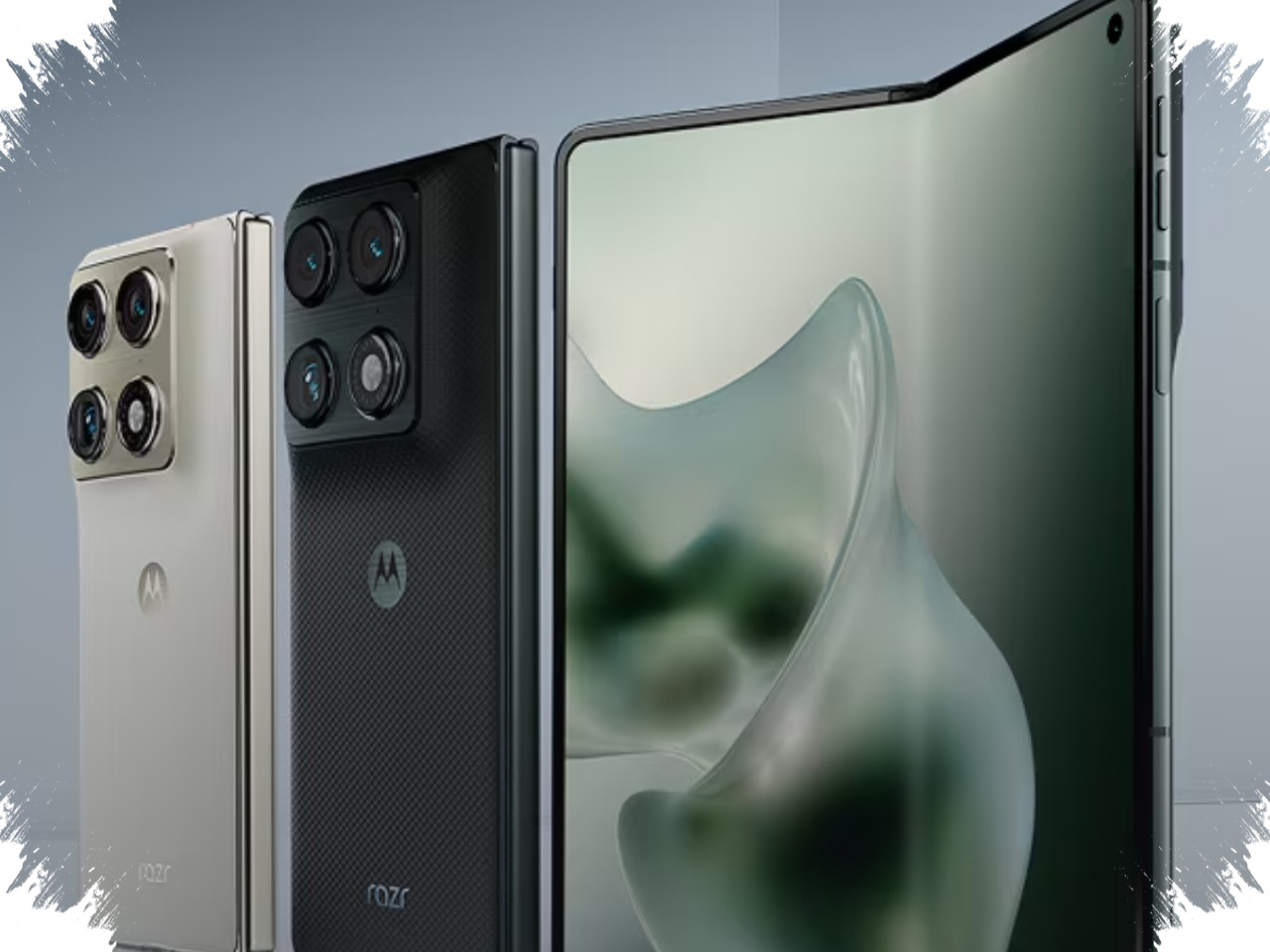
Motorola is pushing the Razr Fold into a segment it has not occupied in India before, and that alone makes the device notable. The company’s first book-style foldable for the market is clearly aimed at users who want a larger screen, stronger multitasking tools, and stylus support rather than the familiar clamshell formula.
That positioning matters because the Razr line has long been associated with compact flip designs. With Razr Fold, Motorola is taking a different route by building a foldable that looks closer to a mobile productivity device than a fashion-first handset.
A larger canvas for work and media
The main attraction is the 8.1-inch LTPO P-OLED inner display. It offers a high-resolution panel with a 120Hz refresh rate and a peak brightness of up to 6,200 nits, which places the internal screen firmly in flagship territory.
Motorola also pairs it with a 6.6-inch LTPO P-OLED outer display. That panel runs at 165Hz and reaches a peak brightness of 6,000 nits, while Gorilla Glass Ceramic 3 protects the cover screen and UTG is used for the inner display.
Built for productivity, not just style
The hardware choices point toward heavier daily use. Motorola has added a foldable interface and multitasking features designed for large-screen workflows, and the inclusion of stylus support strengthens that direction further.
Motorola Pen Ultra is part of the package, making the Razr Fold stand out as more than a conventional foldable phone. That approach gives the device a clearer productivity angle at a time when premium foldables are often judged by how well they handle both entertainment and work.
Flagship hardware underneath
Performance is handled by Snapdragon 8 Gen 5, paired with Adreno 829 graphics. Motorola is offering the phone with 12GB and 16GB RAM options, alongside 256GB, 512GB, and 1TB storage variants.
The company also says the device includes advanced cooling to support sustained performance. That combination suggests Motorola wants the Razr Fold to manage multitasking, gaming, and demanding mobile workloads without falling behind.
Camera setup goes beyond the usual foldable compromise
Motorola has not limited the phone to display upgrades and a premium chip. On the back, the Razr Fold carries three 50MP cameras, including a main sensor, an ultrawide camera, and a 50MP periscope telephoto lens with 3x optical zoom.
The main camera uses a Sony LYTIA sensor and includes OIS. Video support extends to 8K recording and Dolby Vision, while the front camera setup includes a 20MP internal camera and a 32MP external selfie camera for use when the phone is closed.
Battery capacity is unusually large for a foldable
One of the most striking specifications is the 6,000mAh battery. That capacity is paired with 80W wired charging, 50W wireless charging, and 5W reverse charging, giving the device a flexible charging setup for long days.
Motorola uses silicon-carbon battery technology here, which helps reinforce the phone’s focus on endurance. For a foldable with two high-refresh-rate displays, the battery size is one of the clearest signs that the company is targeting more serious all-day use.
Durability and software support round out the package
Physically, the Razr Fold measures 10.1mm when closed and 4.7mm when opened, with a weight of 244 grams. It also carries IP48 and IP49 certification for basic protection in everyday use.
The software side is equally important. The phone launches with Android 16 and is promised seven Android upgrades plus seven years of security updates, which gives it a long support window for a premium device.
With its 8.1-inch inner screen, stylus compatibility, large battery, and flagship-class hardware, the Razr Fold is positioned as Motorola’s most ambitious foldable for India so far. It enters the market with a clear message: this is not just another folding phone, but one built to challenge established premium rivals on productivity, display quality, and long-term usability.