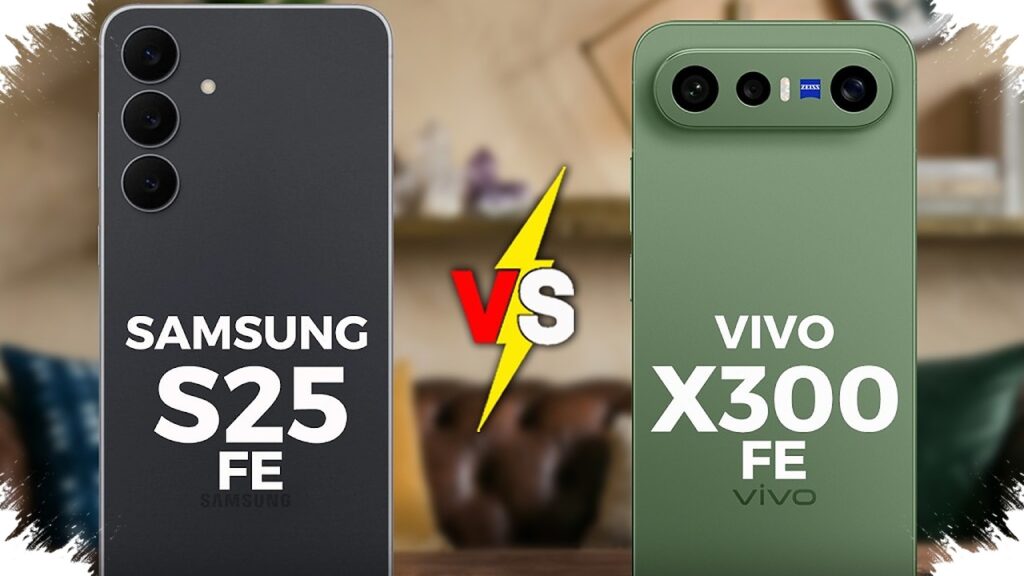
Samsung Galaxy S25 FE still has a clear appeal in one important area: it starts at 44,999 rupees, while the 256 GB version is priced at 50,999 rupees. That keeps it far below the Vivo X300 FE, which starts at 79,999 rupees for the 256 GB model on Amazon.
That price gap shapes the entire comparison. Vivo X300 FE positions itself as the more ambitious phone, but Samsung keeps a practical advantage for buyers who want a flagship-style device without paying nearly as much.
A wider hardware gap than the price alone suggests
The two phones also separate quickly when the specs are lined up. Vivo X300 FE comes with 12 GB of RAM and UFS 4.1 storage of up to 512 GB, while Galaxy S25 FE uses 8 GB of RAM.
Samsung does offer more than one storage tier, but its 128 GB model relies on UFS 3.1, and the 256 GB and 512 GB versions use UFS 4.0. Both phones run Android 16, but Vivo pairs it with OriginOS 6 and Samsung with OneUI 8.
Performance is where Vivo opens the largest lead
The stronger hardware story continues under the hood. Vivo X300 FE uses the Snapdragon 8 Gen 5, while Galaxy S25 FE relies on Exynos 2400.
That difference shows up clearly in Geekbench 6. Snapdragon 8 Gen 5 scores 2903 in single-core, 9602 in multi-core, and 20796 in compute, while Exynos 2400 records 2085, 6507, and 16248.
The result is a 39 percent lead for Vivo in single-core performance, a 48 percent advantage in multi-core, and a 28 percent edge in GPU performance. In practical terms, that means smoother multitasking, better gaming, and a more responsive daily experience on the Vivo phone.
Camera tuning also favors the Vivo model more often
Both devices use a triple rear camera setup, but the overall balance is different. Vivo X300 FE carries 50 MP, 50 MP, and 8 MP cameras, along with a 50 MP front camera.
Galaxy S25 FE has a 50 MP main camera, a 10 MP telephoto, and a 12 MP ultrawide, plus a 12 MP selfie camera. The main 50 MP sensors are shared in spirit, but the Vivo phone is described as delivering more detail, wider dynamic range, less noise, and less oversharpening.
Low-light shots also lean toward Vivo because exposure is handled more evenly. Its telephoto camera is also stronger in detail, shadow handling, natural color, and sharper textures.
Samsung responds best with its 12 MP ultrawide, which does better in detail, especially at night. Even there, the gap is smaller than what appears in the main and telephoto cameras.
The front camera follows the same pattern. Vivo’s selfie camera captures facial detail more cleanly and renders skin tones more naturally.
Display and battery round out Vivo’s stronger package
Vivo X300 FE uses a 6.31-inch LTPO AMOLED panel with 1.5K resolution, a 120 Hz refresh rate, PWM 2160Hz, and a 5000 nits peak brightness. Galaxy S25 FE has a larger 6.7-inch Dynamic LTPO AMOLED 2X display with FHD+ resolution, a 120 Hz refresh rate, and 1900 nits peak brightness.
Samsung’s larger screen may still appeal to users who prefer more space, but Vivo has the more impressive brightness figure for outdoor use. That makes the display argument less about size and more about visibility and premium panel performance.
Battery capacity creates an even bigger divide. Vivo X300 FE carries a 6,500 mAh battery, while Galaxy S25 FE uses a 4,900 mAh unit.
In light to moderate use, Vivo is said to last around two days, while Samsung comes closer to a day and a half. Charging also favors Vivo, with 90W wired charging and 40W wireless/Qi support, compared with Samsung’s 45W wired and 15W wireless charging.
There is one caveat on Vivo’s wireless speed, since the fast wireless charger is not included in the box. Even so, the phone still holds the stronger charging package on paper.
Samsung’s remaining advantage is not trivial
Galaxy S25 FE does not lose the comparison completely. Both phones use a metal-and-glass sandwich design, but Samsung stands out with Gorilla Glass Victus+ protection on both the front and back.
It is also said to be thinner, which adds to its premium feel and day-to-day comfort. Vivo counters with an IP68/69 rating, while Samsung carries IP68, giving Vivo the stronger protection grade on paper.
That leaves the market split in a straightforward way. Vivo X300 FE is the more compelling option for buyers focused on performance, cameras, battery life, charging speed, and display quality, while Galaxy S25 FE still keeps one major advantage alive through its much lower price and polished body construction.