


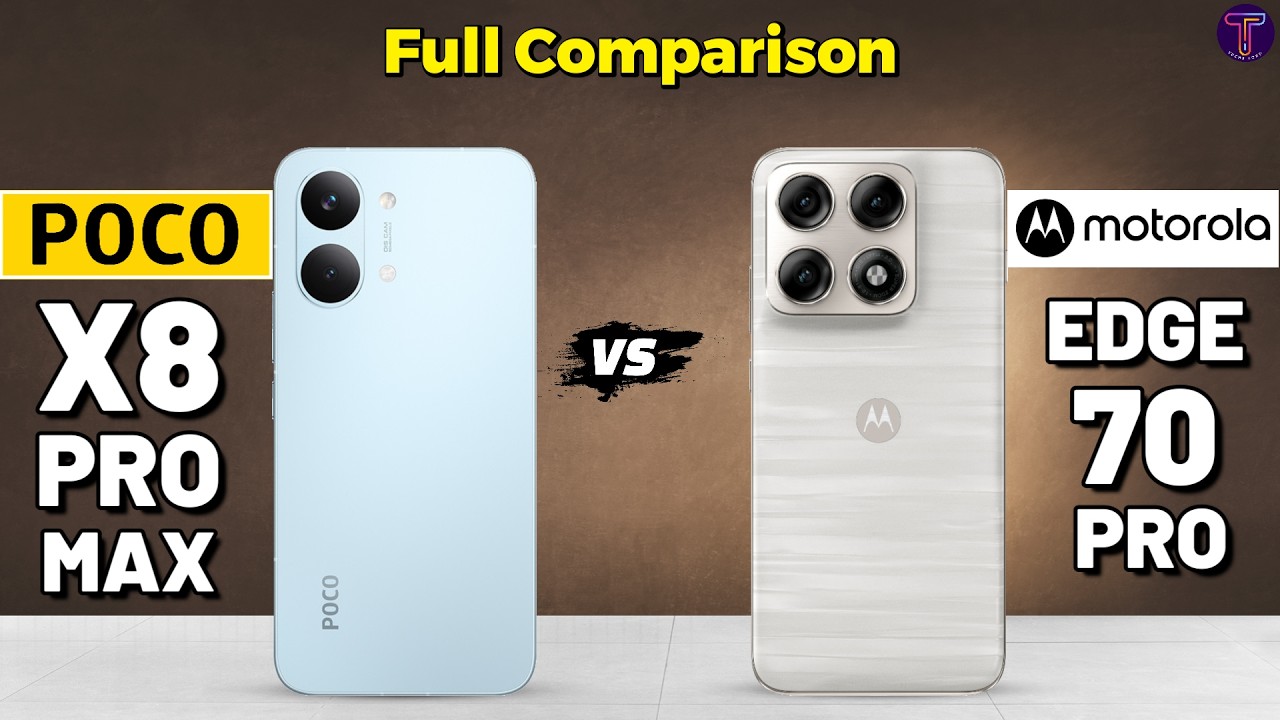
At first glance, the Poco F8 Pro looks like the more aggressive choice. It brings the Snapdragon 8 Elite, an Adreno 830 GPU, and 8K 30fps video recording, but its higher price makes every advantage feel more expensive to justify.
That is where the Motorola Edge 70 Pro changes the conversation. Priced at ₹39,000 / $400, it sits far below the Poco F8 Pro at ₹52,000 / $600, yet still offers a package that is broader in scope and more balanced in daily use.
A cheaper phone with a wider feature mix
The two models follow very different priorities. Poco clearly targets users who want maximum raw performance and strong gaming credentials, while Motorola builds its case around overall completeness rather than one dominant selling point.
That difference matters because the Poco does not pull ahead in every area. Motorola uses the Dimensity 8500 Extreme, which trails the Snapdragon 8 Elite in flagship power, but the rest of its hardware helps narrow the gap in ways that are more visible outside benchmark charts.
Both phones ship with UFS 4.1 storage and Android 16, so neither one feels outdated in the basics. The real split comes from how each brand allocates the budget around the chipset.
Display and durability tilt toward Motorola
Motorola Edge 70 Pro carries a 6.78-inch AMOLED panel with a 144Hz refresh rate and a peak brightness rating of 5200 nits. Poco F8 Pro uses a smaller 6.59-inch AMOLED display with 120Hz refresh rate and 3500 nits peak brightness.
In everyday use, that gives Motorola the edge for smoother scrolling and stronger outdoor visibility. Poco still holds a multimedia advantage because it supports Dolby Vision and HDR10+, while Motorola is listed with HDR support only.
Durability also strengthens Motorola’s position. The Edge 70 Pro includes IP68/IP69 protection and MIL-STD-810H certification, while the Poco F8 Pro relies on IP68 alone.
Camera hardware shows a clearer split
Both phones share a 50MP wide main camera, but the supporting lenses are not equally equipped. Motorola pairs that with a 50MP periscope telephoto camera offering 3.5x zoom, while Poco uses a 50MP telephoto unit with 2.5x zoom.
Motorola also goes further on ultrawide. It uses a 50MP ultrawide camera, compared with Poco’s 8MP ultrawide unit, which makes the Motorola setup more flexible across different shooting situations.
The front camera comparison adds another advantage for Motorola. The Edge 70 Pro features a 50MP autofocus selfie camera with 4K recording, while the Poco F8 Pro uses a 20MP front camera limited to 1080p video.
Poco does answer with stronger main camera video capture. It can record up to 8K at 30fps, while Motorola tops out at 4K at up to 120fps.
Battery and charging favor practical use
Motorola Edge 70 Pro also carries the larger battery, at 6500mAh. Poco F8 Pro comes with a 6210mAh battery, which is still sizable but does not match Motorola’s capacity.
Charging tells a more mixed story. Poco offers 100W wired charging, while Motorola supports 90W wired charging.
Even so, Motorola has the more flexible charging setup overall because it also includes wireless charging and reverse wireless charging. Poco offers only reverse wired charging, which leaves less room for convenience in daily use.
Where Poco still stands out
Poco F8 Pro is not without clear strengths. Its Snapdragon 8 Elite and Adreno 830 GPU make it the more capable device for heavy gaming and peak performance tasks.
It also adds an ultrasonic in-display fingerprint sensor, which gives it a small hardware advantage over Motorola’s optical in-display reader. Audio is another area where Poco adds some flavor, thanks to stereo speakers with Dolby Atmos and Bose tuning.
Both devices support Wi-Fi 7 and stereo speaker setups, so the core modern connectivity and sound experience remain present on either phone.
What makes the comparison interesting is not that one phone wins everything, but that Motorola wins enough of the important day-to-day categories to look easier to recommend. Poco may be the faster machine on paper, but Motorola Edge 70 Pro presents a stronger balance of display, battery, cameras, protection, and charging for less money.