


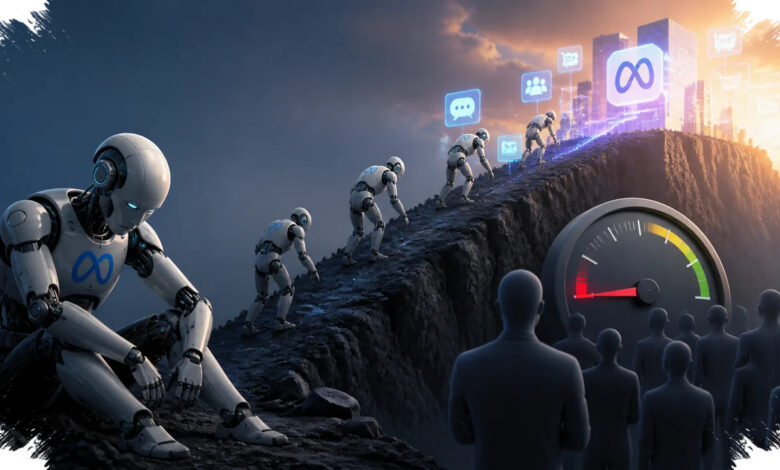
Meta’s aggressive push into artificial intelligence is running into a familiar problem: speed on paper is not matching speed in practice. After cutting around 8,000 workers and shifting thousands more into AI-related roles, Mark Zuckerberg said the company’s AI agent development has moved more slowly than expected.
The admission matters because AI agents sit at the center of Meta’s expensive bet on the next phase of AI products. Even as the company pours huge sums into infrastructure, the results from this line of work have not yet shown the acceleration leadership wants.
What Zuckerberg said about the pace
According to Reuters, Zuckerberg said the company’s agentic progress over the past four months has not improved the way Meta expected. In simple terms, the systems designed to carry out tasks for users are advancing, but not fast enough to satisfy the company’s internal timeline.
He also said Meta still sees itself moving toward “superintelligence,” while expecting more meaningful benefits from its AI spending to become visible within the next three to six months. That framing suggests the company remains committed, even if the near-term progress looks uneven.
| Key Point | Details |
|---|---|
| AI agent pace | Zuckerberg said progress has been slower than expected for at least four months. |
| Infrastructure spending | Meta is projected to spend up to $145 billion on AI infrastructure this year. |
| Expected payoff window | Meta expects more visible benefits in three to six months. |
A restructuring that did not go smoothly
The slowdown in AI agent development is unfolding alongside a major internal overhaul. Zuckerberg acknowledged that the restructuring effort may not have been as clean or effective as the company hoped.
He said the changes made in recent months “have not produced results.” In January and February, senior executives were reportedly worried that Meta was not moving quickly enough to reorganize itself for AI development.
That pressure helped drive a series of aggressive organizational moves. In March, Meta created a new Applied AI division and shifted about 6,500 engineers and product managers from other teams into AI-focused work.
The company also cut roughly 10% of its global workforce, or about 8,000 employees. At the same time, Meta reassigned around 7,000 workers to AI or AI-native teams and closed 6,000 open roles that had been planned for hiring.
Internal friction and communication problems
Those changes have not landed smoothly with everyone inside the company. Some employees reportedly disliked the scale of the shift, which reinforced concerns that the restructuring itself was creating friction.
Meta’s Chief Technology Officer, Andrew Bosworth, also admitted there were problems in how the restructuring was explained. In an internal memo, he said the company did an “atrocious” job of communicating the vision behind the changes.
That admission highlights a challenge beyond technology. Meta is trying to move faster in AI, but its internal alignment appears to be lagging behind the pace of the strategy.
AI agents remain a priority despite the delay
Even with the slower rollout, Meta has not backed away from AI agents. The company previously acquired Moltbook, a viral social media platform for AI agents, and brought its team in to work on AI agents inside Meta.
The move shows that Meta is relying on more than internal development alone. Acquisitions and team integrations are part of the company’s effort to catch up and strengthen its position in a field it clearly sees as central.
The broader picture is one of heavy spending, structural disruption, and uncertain short-term payoff. Meta has already moved thousands of workers and committed massive capital to AI infrastructure, yet AI agents still need more time before they show the kind of progress the company wants to see.
Privacy concerns added another layer of pressure
Meta’s push to speed up AI work has also sparked controversy inside the company. In April, it began using software to track mouse movements and keyboard presses from employees to help train AI agents.
The program triggered strong concern over privacy, and Meta later paused it. During a town hall, Bosworth said a review of the mouse-tracking software found that no employee data had been included in the AI training.
He also said that if the program returns, no employee will be forced to take part. Workers who feel comfortable can contribute, while those who do not will not be required to join.
For now, Zuckerberg’s comments suggest Meta is still betting heavily on AI agents, but the company’s internal rebuild has not yet delivered the speed it wanted. The gap between investment and visible progress remains the central issue as Meta pushes toward its next AI milestone.