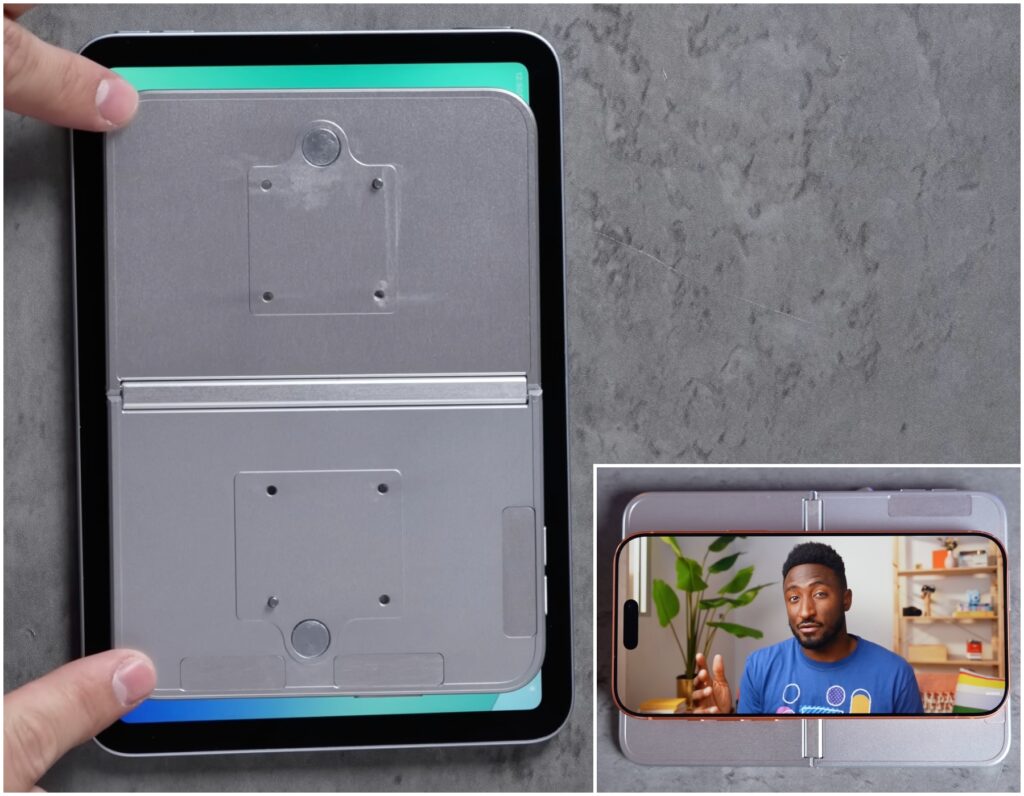
A new hands-on look at Apple’s long-rumored foldable device is giving the clearest picture yet of how different it may be from today’s mainstream foldables. Instead of a narrow, phone-first layout, the dummy unit points to a wider device that opens into something closer to a compact tablet.
The video came from Unbox Therapy on YouTube, where Lewis Georgie Hilsenteger often showcases mockups of upcoming phones before launch. This time, the dummy model being shown is tied to what many have been calling iPhone Ultra, and it offers a far more tangible glimpse than the usual 3D renderings.
A foldable layout that feels more like a mini tablet
The most noticeable detail is the display shape when the device is opened. It follows a book-style folding concept, but the main screen expands horizontally in landscape orientation rather than matching the tall proportions common on many Android foldables.
That design choice makes the device look closer to a mini tablet than a standard foldable phone. In its fully opened state, its aspect ratio is even said to resemble iPad Mini, which reinforces the impression that Apple may be aiming for a wider use case than the slimmer foldables already on the market.
The same dummy unit had also been compared with Huawei Pura X Max and Google Pixel Fold before, based on the feel of its ratio. Rumored screen sizes suggest a 5.3 to 5.5-inch outer display and a 7.6 to 7.8-inch inner panel.
Thickness and camera bump stand out immediately
Beyond the screen format, the physical bulk of the dummy is another major talking point. When folded, it appears to measure around 11 mm, making it noticeably thicker than the iPhone 17 Pro Max, which is listed at 8.8 mm.
That figure does not include the rear camera protrusion, which is said to add about 5.5 mm more. Combined, the total thickness could reach roughly 16.5 mm, giving the device a much more substantial profile than a typical slab-style iPhone.
The rear camera module itself is also large and appears somewhat similar to the camera concept used on iPhone Air. The difference is that this module does not stretch across the full width of the back, but instead occupies about half of the rear surface.
Because of the large camera bump, the dummy does not sit perfectly flat on a table. Inside that module, two rear camera lenses are visible, although their exact functions are still unknown.
Unexpected button and port placement
The hands-on video also reveals a layout that is not common for an iPhone. Volume buttons are positioned along the top side of the device when the screen is fully opened, while the power button sits on the right side.
There are also external speaker openings on both the top and bottom edges, with the USB-C port placed on the bottom next to one of the speaker holes. The diagonal placement of the speakers is believed to help preserve stereo audio quality across different holding orientations.
Lewis did not discuss internal hardware, since the unit shown is only a dummy model and has no active components.
Rumored hardware remains unconfirmed
Several rumors have linked the foldable device to a titanium frame. Other leaks have pointed to an A20 Pro chip, iOS 27, and iPad-style multitasking features.
Apple has not confirmed either the name or the release schedule for its first foldable phone. Even so, it is widely predicted to arrive in September alongside the iPhone 18 Series.
For now, the dummy offers the most concrete look yet at Apple’s direction for a foldable. If the design stays close to what is shown, the company appears to be building a device that favors a wider screen, a thicker body, and a usage style that feels closer to iPad Mini than to the thin foldables already familiar in the Android market.