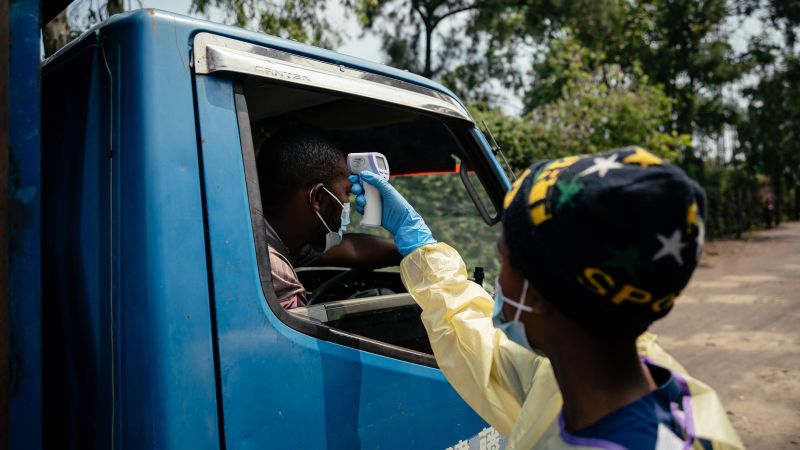
Public health officials say the Ebola outbreak in the Democratic Republic of Congo and Uganda is moving quickly, but the risk profile is not the same everywhere. The World Health Organization says the danger is high at the national and regional levels, while the global risk remains low.
That split matters for understanding whether people outside the affected area should worry. The outbreak is linked to the Bundibugyo strain, a rare form of Ebola with no specific treatment or vaccine, which makes containment harder.
What the numbers show
The Democratic Republic of Congo said at least 148 deaths are thought to be linked to the outbreak. Officials have officially confirmed 51 cases, but 575 cases are suspected, and more than 800 contacts are being tracked in the DRC.
WHO said the figures still carry major uncertainty. Dr. Anne Ancia, WHO’s representative in the DRC, said there is “significant uncertainty about the number of infections and how far the virus has spread.”
Uganda has also reported two confirmed cases. One patient came from the DRC, was treated in a Ugandan health facility, and later died, while the second case was also considered imported from the DRC.
Why health officials are concerned
WHO Director-General Dr. Tedros Adhanom Ghebreyesus pointed to several warning signs. He said the outbreak was slow to be identified, health care workers are among those who died, population movement in the area is significant, and the strain has no specific treatment or vaccine.
WHO also said there was a “critical four-week detection gap” between the first known illness and the point when the disease was identified. That gap gave Ebola more room to spread before control measures could fully begin.
Officials say the outbreak likely began “a couple months ago,” but they are still investigating exactly when and where it started. WHO has not yet identified a clear “patient zero,” according to Ancia.
How the outbreak spread
The first confirmed Bundibugyo patient in this outbreak was one of four health workers from Mongbwalu. The worker went to a hospital in Bunia on April 24 with symptoms that looked like many other diseases, including fever, vomiting and intense malaise.
The case was not immediately recognized as Ebola. Hemorrhaging, one of the classic signs of the disease, did not appear until the fifth day of infection, and initial testing for the more common Zaire strain came back negative.
The patient died on May 5. Later testing sent to Kinshasa showed the illness was caused by the Bundibugyo strain.
Funeral practices appear to have amplified the spread. Local officials said mourners gathered after believing the death was caused by a mystical illness, and traditional customs involving close contact with the body may have exposed more people.
What Bundibugyo means for this outbreak
There are six known strains in the Ebolavirus genus, and three have caused large outbreaks. Bundibugyo was first identified in 2007 in western Uganda near the border with the DRC, and it has only two other documented outbreaks, in 2007 and 2012.
WHO says Ebola case fatality rates range from 25% to 90%. The first known Bundibugyo outbreak had a case fatality rate of 32%, which is lower than some other Ebola outbreaks but still severe.
Research suggests Bundibugyo may replicate more slowly and disable immune cells more slowly than other strains. That may help explain why outbreaks tied to it have appeared less lethal, although slower progression can also allow the virus to remain in the body longer.
Unlike Ebola Zaire, Bundibugyo has no vaccine and no specific treatment. Dr. Vasee Moorthy said at a WHO news conference that it is likely to take months to develop a vaccine specific to the virus.
What treatment and response look like
Without a targeted drug or vaccine, supportive care becomes essential. WHO says that can include treating dehydration, maintaining oxygen levels and blood pressure, easing pain and providing nutrition.
The U.S. Department of Health and Human Services said it plans to send an experimental antibody treatment to Germany for Americans exposed to Ebola. HHS did not name the product, but one experimental antibody, MBP134, has shown promise against Bundibugyo in animal testing.
The U.S. Centers for Disease Control and Prevention said six high-risk contacts of one American patient are being moved to Europe for observation. Five are headed to Germany and one to the Czech Republic.
That American patient, Dr. Peter Stafford, is a general surgeon who specializes in burn care and was helping patients in Bunia, according to the charity Serge. German authorities said the patient arrived in Berlin and was being treated at Charité University Hospital, and the patient was in stable condition.
Serge said two other doctors, Dr. Rebekah Stafford and Dr. Patrick LaRochelle, may have been exposed but remain asymptomatic and are following quarantine and monitoring protocols.
Should people outside the region worry?
WHO says the outbreak is a serious concern for the DRC and neighboring countries, but it still assesses global risk as low. The CDC also says the overall risk to the U.S. remains low, even as it works with state and local health departments on airport screening plans.
The virus spreads through direct contact with body fluids such as blood or vomit, and it can also spread through contaminated objects, surfaces or fecal matter. People are usually not infectious until symptoms appear, and the incubation period runs from two to 21 days.
Many countries have already tightened screening and travel measures, and the U.S. created entry restrictions for non-citizens who have been in Uganda, the DRC, Congo or South Sudan in the past 21 days. It also raised the DRC travel advisory to Level 3 and designated Ituri province as Level 4, or Do Not Travel.
The broader challenge is that years of war, aid cuts and insecurity have weakened disease surveillance in the region. The CDC says it has decades of experience there, including 100 staff in Uganda and nearly 30 in the DRC, and it has added hundreds more people to the emergency response.
Read more at: www.cnn.com