


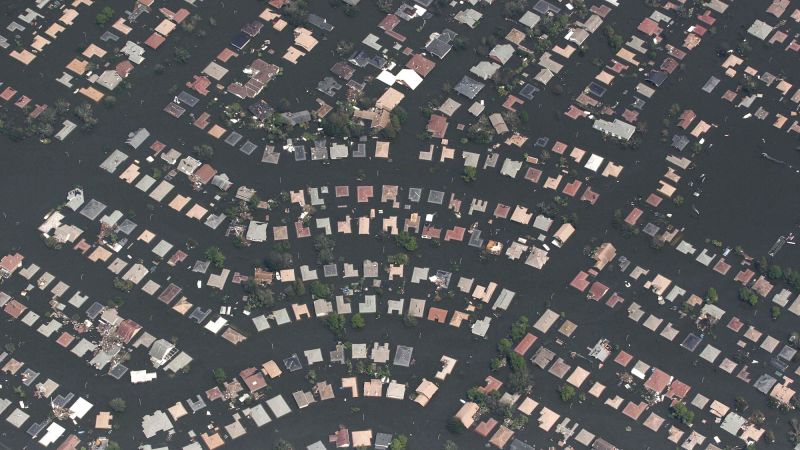
New Orleans is facing a future in which rising seas could push the Gulf of Mexico into the city’s doorstep, and scientists say waiting too long may make the move far harder and more unequal. The warning is not about a distant risk alone, but about a place that already sits low, floods often, and is losing its natural defenses.
The new analysis argues that relocation planning should begin now, before the process becomes chaotic and expensive. Researchers say the city has already crossed “the point of no return,” even if the exact timing of major change remains uncertain.
A city built below the waterline
New Orleans sits in a bowl-shaped basin that is mostly below sea level, in the middle of a shrinking delta. Coastal Louisiana is one of the lowest-lying regions in the world, and the city’s estimated 360,000 residents live with chronic exposure to water on all sides.
Wetlands once helped shield the region from hurricanes and storm surge, but those buffers are disappearing fast. Human drainage for development, canal dredging for oil and gas, and river levees that cut off sediment flow have helped Louisiana lose about 2,000 square miles of wetlands since the 1930s.
The study published in May in Nature Sustainability projects sea level rise of around 10 to 23 feet for coastal Louisiana. It also warns that about 75% of the region’s remaining wetlands could vanish and that the shoreline may retreat inland by as much as 62 miles.
Why the researchers say relocation cannot wait
The paper’s authors say New Orleans “may well be surrounded by the Gulf of Mexico before the end of this century.” They also argue that the city should use the time left to build a relocation strategy that can guide other places facing similar threats.
Benjamin Strauss, CEO and chief scientist at Climate Central, said sea level rise is coming for coastal cities around the world, including New York, London, Bangkok, and Shanghai. He said the key issue is not whether the threat exists, but “how soon those futures will come, and how they will play out.”
Torbjörn Törnqvist, a geology professor at Tulane University and one of the report’s authors, said the team looked to the past to understand what the region may face. The researchers identified an ancient shoreline about 30 miles north of New Orleans that formed roughly 125,000 years ago, when temperatures were similar to today but oceans stood at least 10 feet higher.
“It’s very likely that sea level will rise to that elevation in the future,” Törnqvist said. “The question is what should be done and when.”
The social cost of waiting
Scientists involved in the report warn that a delayed and unmanaged retreat would hit the poorest residents hardest. As people leave, the tax base shrinks, services weaken, insurance costs rise, and home values fall, creating a cycle that can deepen inequality.
Brianna Castro, a study author and assistant professor of urban sustainability at Yale School of the Environment, said people have already been leaving coastal Louisiana for decades. New Orleans has lost around 25% of its population since Hurricane Katrina, which killed nearly 1,400 people in Louisiana in 2005.
Castro described the exodus as “pulse-like,” with each major storm or flood triggering another wave of departures. That pattern matters because nearly 99% of New Orleans residents are considered at high flood risk in a recent study, meaning another Katrina-like hurricane could bring damage to almost everyone in the city.
A difficult debate over adaptation and moving out
Some residents may still choose to stay and protect their homes for as long as possible. Castro said that approach has limits, because every dollar spent trying to flood-proof the present is a dollar that cannot help pay for a future move.
“If the writing is on the wall that we need to go eventually, do we want to wait until people’s resources are exhausted and there’s a crisis?” she asked.
The warning is especially sensitive in a city where community history runs deep. Beverly Wright, founder and executive director of the Deep South Center for Environmental Justice, said her family has lived in New Orleans for eight generations and fears relocation could break neighborhoods apart.
“The culture that we have has grown out of life experiences and neighborhoods, so anytime you break up a neighborhood, you lose things,” Wright said. She also said she does not trust officials to handle the process fairly for Black residents, pointing to the widely criticized response after Katrina.
What relocation could look like
The idea of moving an entire community is not without precedent. In Kiruna, Arctic Sweden, a town built on top of an iron ore mine is being relocated over decades because expanding mine operations damaged buildings and fractured the ground.
That process began after a vote in 2004 and is expected to finish in 2035. Kiruna has already moved its more than 100-year-old church to a new city site on a specially designed trolley, although the transition has brought higher rents and fears of cultural loss.
Nyström, Kiruna’s municipal heritage officer, said relocation has come with grief. “It is a big sorrow to leave everything, and I think that is important to understand that,” she said.
Castro said New Orleans could still build a “New Orleans 2.0” on safer ground without losing its identity. She argued that a strong city can attract people again, and that the city’s spirit does not have to disappear with the land.
Few signs of urgency in policy
Despite the research, there is little evidence of a broad policy push toward relocation planning, Törnqvist acknowledged. Some efforts have focused instead on buying the region time through coastal protection and restoration.
In August 2023, work began on a major sediment diversion project meant to rebuild wetlands and help shield south Louisiana from storms and rising seas. That project was cancelled in 2025 by Republican Gov. Jeff Landry, who cited cost and harm to fisheries.
The report authors said the cancellation “effectively means giving up on extensive portions of coastal Louisiana, including the New Orleans area.” Landry’s office did not respond to a request for comment.
A warning far beyond Louisiana
The scientists say the Gulf Coast offers a preview of what many other coastal communities may face later this century. They note that New Orleans may reach these pressures sooner than many places, but they argue the lessons are global.
Törnqvist said the region’s experience should be watched closely because it shows what can happen when the land keeps sinking, the water keeps rising, and the choice to move gets postponed until the options are much worse.