


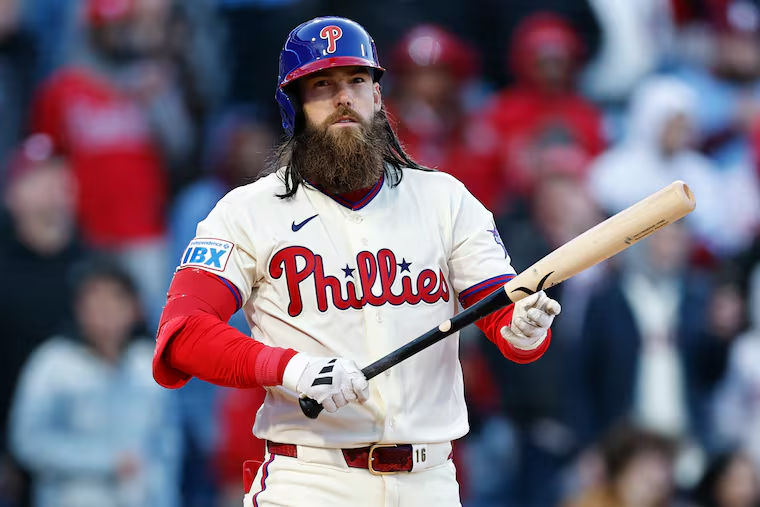
The Phillies are facing two separate but connected questions as the season moves toward the trade deadline: whether Brandon Marsh still fits their long-term plans, and whether Trea Turner has become the club’s biggest offensive concern. Both issues point to the same larger problem, which is how Philadelphia builds a lineup that can hold up when games tighten in October.
Marsh has improved enough to make the discussion real, but his value is still tied to performance that can swing quickly. Turner, meanwhile, carries the heavier financial and roster burden, and his early-season production has not matched the expectations that come with his contract.
Why Brandon Marsh is part of the deadline conversation
Brandon Marsh is not the kind of player who normally headlines trade talks. He has improved and can run hot for long stretches, but he is not the classic late-July impact bat that contenders usually chase.
That said, the Phillies could be buyers looking for exactly that kind of hitter. Marsh is under team control only through next season, so the front office has to weigh whether his future value is strong enough to keep him or useful enough to move in a larger deal.
The logic is straightforward. If packaging Marsh helps the Phillies land a right-handed hitter who better matches their needs, Dave Dombrowski may have to consider it. The club’s lineup balance remains a concern, and that issue does not disappear just because Philadelphia expects to contend.
Marsh’s trade value also depends on the next stretch of his season. He was hitting .353 with an .893 OPS on May 10, but those numbers had dropped to .326 and .836 going into Wednesday after a 12-for-48 slump that included 14 strikeouts and only two walks.
Marsh’s improvement is real, but not complete
The larger question with Marsh is not whether he has made progress. It is whether that progress is stable enough to matter in a trade discussion or in a contract conversation down the line.
His recent numbers suggest he remains streaky. The reference point is important because his breakout narrative has sometimes glossed over how uneven his production can be.
Marsh has gone through stretches where the bat disappeared for days at a time. In one 25-game span, he struck out 22 times in 78 at-bats and posted a .586 OPS, then followed it with a separate 17-game run in August where he went 7-for-45 with a .404 OPS.
He also showed how dangerous he can be when locked in. In the 11 games between those slumps, Marsh went 16-for-31 with 10 extra-base hits and four home runs.
That mix explains why the Phillies have a difficult decision ahead. Marsh has enough upside to be useful, but his profile still raises the question of whether he is the best asset to keep if a larger upgrade becomes possible.
Turner’s production has become hard to ignore
The Turner discussion is more uncomfortable because of the expectations attached to his contract and role. He is supposed to drive the offense, but the early stretch of the season has not looked like that.
There is no need to frame it as a public pile-on. Baseball makes slumps visible, and the criticism can become disproportionate when one player absorbs blame for a team’s broader offensive issues. Still, Turner’s numbers make him difficult to overlook.
He was brutal through the first five weeks, posting a .433 OPS across 37 games. A recent 16-game surge, during which he put up a .968 OPS with eight extra-base hits and four home runs in 64 plate appearances, has helped, but his overall production still sits below what the Phillies need from their top hitter.
Turner carried a .626 OPS that was only 23 points higher than Bohm’s, which is why the comparison matters. From a roster-building standpoint, the Phillies do not need Turner to be a perfect cleanup hitter or a five-hole slugger, but they do need stronger production from the player at the top of the order.
That is what makes his start so important. At his salary, he is the Phillies’ biggest offensive problem, and the gap between expectation and output is large enough to shape how the lineup is judged.
The postseason numbers add another layer
The concern is not limited to the regular season. Turner’s recent postseason line also adds to the pressure, especially because the Phillies have been trying to build a roster that can carry October weight.
Over the Phillies’ last three postseason series, dating back to the NLCS loss to the Diamondbacks in 2023, Turner has gone 12-for-57 with two extra-base hits and seven walks. That is not the kind of production that supports a lineup built around a high-priced star.
The reference point matters because the Phillies have other hitters who attract criticism, including Bohm, Stott, and Realmuto. But the scale of the expectations is different when the player in question makes $2 million more than Bryce Harper annually.
That is why the Turner conversation has grown louder. It is not only about whether he has had enough bad weeks to become a problem. It is about whether the Phillies are getting the return they need from the most expensive offensive piece on the roster.
How the two decisions connect
The Marsh and Turner questions are linked by roster construction. If the Phillies need to add a hitter with a better fit, moving Marsh could be one way to create that path.
A team such as the Rays could make sense as a trade partner because of their need in the outfield, their budget limitations, and their preference for players who are not simple rentals. If Tampa Bay were willing to send prospects that Philadelphia could later flip for an impact bat, the deal structure would become more realistic.
That kind of chain reaction would not solve everything, but it would give the Phillies more flexibility. It also fits into a broader market in which right-handed bats such as Mike Trout and Byron Buxton are likely to draw attention.
For now, the more immediate issue is whether the Phillies trust Marsh’s current level enough to keep him through the next phase of roster planning. His value on the field and in a deal will keep changing with each week of production, and that makes the deadline conversation more fluid than it first appears. Turner’s case is different, but it carries even more weight because his struggles affect both the present lineup and the way the Phillies have to think about the roster they built around him.
Read more at: www.inquirer.com