


After Mount St. Helens erupted, the biggest lesson for scientists was not only how to track the next volcanic blast. The larger concern was a fast-moving mudflow called a lahar, which can destroy communities even when a volcano is not actively erupting.
That risk has made the Cascade Range one of the most closely watched volcanic regions in the United States. Researchers say the most dangerous threat may come from the ground shaking, a landslide, or another trigger that sends volcanic debris racing downhill with little or no warning.
Why Lahars Are Such a Serious Threat
A lahar is a mixture of sediment, rocks, and water that starts high on a volcano and moves downslope at speed. Once it begins, it can spread far beyond the volcano itself and flatten almost anything in its path within minutes.
Volcanologist Lizeth Caballero García of the National Autonomous University of Mexico described them as highly changeable events. “They are complex phenomena that change a lot during transport,” she told Popular Mechanics, adding that they can grow or dilute as they move.
That unpredictability is part of what makes lahars so alarming for emergency planners. Unlike lava, which often gives clearer signs of movement, a lahar can act quickly and overwhelm roads, buildings, and other infrastructure before communities have time to react.
Mount Rainier Sits Near Dense Population Centers
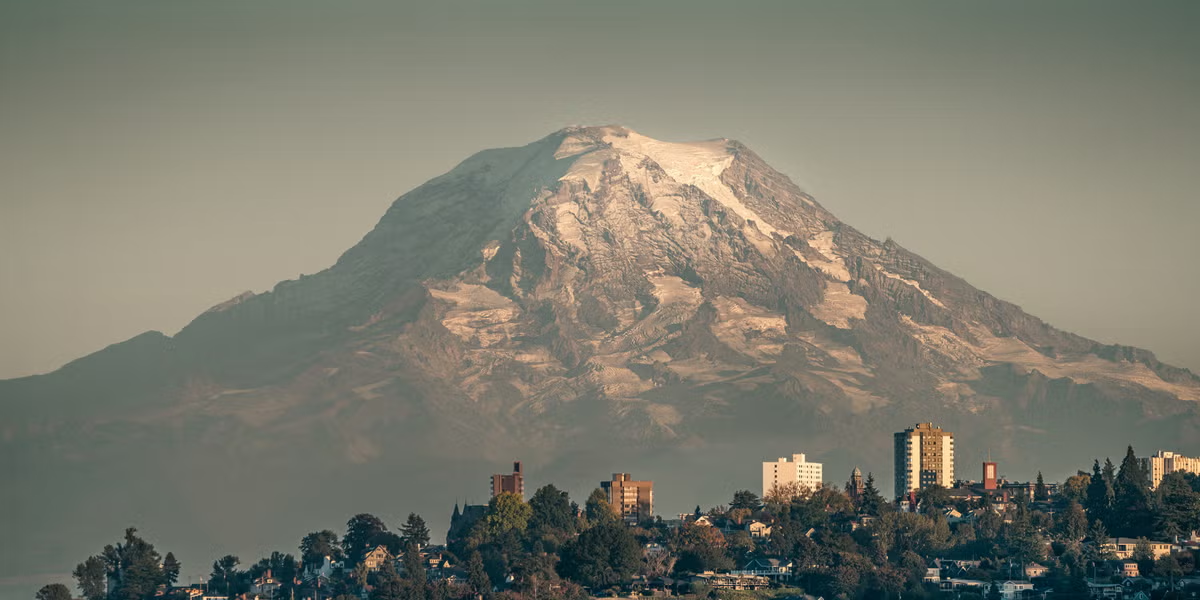
The United States Geological Survey has called lahars the “most threatening hazard” in the Cascades, and the concern is especially strong around Mount Rainier. The volcano is located about 60 miles from Seattle, and around 150,000 people live in Pierce County, which lies in a projected lahar path.
Scientists say a landslide on Rainier’s western side could be especially destructive. In that scenario, the towns of Orting, Puyallup, and Sumner could be hit in about half an hour, with more than 60,000 residents affected.
Former Cascades Volcano Observatory geophysicist Andy Lockhart underscored how unsettling that threat can be. He told Popular Mechanics that no-notice lahars are “the thing that goes bump in the night,” adding, “It creeps me out.”
A Disaster That Changed the Way Experts Think
The Mount St. Helens disaster in 1980 killed 57 people and caused $860 million in damage to roads, railways, local infrastructure, and the logging industry. Triggered by a 5.1-magnitude earthquake, the event became a turning point for scientists studying volcanic hazards in the Pacific Northwest.
The eruption showed that the destruction did not come only from ash or lava. The huge lahar it generated caused much of the damage, reinforcing the need to study volcanic mudflows as a separate and serious threat.
That shift in focus has shaped decades of research on how to prepare for future emergencies in the Cascade Range. Scientists have worked to build better seismic monitoring systems and improve warning efforts for communities that could be hit without much notice.
Why Some Lahars Are Harder to Predict
Researchers worry most about lahars that happen without an eruption first. The reference material notes that even dam failures and heavy thunderstorms have triggered fatal lahars around the world, which means volcanic mudflows do not always need an explosive event to start.
That reality makes forecasting difficult and raises the stakes for nearby towns. A hazard that can begin from a landslide or other sudden event leaves little time for evacuation unless monitoring systems detect it early enough.
To improve their understanding, scientists have built specialized tools and sites for study. One example is a custom flume in Oregon’s H.J. Andrews Experimental Forest, funded by the USGS to replicate lahar flows and measure how they behave.
How Scientists Are Preparing
The Cascades Volcano Observatory has also created a broad network of monitors across the region. These systems are designed to detect lahars and volcanic activity and to send signals to emergency managers in affected communities.
That communication matters because it can help local officials act quickly when minutes count. In a region where people, roads, and towns sit close to projected flow paths, even a small gain in warning time can make a major difference.
Researchers continue to study lahars because they see the threat as immediate, not distant. As the reference material notes, the next event could be “scarily imminent,” and that possibility is driving efforts to improve detection, forecasting, and emergency response across the Pacific Northwest.