


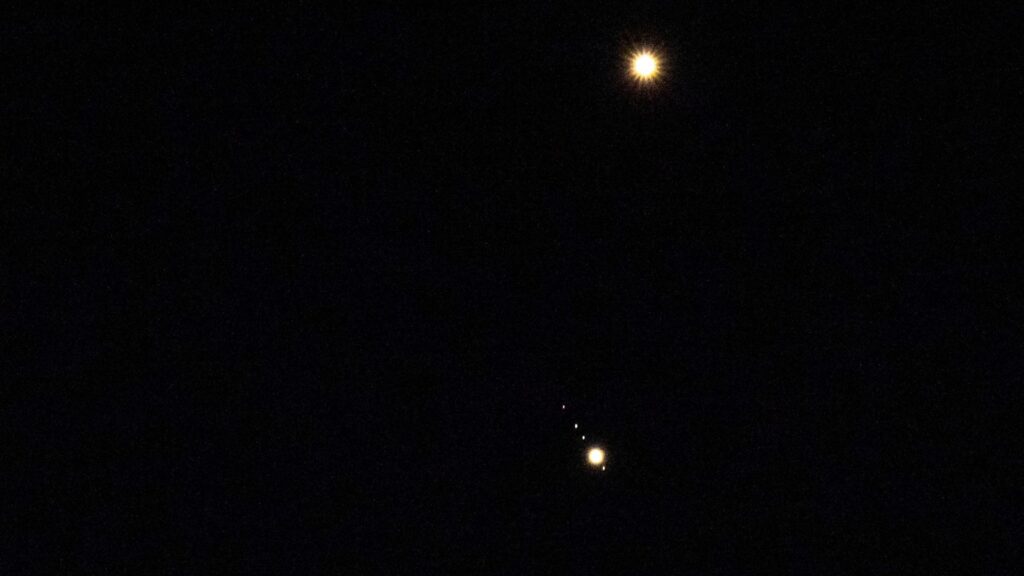
Jupiter and Venus are set for a striking close approach in the evening sky on June 9, giving skywatchers a rare chance to see the two brightest planets appear close together after sunset. In the U.S., Venus will stand less than 20 degrees above the western horizon, with Jupiter visible to its lower left, while Mercury will sit much closer to the horizon and will be harder to find.
Where to look
The best view will come shortly after sunset, facing west where the sky is still bright with twilight. Venus should be the easiest planet to spot because of its strong glow, while Jupiter will appear nearby and slightly lower, making the pair a clear target for the naked eye.
Mercury will be the most difficult of the three to pick out because it sits around 10 degrees below and to the lower right of Venus and Jupiter. A clear, unobstructed western horizon will matter most for anyone trying to catch all three planets in the same view.
How close the planets will appear
Venus and Jupiter will be separated by less than 2 degrees, close enough to fit into the field of view of a pair of 10×50 binoculars. That tight spacing should make the conjunction especially noticeable for observers using basic binoculars or simply scanning the sky with the naked eye.
The planets’ proximity may also make Jupiter’s four Galilean moons easier to appreciate, if the sky is steady and the view is sharp. Those moons — Io, Europa, Callisto and Ganymede — can appear as tiny points of light around the giant planet.
What changes after June 9
The view will not stay the same for long, because Venus will move higher than Jupiter in the nights that follow. It will continue along its path toward the nearby constellation Cancer, where it will line up with the open star cluster Messier 44, also known as Praesepe or the Beehive Cluster, on June 20.
Jupiter will fade from easy view more quickly after the conjunction, dropping lower against the horizon each night. By early July, the planet will become difficult to see in the glare of sunset, and it will not return to the evening sky until mid-August, when it reappears in the eastern morning sky.
Best viewing conditions
A dark western horizon and a clear sky will give the best chance of spotting the conjunction and Mercury. Binoculars can help separate the planets visually, but Venus should remain visible without any equipment because of its brightness.
For anyone wanting a closer look at the planets or future sky events, astronomical viewing tools can help reveal more detail than the unaided eye can show. The June 9 encounter, though, should already stand out as one of the most eye-catching twilight sights of the month.