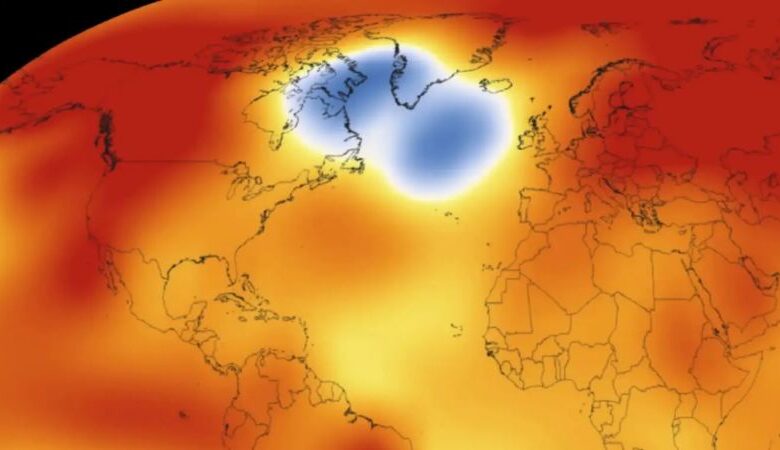
A strange cold patch south of Greenland and Iceland is drawing renewed attention because it may be more than an ocean quirk. New research says the “cold blob” is best explained by a weakening Atlantic current system, raising concern that one of the climate system’s most dangerous tipping points could be getting closer.
The area has cooled by nearly 1 degree Celsius, or 1.8 Fahrenheit, since 1900, even as much of the wider ocean has warmed. Scientists have debated for years whether winds and clouds could explain the anomaly on their own, but the new findings point to changes in ocean heat transport instead.
Why the cold blob matters
The Atlantic Meridional Overturning Circulation, or AMOC, acts like a giant conveyor belt that carries warm water from the tropics northward, where it cools, sinks, and flows back south. That circulation helps shape weather and climate far beyond the North Atlantic.
Researchers have warned that the AMOC is weakening as human-driven warming melts ice and adds freshwater to the ocean, disturbing the system’s balance of heat and salinity. Some studies suggest the circulation could be approaching a tipping point this century, which would mean a collapse is already locked in.
An AMOC shutdown would be devastating. It could drive faster sea level rise along the US East Coast, push Europe into severe winter cold, and shift African monsoons in ways that could bring prolonged drought.
What the new study found
To understand the cold blob more clearly, the study combined real-world ocean heat measurements from instruments and satellites with climate models. The results showed that the cooling was happening not only at the surface, but also deep in the ocean, where winds and clouds have much less influence.
That deeper cooling makes the AMOC explanation much stronger. “It is changing ocean heat transport” and driving the cold blob, said Stefan Rahmstorf, a study author and a physics and oceans professor at Potsdam University in Germany.
Rahmstorf also pointed to other evidence that the AMOC is weakening, separate from the cold blob itself, including studies that suggest it may be at its weakest in around 1,000 years.
Experts say the case is stronger, but not settled
Other scientists say the new analysis adds weight to the AMOC interpretation without ending the debate. René van Westen, a marine and atmospheric researcher at Utrecht University who was not involved in the study, said previous work has shown that atmospheric conditions alone can create a cold blob.
Still, he said the consistency across different datasets strengthens the study’s conclusions. David Thornally, a professor of ocean and climate science at University College London, said the work bolsters the link between the cold blob and a weakening AMOC, but that the available ocean data remain limited.
Thornally said those datasets should be seen as “good approximations rather than perfect representations of reality,” and added that he does not think the study will be the final word. Jonathan Baker, a senior climate scientist at the UK Met Office, gave a similar view and told CNN he would treat the research as evidence for an AMOC contribution to the cold blob, rather than as a definitive answer.