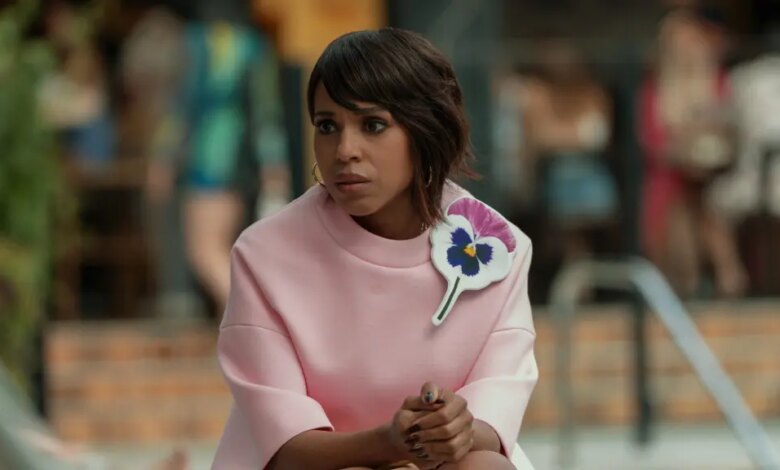
Kerry Washington says Imperfect Women stands out because its conflict is far more internal than the high-stakes battles she has played before. The Apple TV psychological thriller centers on jealousy, envy, desire, denial, and the struggle to admit the truth.
The actor and executive producer told Deadline that the project gave her the kind of creative control she now looks for, especially as a producer at Simpson Street. That involvement stretches from hiring and casting to writing, post-production, and marketing.
Building the show with female collaborators
Washington said it mattered that production stayed in Los Angeles and that the series was built with female collaborators. She described the process as a chance to work with people who can make her better and whom she can make better in return.
She also said she is selective about acting jobs she takes without producing. In those cases, she looks for directors she trusts, pointing to Rian Johnson on Knives Out and Ben Affleck on Animals as examples of projects where she believed she would learn from the collaboration.
Why the story drew her in
Washington said Araminta Hall’s source material impressed her because the perspective shifts so dramatically across the story. The framework, she said, makes a strong case for seeing situations through more than one point of view.
That structure also shaped how the eight-episode series was built. Washington said the show moves from one character’s perspective to another, eventually creating a shared view of Eleanor and Mary, played by Elisabeth Moss.
Passing the baton between characters
Washington said she and the cast were very aware that different episodes required different performance focuses. By the middle of the series, she said her job was to support Kate Mara, and later to support Moss as the story shifted again.
She described that shifting attention as one of the joys of the production, saying each actor got to step into a lead role and then comfortably serve the others as the story moved forward.
The actor also said the writing did much of the heavy lifting. Annie Weisman led the series as showrunner, while Kay Oyegun worked on every episode, and Washington said Simpson Street pushed for a writers’ room with real inclusivity and several voices of color.
A quieter kind of drama
Washington said the show’s tension comes from a more intimate form of conflict than the kinds of external forces many of her past roles have faced. She compared it with stories built around the White House, Gilead, journalism, or the advertising world, where the opposition is larger than life.
Here, she said, the challenge is closer to home. The force the characters face is their own fear, jealousy, envy, and desire, which makes the drama quieter but still high stakes.
Washington said one scene that helped unlock Eleanor for her was the moment Eleanor admits to her brother that she has loved Robert, played by Joel Kinnaman, for years. That confession, she said, is the first real leap into truth for a character who has spent decades suppressing it.
She also pointed to Donovan, played by Leslie Odom Jr., as the first person Eleanor risks honesty with in order to see whether she can survive it. For Washington, that moment marked a meaningful shift in the character’s emotional life.
Working with Lesli Linka Glatter and the rest of the team
Washington said it was exciting to work with Lesli Linka Glatter on the first episode, especially because she had long wanted to collaborate with her. She called Glatter a legend and said getting the head of the DGA to direct helped make the show feel real.
She also praised Glatter’s resilience after the fires, saying the director lost her house and had to reschedule a meeting because all of her notes burned. Even so, Glatter returned the next day and kept working.
Washington said that same care and clarity carried through the rest of the production, including her work on Animals with Ben Affleck. She said the writing was strong, the cast was strong, and the chance to work under the hood with Artists Equity made the experience especially valuable as a producer.
Why the show still feels rare
Even with more female-led projects in the industry, Washington said a production like Imperfect Women still stands out. She said people continue to ask about female-led productions, which suggests the space is improving but not yet equitable.
For Washington, the appeal is not just that the show centers on women. It is that it lets three experienced actors play complicated characters whose biggest conflicts come from inside themselves, not from the outside world.