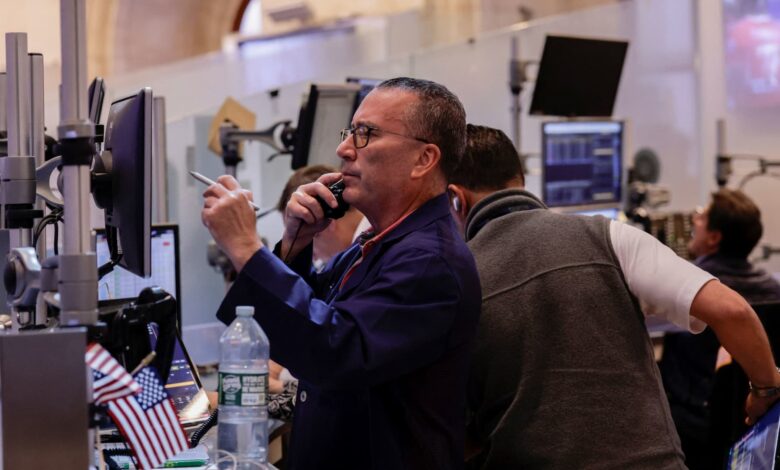
U.S. equity futures slipped early Monday as investors weighed fresh developments in the Iran war negotiations and waited for inflation data that could shape the Federal Reserve’s next move. The pullback came after a week in which U.S. stocks recovered from a sharp midweek sell-off.
S&P 500 futures fell 0.5%, while Nasdaq-100 futures were down 0.6%. Futures tied to the Dow Jones Industrial Average dropped 187 points, or 0.4%, signaling a cautious start for Wall Street.
Global markets opened the week with a split tone
Asia-Pacific trading ended mixed, with Japan’s Nikkei 225 jumping 1.55% to a fresh record of 72,353.96. South Korea’s Kospi added 0.69% to 9,114.55, while Hong Kong’s Hang Seng Index slipped 0.63% and Australia’s S&P/ASX 200 edged 0.14% lower to 8,816.10.
Mainland China stood out with the CSI 300 up 2.39% at 5,059.66. In Europe, the Stoxx 600 rose 0.12% even as most sectors traded in the red, led lower by retail and construction.
Oil turned lower after progress in negotiations
Brent crude futures fell 0.38% to $80.26 a barrel after mediators Qatar and Pakistan said U.S. and Iranian officials had agreed on a roadmap to reach a final deal within 60 days. U.S. West Texas Intermediate futures for July were about 1% higher at $77.52 per barrel after earlier jumping 3%.
The shift in oil came after a volatile session that reflected changing expectations around the Iran talks. Markets are also watching for any broader supply chain effects if tensions around the Strait of Hormuz continue to influence sentiment.
Inflation is the next big test for stocks
On Thursday, May’s reading of the personal consumption expenditures price index is due, and it is the Fed’s preferred inflation gauge. Economists polled by FactSet expect core PCE, which excludes food and energy, to rise from April.
After last week’s hawkish Fed meeting, expectations for a rate increase have moved up to as soon as October. That leaves traders highly sensitive to any inflation report that could reinforce the case for earlier tightening.
The three major U.S. indexes posted a comeback Thursday after Wednesday’s sell-off, helped by chip stocks, and ended the trading week higher. The S&P 500 gained nearly 1% on the week, the Dow rose close to 1%, and the Nasdaq Composite advanced more than 2%.
The U.S. stock market was closed on Friday for the Juneteenth holiday, leaving Monday’s open to absorb both geopolitical and inflation concerns at once. Fundstrat Global Advisors’ Tom Lee said on CNBC’s “Closing Bell” that catalysts such as Fed task forces and supply chain impacts from the Strait of Hormuz closure could matter later, but he still sees conditions as favorable for stocks.
“We still believe later this year there is going to be an abrupt change of market conditions, one that feels very much like a bear market, but we don’t want to stand and call a top,” he said. “I think conditions are still favorable for stocks.”