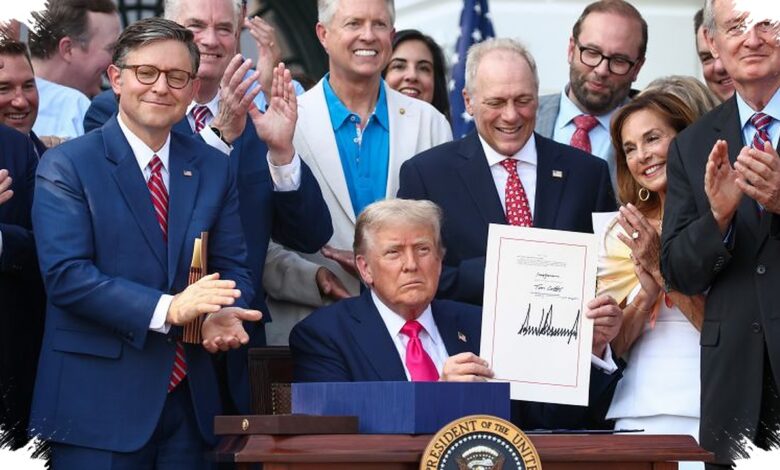
One year after Donald Trump signed the One Big Beautiful Bill Act, the law is becoming less of a victory lap and more of a political fight. Republicans hoped it would anchor their 2026 message, but Democrats are now using its most unpopular provisions to pressure vulnerable GOP lawmakers.
The clash is sharpening in battleground House districts and a competitive Senate race, where Medicaid cuts, food stamp reductions and new work requirements are colliding with GOP claims that the package is a boon for working families. The result is a law that could help define the midterms for both parties, though not in the way Republicans first expected.
Medicaid cuts have become the biggest liability
Historic reductions in federal Medicaid spending are the most politically damaging part of the package. The law, known as OBBBA, is projected to cut about $1.2 trillion from the program through 2035 and leave 7.5 million more people without coverage by 2034, according to the Congressional Budget Office.
One of the most controversial changes adds a federal work requirement to Medicaid, a longtime Republican goal. Democrats have seized on the move across the country, arguing that it threatens health care access for lower-income Americans and puts extra strain on clinics and hospitals.
| OBBBA impact | Projected effect | Source |
|---|---|---|
| Federal Medicaid spending | Down about $1.2 trillion through 2035 | Congressional Budget Office |
| People without coverage | 7.5 million more by 2034 | Congressional Budget Office |
| Medicaid policy change | New federal work requirement | OBBBA |
In California’s battleground 22nd District, Democrat Randy Villegas has made the cuts central to his campaign against GOP Rep. David Valadao. He told CNN that “two out of every three of our constituents rely on Medicaid” and warned that “almost 70,000 people stand to lose healthcare in our district.”
Valadao has said the law will preserve Medicaid over the long term and told CNN in a statement last month that he wants to protect the program for “seniors, vulnerable children, and disabled Americans.”
Rural health funding helps, but not enough to erase the damage
The law includes a $50 billion Rural Health Transformation Program, a concession aimed at easing concerns in places where hospitals and providers are already under pressure. Supporters say the fund can help states strengthen workforces, expand telehealth and address chronic disease.
Even so, experts say the temporary aid does not come close to offsetting the deeper losses tied to Medicaid. KFF estimates rural areas are projected to lose $137 billion in federal Medicaid funding over a decade, while Iowa alone is expected to lose more than $3.8 billion during that period.
“There’s no doubt that the $50 billion investment for rural health transformation is helpful,” said Timothy McBride, a health economics professor at Washington University’s School of Public Health. “But the net effect is probably going to be that the rural health systems will be worse off.”
Republicans are leaning on tax cuts and worker-focused provisions
Republicans are trying to shift attention to the law’s more popular tax measures, including no tax on tips and no tax on overtime. Trump has also claimed, inaccurately, that the bill delivered the largest tax cuts in American history and eliminated tax on Social Security for seniors.
In manufacturing-heavy battlegrounds such as Michigan, Wisconsin and Pennsylvania, GOP lawmakers have been visiting small businesses and construction sites to highlight the provisions that help hourly workers and seasonal laborers. Michigan Rep. Tom Barrett said workers at a road paving site were “very excited about no taxes on overtime.”
Republicans are also pointing to the business tax break that was made permanent and to provisions meant to encourage investment. Wisconsin Rep. Derrick Van Orden said the reforms were necessary to root out waste and fraud and argued that “there’s truly dignity in working and supporting yourself and your family.”
| Republican talking points | What they emphasize | Political target |
|---|---|---|
| No tax on tips | Appeal to service workers | Battleground districts and states |
| No tax on overtime | Appeal to hourly and seasonal workers | Manufacturing-heavy areas |
| Business tax incentives | Encourage investment | Small businesses and manufacturers |
Still, some of those benefits are temporary. Rep. Susie Lee, a Nevada Democrat seeking reelection in a competitive Las Vegas-area district, said she supports cutting taxes on tips and overtime but argued it is unfair that those provisions expire in 2028 while tax cuts for the wealthiest Americans do not.
She also said rising costs have swallowed up some of the benefit for working families, describing a waitress who got a $2,500 refund but had to spend it on medical care after going without insurance.
Democrats see health care as their strongest counterattack
Democrats have historically had the advantage on health care, and they are betting that OBBBA gives them a clear line of attack. Protect Our Care is launching a nearly $5 million campaign in more than a dozen key states, using ads, town halls and a bus tour to spotlight the cuts.
Justin Chermol, a spokesperson for the Democratic Congressional Campaign Committee, said House Republicans built their agenda around a bill that made life “measurably harder, hungrier, and more expensive for working families.” He called it “a political loser” that will hurt vulnerable Republicans in swing seats.
That message is now running head-on into Republican efforts to sell the law as a working-class tax cut. With control of the House potentially at stake, both parties are treating the bill less like a finished legislative victory and more like a live campaign issue.
In Iowa’s Senate race, Democrat Josh Turek has also targeted Republican Rep. Ashley Hinson over her vote for the law and its health care changes. Turek, who uses a wheelchair because of spina bifida, has leaned on his own experience navigating the health system to frame the issue around access and cost.
As the midterms approach, the same bill Trump once expected to showcase as a signature achievement is giving Democrats a ready-made contrast on health care, costs and who actually benefits from the policy.