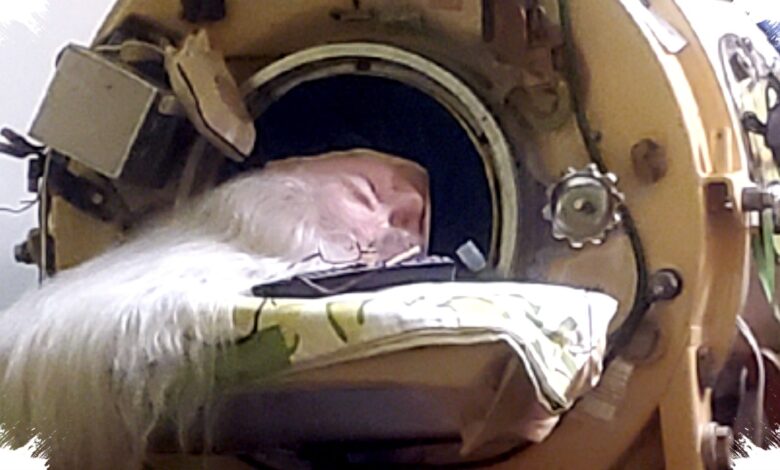
At six years old, Paul Alexander woke after an emergency tracheostomy unable to move, speak, or breathe on his own. The Texas child had contracted polio and would spend the next seven decades relying primarily on an iron lung.
The enormous metal respirator became an unlikely constant in a life that included university, a legal career, friendships, and a memoir. When he died in March 2024 at 78, Alexander was known as the longest-surviving person to rely on an iron lung.
A Childhood Shaped by Polio
Polio left Alexander paralysed from the neck down during one of the disease’s most devastating eras in the United States. After he regained consciousness, he found himself inside a metal cylinder with only his head outside the machine.
According to the World Health Organization, roughly one in 200 polio infections results in irreversible paralysis. When paralysis affects the muscles used for breathing, patients can require respiratory support to survive.
Alexander spent nearly two years in hospital alongside other children affected by the virus. Doctors eventually doubted he would live much longer, prompting his parents to bring him home rather than leave him in institutional care.
The Machine That Kept Him Breathing
An iron lung uses changing air pressure around the body to help inflate and deflate the lungs. It required electricity, and power failures could quickly become emergencies for Alexander and his family.
During outages, relatives and sometimes neighbours manually pumped the machine until power returned. His father also devised an alarm system that Alexander could activate with his mouth whenever he needed urgent help.
| Stage of Life | Challenge | What Made It Possible |
|---|---|---|
| Childhood at home | Constant need for respiratory support | Family care, manual pumping during outages, and an emergency alarm |
| University | Daily assistance was not available as expected | Classmates who helped with mobility and everyday needs |
| Later adulthood | Aging equipment and scarce replacement parts | Caregivers and a mechanic who restored an iron lung |
The machine was not simply medical equipment but the centre of a carefully organised home life. It allowed Alexander’s family to build a future around his needs instead of accepting the limits predicted for him as a child.
Learning to Breathe Outside the Cylinder
Alexander gradually learned glossopharyngeal breathing, a difficult method often called “frog breathing.” The technique involved gulping small amounts of air into his lungs using muscles in his throat.
Each successful effort gave him more time outside the iron lung, although the machine remained essential. His family promised him a puppy if he could stay out for three minutes using the method, and he succeeded.
Those brief periods slowly became longer, allowing him to use a wheelchair, meet neighbourhood friends, and take part in activities beyond his bedroom. When he became tired, he returned to the iron lung for respiratory support.
University and a Career Few Expected
Alexander completed much of his early education at home before gaining admission to the University of Texas. His parents helped install the iron lung in student accommodation, then left him to begin university life.
A paid caregiver expected to assist him did not arrive, leaving Alexander dependent on fellow students. Classmates stepped in to push his wheelchair, help with daily tasks, and form an informal support network.
He later studied law and established a legal practice in Dallas. Clients were often surprised to meet an attorney working from inside an iron lung, but the focus soon turned to their legal matters.
Alexander’s life showed that independence did not always mean doing everything alone. It also meant directing his own decisions and building dependable support around the help he required.
Keeping an Obsolete Respirator Alive
By 2015, keeping the iron lung operational had become one of Alexander’s most serious challenges. Few machines remained in working condition, and replacement parts had become extremely difficult to find.
As reported by timesofindia.indiatimes.com, carers eventually found Brady Richards, the owner of a mechanical testing company near Dallas. Richards had acquired two unused iron lungs years earlier and used them to understand how to rebuild damaged parts.
He restored a replacement machine and declined payment for the work. When a poorly fitted neck seal caused another emergency that evening, Richards returned and found Alexander turning blue after the seal had loosened.
Modern ventilators are smaller and portable, using positive air pressure through masks or tubes. Alexander occasionally used portable ventilators in emergencies, but he continued to prefer the negative-pressure breathing produced by his iron lung.
A Voice for Polio Survivors
Alexander became more visible in later life as he shared his story beyond his local community. He published a memoir in 2020, typing with a pencil attached to a stick held in his mouth.
His message was closely linked to the history of polio and the importance of vaccination. He wanted the disease eradicated worldwide so that no child would have to endure what he experienced.
Widespread vaccination has eliminated polio from most countries, though global health organisations continue efforts to eradicate it completely. Alexander’s life remained a reminder of the severe consequences the disease could have before vaccines changed public health.
Guinness World Records recognised Paul Alexander in 2023 as the person who had lived the longest while relying on an iron lung. For those closest to him, the record reflected not only survival but a lifetime shaped by education, work, care, and determination.