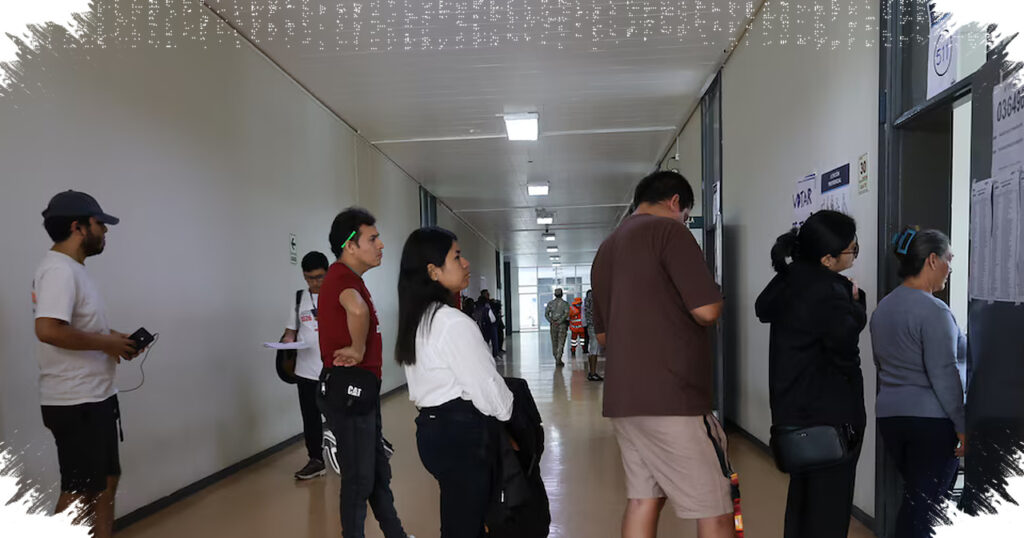
More than 27 million Peruvians are deciding the country’s political direction in a tense election day marked by long lines, delayed polling setups, and growing concern in several districts of Lima Sur. In multiple voting centers, the opening of polling tables has been delayed by more than four hours because of a shortage of electoral materials and the absence of some table members.
Election officials are trying to speed up the distribution of supplies and reduce the risk of more stations being closed before voters can cast their ballots. Under current rules, if a polling table is not installed before noon, it can be shut down, leaving registered voters unable to participate in the process.
What is happening at polling stations now
Reports from the UNMSM campus and other centers show crowded hallways, with voters waiting outside classrooms marked as voting rooms. The scene has also included personnel from ONPE and JNE, who are facing pressure to organize the setup amid missing materials and delayed attendance from table members.
The situation has created uncertainty for voters who arrived early and still do not know whether their table will open on time. In practical terms, every additional delay raises the chance that some citizens may lose the right to vote in this round.
Why the delays matter
The legal deadline makes the morning hours critical for every polling place that is still not fully operational. If a table does not open before noon, it is not simply late, but at risk of being canceled, which can directly affect turnout and public trust in the process.
This is especially sensitive in high-traffic districts where queues have already stretched for hours. For many voters, the issue is no longer only inconvenience, but the possibility of being turned away after waiting all morning.
Key points reported by election authorities
- Electoral materials are arriving slowly in some voting centers.
- Some polling table members have not shown up on time.
- Long lines are forming outside schools and universities.
- Tables that remain closed past noon can be shut down under election rules.
- ONPE and JNE staff are working to prevent more closures.
Current impact on voters
The delay has affected both the pace of voting and the mood outside several centers. Many citizens are waiting in uncertainty, while others are expressing frustration after arriving early and still finding their tables not ready.
The problem also highlights how sensitive election-day logistics can be in a vote that will shape Peru’s political future. With millions expected to participate, even small operational failures can quickly become nationwide concerns.
Why observers are watching Lima Sur closely
Lima Sur has become one of the most closely watched areas because the delays there are large enough to affect turnout in a visible way. The concentration of delayed polling tables has also put extra attention on the response capacity of election institutions in real time.
The process remains active, and election personnel continue working against the clock to open as many tables as possible before the legal cutoff. Voters, meanwhile, are staying in line and waiting for updates as the day continues.