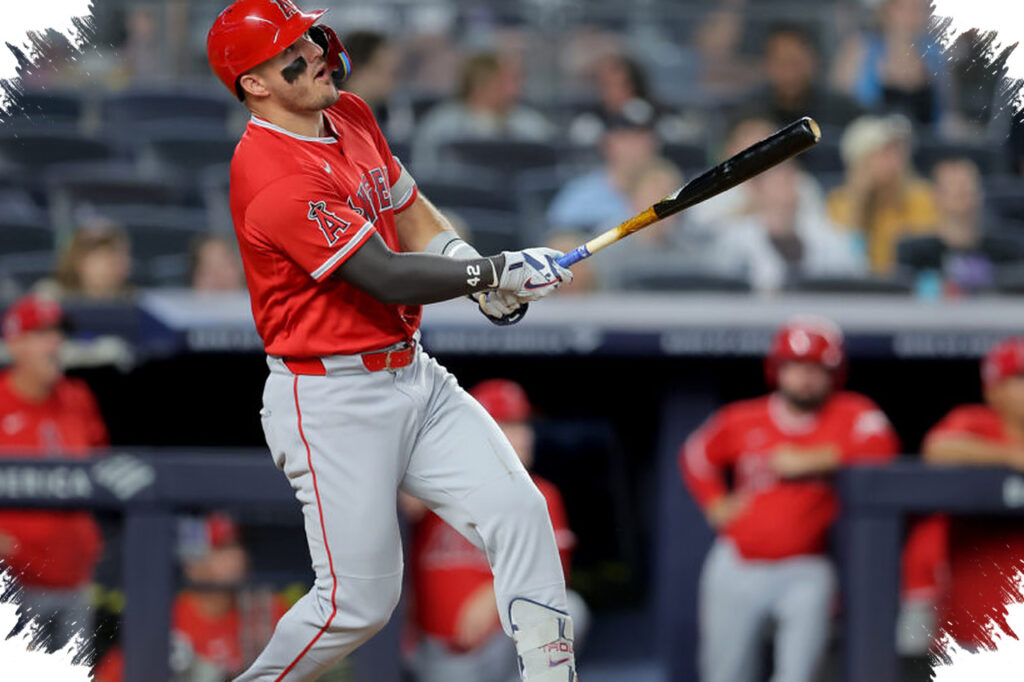
Mike Trout’s bat has become the loudest part of the Angels’ trip to the Bronx, even as late bullpen losses kept the spotlight off the final score. The veteran outfielder has homered in every game of the series and has four home runs against the Yankees overall, including three straight across consecutive plate appearances from Monday into Tuesday.
That surge has pushed fresh attention toward whether Trout is showing signs of a real rebound rather than just another hot streak. Through 18 games, he has six home runs, a .945 OPS, and the kind of contact quality that suggests the power is backed by more than timing alone.
Trout’s early numbers point to a different profile
The biggest change is not only the power, but the way he is getting to it. Trout has cut his strikeout rate to 21.4%, and his swinging-strike rate is down to 6.0%, both encouraging signs for a hitter in his mid-30s.
His contact metrics are even more notable. Trout is posting an 84.4% overall contact rate and a 93% in-zone contact rate, both career bests, while still producing elite damage when he connects. He ranks in the 100th percentile in barrel rate, expected slugging percentage, and expected wOBA, according to Statcast-based measures cited in the reference data.
Why this start matters for the Angels
A strong Trout season would carry added weight for a club that has trimmed payroll but still has a major financial commitment tied to its star. Trout is owed $35.45 million per year through the 2030 season, and his salary now represents about 23.5% of the Angels’ payroll, up from roughly 17% last year.
That makes his health and production central to the team’s outlook. The Angels already saw him play 130 games in 2025, his most since 2019, and he has stayed in the lineup since taking a pitch off the hand in early April.
What has changed in the field and on the bases
Trout has also returned to center field after spending most of 2025 at designated hitter in an effort to manage his health. His defense has been roughly league average so far, with 1 Defensive Runs Saved and minus-1 Outs Above Average, while his sprint speed has climbed back into the 90th percentile.
That is a meaningful bounce from last season, when he sat in the 62nd percentile in sprint speed and fell below the 90th percentile for the first time in the Statcast era. The improvement matters because it suggests better mobility, better availability, and a body that is responding more like the version of Trout that defined much of his prime.
How the current version compares with other late-career paths
Trout’s start is drawing comparisons because aging sluggers often go in one of two directions. Some lose contact while trying to keep power, while others preserve contact by sacrificing damage, which can limit their value in different ways.
A useful contrast comes from Yankees veterans Giancarlo Stanton and Paul Goldschmidt. Stanton remained a dangerous power threat last season but did so with a career-worst 34.2% strikeout rate, while Goldschmidt leaned into contact, posting a strikeout rate of 18.7% but reduced power output with just 10 home runs.
Trout has not followed either extreme. He has improved his contact without giving up impact, and his average exit velocity of 93.5 mph is the best of his career outside the shortened 2020 season.
Key indicators behind Trout’s early rebound
- Strikeout rate: 21.4%, down from his rougher recent levels.
- In-zone contact rate: 93%, a career high.
- Exit velocity: 93.5 mph, his best mark as a pro outside 2020.
- Barrel rate: in the 100th percentile, showing elite damage on contact.
- Sprint speed: 90th percentile, signaling strong physical condition.
Even with a .233 batting average on balls in play, Trout has paired stronger contact with lifted-ball authority that has produced consistent extra-base damage. His fly-ball approach has helped keep the ball in the air, and that has kept his homer pace high despite a relatively low batting average on balls in play.
More than just a hot week
One good series does not settle the question of whether Trout has fully turned back the clock. Still, the combination of better contact, maintained power, and improved athletic measures gives this start more substance than a typical early-season heater.
The next test comes against Max Fried, who will see Trout for the first time and will try to end the home run streak. For the Angels, the broader storyline is now less about the collapse in the bullpen and more about whether their franchise player can sustain the kind of production that would make this look like the beginning of a bounce-back season rather than a short-lived spark.
Read more at: www.mlbtraderumors.com